
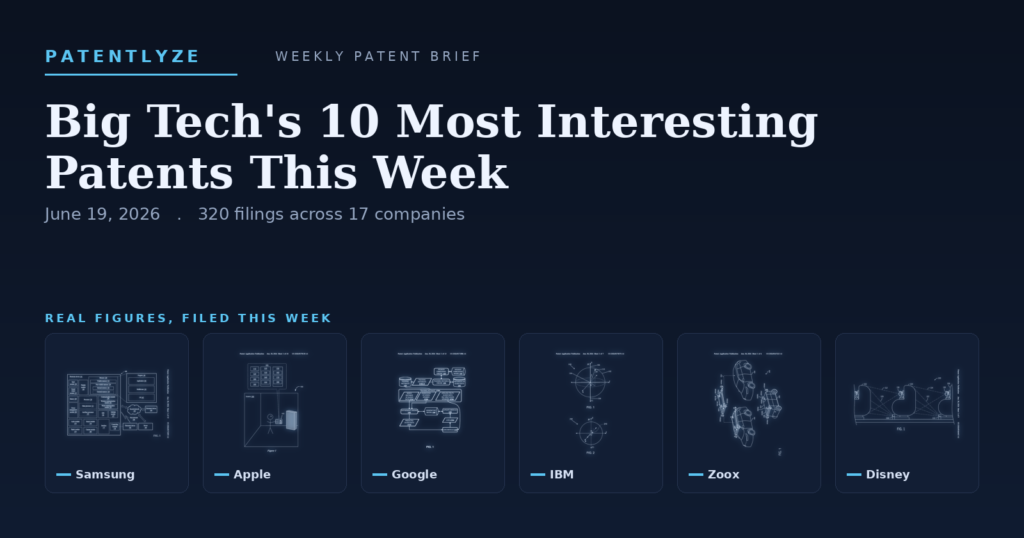
A weekly read of what the world’s biggest technology companies just told the U.S. patent office.
Every Thursday, the U.S. Patent and Trademark Office publishes a fresh batch of patent applications. Most of them are routine: defensive filings, small tweaks to existing IP, paperwork nobody outside an examiner’s office will ever open.
But a patent is one of the more honest documents a big company produces, and one of the earliest. Companies file claims two to four years before products ship, sometimes before a project even has a name. By the time something turns up in a keynote, the patent behind it has often been public for a year or more.
This week’s drop included 320 applications across the 17 companies we cover at Patentlyze. Most were forgettable. These ten were not.
1. Samsung’s foldable bet doubles down, literally
Samsung helped invent the modern foldable, and it is not done bending glass: Samsung’s patent for a phone that folds twice, with a screen that is rigid in some spots and flexible in others at the same time.
A phone that folds twice has to survive two crease lines instead of one, and the panel has to feel solid where you tap it while still bending cleanly where it folds. Samsung’s filing describes a three-panel screen engineered to do both at once, stiff across the flat sections and pliable at the hinges.
Apple is reportedly about to ship its first single-fold iPhone. This filing is a reminder that Samsung is already two folds ahead on paper, and that the hard part of a foldable was never the hinge. It was always the glass.
2. Apple wants your headset to stop asking who you are
If you use face recognition, you know the small annoyance: you verify once, then a minute later the same app asks you to do it again. Apple’s fix is to track whether you ever stopped being you: Apple’s patent for skipping repeat identity checks by confirming you never left.
The idea is aimed squarely at headsets like the Vision Pro. Once the device has verified your identity, it watches for continuous presence, the headset staying on, the same person wearing it, so it can treat you as already authenticated instead of demanding a fresh scan for every secure action.
It is a small comfort feature with a big implication. For a device you wear for hours, constant re-verification is the difference between effortless and exhausting, and Apple clearly wants the headset to get out of your way.
3. Google can mute everyone but you, on the device
Noise cancellation removes background hum. This goes further: Google’s patent for on-device audio that strips out every voice except the one you want to hear.
Record a voice memo in a busy cafe and you also record the table next to you. Google’s system isolates a single target speaker and removes the rest, and the filing is explicit that it runs entirely on the device rather than shipping your audio to a server.
That last detail is the story. Voice isolation this clean usually needs cloud horsepower. Doing it locally means it can run on a call, in a hearing aid, or inside earbuds without sending a recording of the room to anyone, which is exactly where audio AI has been heading.
4. Nvidia teaches a robot to dig through a messy bin
The classic unsolved task in warehouse robotics is not walking or lifting. It is reaching into a tote of jumbled items and pulling out the right one without scattering the rest: Nvidia’s patent for a robot vision system that picks a specific object out of a cluttered bin.
Nvidia’s approach lets the robot identify and grasp a target item among many overlapping ones, the situation that trips up most pick-and-place machines today. Solve bin-picking reliably and a huge slice of warehouse and manufacturing work opens up to automation.
This is infrastructure-level robotics IP, the kind that does not show up in a product announcement but ends up inside the arms doing the work. Given how hard Nvidia is pushing robotics, that is the point.
5. Microsoft runs an AI memory on light, not silicon
Most AI runs on silicon shuttling electrons. Microsoft is sketching an alternative: Microsoft’s patent for an AI memory network that runs on lasers instead of conventional chips.
The filing describes an associative memory, the kind that reconstructs a whole pattern from a partial one, the way you recognize a half-remembered face, built with light rather than transistors. Done optically, the recall step can happen at the speed of light instead of waiting on silicon.
Optical computing has been a someday technology for decades. A filing like this does not mean it ships soon, but it signals where a company looks when it starts running into the physical limits of electronic chips, and Microsoft is clearly looking.
6. IBM turns quantum programming into rolling a ball
Quantum computers are infamously hard to program, because the basic operations are precise mathematical rotations that almost nobody can picture in their head. IBM’s answer is delightfully physical: IBM’s patent for programming a quantum computer by rolling a real ball.
The system turns the motion of a physical ball into the rotations that define quantum gates, so a person can set up an operation by moving something in the real world instead of typing abstract math. It is a human-interface idea, not a hardware one, aimed at making quantum tangible.
That matters more than it sounds. The bottleneck for quantum is not only better machines, it is more people who can program them, and the filing is a bet that the right interface widens the door.
7. Meta wants your body to be the wire
Your wearables currently chatter over Bluetooth, which sprays radio in every direction and drains batteries. Meta has a stranger idea: Meta’s patent for sending data between wearables through your own skin.
The filing describes a body-area network where devices on or near you, glasses, watch, earbuds, exchange data by using your body as the conductor instead of broadcasting over the air. Signals travel across you rather than around you.
The appeal is power and privacy. A signal carried through your skin is far harder to intercept from across the room and can use less energy than Bluetooth, which is the whole game for the always-on wearables Meta keeps building toward.
8. Sony files for a device that decides if you need a doctor
This is the boldest, and most contested, filing of the week: Sony’s patent for a device that assesses a patient and decides whether they need treatment.
The system is meant to evaluate a person’s condition and determine, as a first step, whether medical treatment is warranted, before a physician is in the loop. Worth a flag: our read gives this one a low chance of being granted as written, and the patent office has already pushed back with a rejection, which is what you would expect when a filing wanders into medical decision-making.
Even if the claims get narrowed, the direction is notable. Sony is better known for sensors and PlayStations, and a filing like this shows it eyeing the same consumer-health frontier as Apple and Samsung, just from a more clinical angle.
9. Zoox trains its robotaxi using ordinary cars
You cannot put robotaxis on every road before they are good enough to be on the road. Amazon’s self-driving unit Zoox has a workaround: Zoox’s patent for training self-driving AI with a sensor rig bolted onto a regular, human-driven car.
The filing describes a precisely arranged set of sensors mounted on an everyday vehicle, so a normal car driven by a person can gather the same kind of data a robotaxi would, across far more roads and miles than a limited autonomous fleet could cover.
It is a quiet logistics insight with real payoff. The hardest input for self-driving is varied, real-world data, and this turns ordinary cars into a fleet of data collectors without the cost or risk of deploying driverless ones.
10. Disney turns the ride car itself into a screen
We saved the most fun one for last: Disney’s patent for projecting live video onto moving ride vehicles.
Instead of building screens into a ride, Disney would project content directly onto the cars as they move, adjusting the image in real time as each car turns, speeds up, and shifts position relative to the others on the track. The vehicle becomes the display.
The use case is pure Disney: a ride where the scenery, the characters, and the cars themselves appear to come alive with no visible screens, only projection. For a company whose entire craft is hiding the machinery, turning the ride car into a canvas is exactly the kind of trick worth patenting.
What ties them together
Read the ten back to back and the theme is substrate. The interesting bets this week are not new apps, they are new materials and media for computing to live in: light instead of electrons, the body instead of Bluetooth, a rolling ball instead of a keyboard, glass that is stiff and bendable at once, a ride car that doubles as a screen.
The press releases this season are about smarter models. The filings are about where that intelligence physically goes, into hardware, into the body, into the spaces and objects around us. That is usually the better place to look if you want to know what is actually coming.
Patentlyze reads every new patent application that Apple, Google, Microsoft, Meta, Nvidia, Samsung, OpenAI, Qualcomm, Sony, Intel, AMD, IBM, Adobe, Salesforce, Tesla, Amazon, and Disney file at the USPTO, and writes a plain-English breakdown of the ones that say something about where products are heading. New filings drop every Thursday. Full archive at patentlyze.com.
Get lists like this in your inbox
We read every patent application Big Tech publishes and send you the ones worth knowing. Plain English, free, every week.