
Sony Patents a System That Rewrites Physics Rules in XR Spaces
What if your mixed-reality headset could decide that gravity doesn't apply to a virtual object right now — because you're holding a controller, standing, or switching tasks? That's the core idea in Sony's latest XR patent.
What Sony's context-aware XR physics actually does
Imagine you're using a mixed-reality headset to arrange virtual objects on a desk. When you reach out to grab one, it behaves like a real object — it falls if you drop it, resists being pushed through a surface. But when you switch to a design task where you need to float objects freely in mid-air, the system recognizes the change and quietly relaxes those rules.
That's the idea behind this Sony filing. Instead of applying a fixed set of physics rules to everything in an XR scene, the system watches what's happening — what input devices you're using, how you're positioned, what mode you're in — and adjusts the physical behavior of virtual objects accordingly.
In practice, this could mean virtual objects that snap into place when you're doing precision work, but drift and float freely when you're brainstorming. The system is trying to make the XR environment feel appropriate for whatever you're actually doing, rather than forcing you to fight the same physics all the time.
How the recognition unit drives XR physics changes
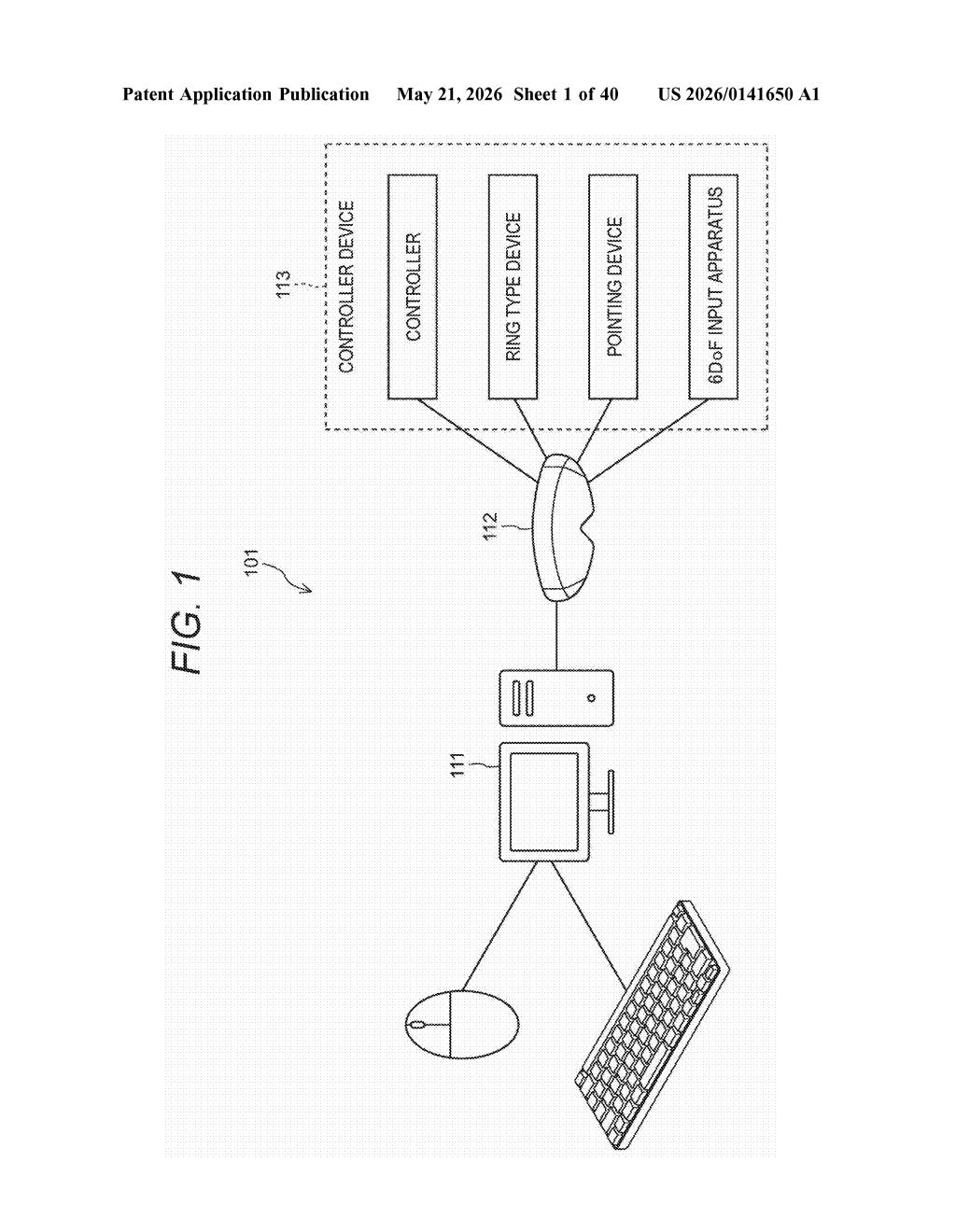
The patent describes two core components working together. First, a recognition unit monitors the state of elements "related to XR" — this is deliberately broad, but likely covers things like which input device is active (a controller, a pointing device, a 6DoF input apparatus), the user's physical posture, or the current application mode.
Second, a space control unit uses that recognized state to modify the physical laws applied to virtual objects in the XR scene. "Physical laws" here means things like gravity, collision response, friction, or object rigidity — the rules that govern how virtual things move and interact.
The patent's diagram references a controller device, a pointing device, and a 6DoF input apparatus as examples of XR-related elements the system can track. So the trigger for a physics change might be as simple as: user picked up a 6DoF controller → switch to free-floating physics mode.
- Recognition unit: reads input device type, posture, or contextual state
- Space control unit: maps that state to a specific physics configuration
- XR space: virtual objects then behave according to the selected rules
The filing is a PCT application, meaning Sony is pursuing international protection, not just US coverage.
What this means for XR workspaces and mixed-reality tools
For XR to be genuinely useful as a workspace — not just a gaming environment — the system needs to adapt to what you're trying to accomplish. Fixed physics that work great for one task (say, stacking virtual boxes) can actively hinder another (rearranging a 3D design layout). Sony is essentially arguing that physics should be a variable, not a constant in XR.
This fits a broader industry push toward context-aware XR interfaces, where the environment responds intelligently to user state rather than requiring manual mode-switching. If Sony is building toward a professional or productivity-oriented XR platform, adaptive physics is a reasonable foundational layer to patent early.
This is a conceptually interesting filing, but it's written at a level of abstraction that makes it hard to know exactly what Sony has actually built. The claim covers a very wide design space — anything that changes virtual physics based on context — which is either a sign of smart broad-patent strategy or an indication the implementation details aren't locked down yet. Worth watching as a signal of Sony's XR product direction, but don't expect a product announcement based on this alone.
There are more where this came from
We read every patent application Big Tech publishes and send you the ones worth knowing. Plain English, free, every week.
Want this weekly breakdown for a company we don't cover? Patentlyze Pro →