
Adobe Files Patent for an AI Helper That Writes Its Own Tools When Stuck
Most AI assistants give up or loop when a job needs a tool they were never given. Adobe's patent application describes one that writes the missing tool itself.
What Adobe's self-writing AI helper actually does
Every time you hand an AI assistant a job, it picks from a fixed menu of moves its builders wrote ahead of time. If the job needs a move that isn't on the menu, the assistant often gets stuck, trying the same wrong tool again and again until it gives up.
Adobe's patent application describes an assistant that notices when its menu falls short. Instead of looping, it writes a small piece of software on the spot, runs it, and checks what came back. If that code throws an error, it reads the error and fixes the code.
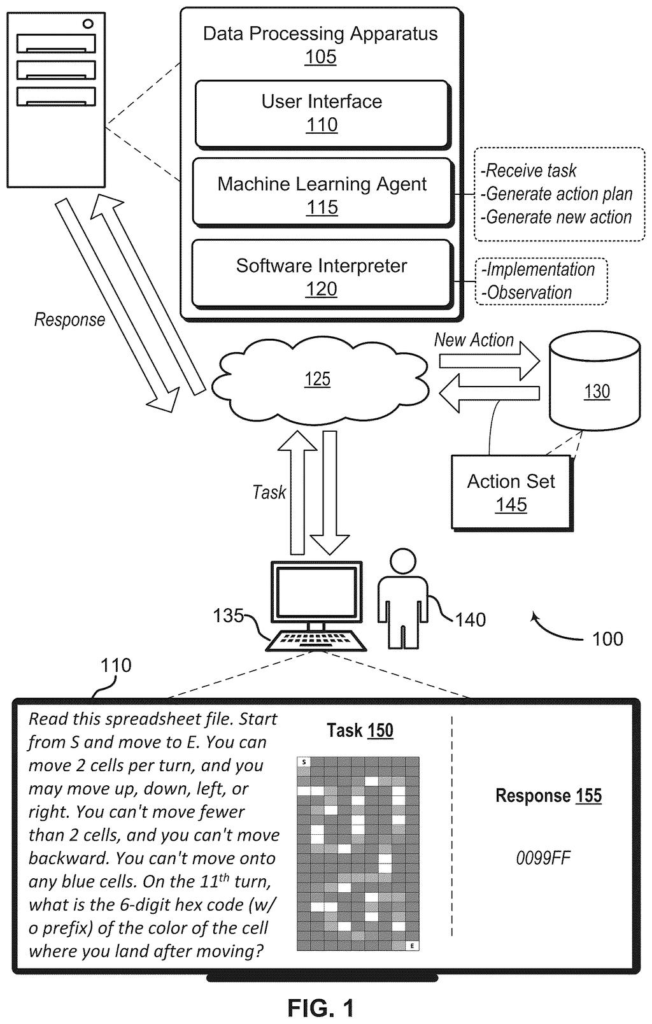
The filing's example is a spreadsheet puzzle about colored cells. The built-in file reader ignored cell colors, so the assistant wrote its own function to read them and returned the answer, a color code. Good new tricks can be saved so the assistant can reuse them later.
… determining, using a machine learning agent, that an action set of the machine learning agent is inadequate for performing the task; generating, using the machine learning agent, a new action for the action set, wherein the new action comprises software code for performing the task; …
Translation: The AI realizes its current skills are not enough and writes its own code to solve the problem.
How the agent spots a gap and codes a fix
The system hands a task to a machine learning agent (an AI model, typically a large language model like the ones behind chatbots). The agent works from an action set, a list of abilities written as code. Before each step, it writes an action plan, a short text note on what to do next.
If the plan calls for an ability that isn't in the list, or if a listed ability returns a useless result, the agent decides the set is inadequate. Then it moves through these steps:
- It writes a new action, which is software code, often defining a new function (a reusable block of code that takes an input and returns an output).
- It hands the code to a software interpreter (a program that runs code line by line) and gets the result back.
- If an error message comes back, it revises the code. It also checks whether the output is actually relevant to the task.
- If the code works, it adds the action to the action set. Saved actions can later be found again using a similarity score, and extra actions can be pulled from an outside source.
A prompt gives the agent guidelines for writing code. The filing says the agent is not specially retrained for this, which keeps computing costs down. It also says the system beat existing agents on a benchmark, though the text gives no figures.
Why a self-fixing AI helper matters to you
If this works as described, you would run into fewer AI assistants that stall, loop, or say they can't help when a job is slightly off the beaten path. In the filing's example, the built-in file reader missed cell colors, and older agents keep retrying it until they hit a limit. Writing a fix on the spot gets the answer instead.
It also takes work off people. Today, someone has to anticipate and code every ability an assistant might need. Saved actions that pile up over time could cut that effort. The filing names no Adobe product, so treat this as a research direction. Code that an AI writes and runs by itself raises its own questions, and the filing describes one limit: a maximum number of tries.
This is the seventh Adobe filing we've tracked in our AI agents that act watchlist since August, following applications like finding the right table and typed request to automation steps.
Claim 1 is short and wide. It covers four steps: receive a task, have an AI model decide that its list of available actions falls short, have it write new software code as the fix, and run that code. Nothing in it mentions spreadsheets, a particular type of model, or how the AI should judge that its tools are inadequate.
That breadth carries most of the weight. The detailed ideas, such as saving working code for reuse, finding saved actions by a similarity score, and rewriting code after an error message, sit in the dependent claims that narrow things down. If granted, the wide first claim would describe any assistant that follows those four steps, whatever it is built for.
Whether a loop that wide can hold up is a separate question, and an examiner will have a say. For you, the takeaway is modest: Adobe has put a clear process around an AI helper that fixes its own gaps by writing code.
Get our take in your Top Stories
Liked this breakdown? Add Patentlyze as a preferred source on Google, and our plain-English take shows up more often in your Top Stories the next time Adobe patent news breaks.
There are more where this came from
We read every patent application Big Tech publishes and send you the ones worth knowing. Plain English, free, every week.
The drawings
16 drawing sheets from US 2026/0339725 A1 · click any drawing to enlarge


Show the other 8 sheets


Want this weekly breakdown for a company we don't cover? Patentlyze Pro →
Be the first to weigh in