
Adobe Files Patent for AI That Highlights Where in Your Document an Answer Came From
When an AI answers a question about your document, how do you know it didn't make the answer up? Adobe's patent application has the AI point to the exact passage it leaned on.
What Adobe's AI answer-highlighting does
Someone pastes a long contract into an AI chatbot and asks when it expires. The bot replies with a date in about a second. Then comes the nagging part: is that date really in the contract, or did the AI invent it?
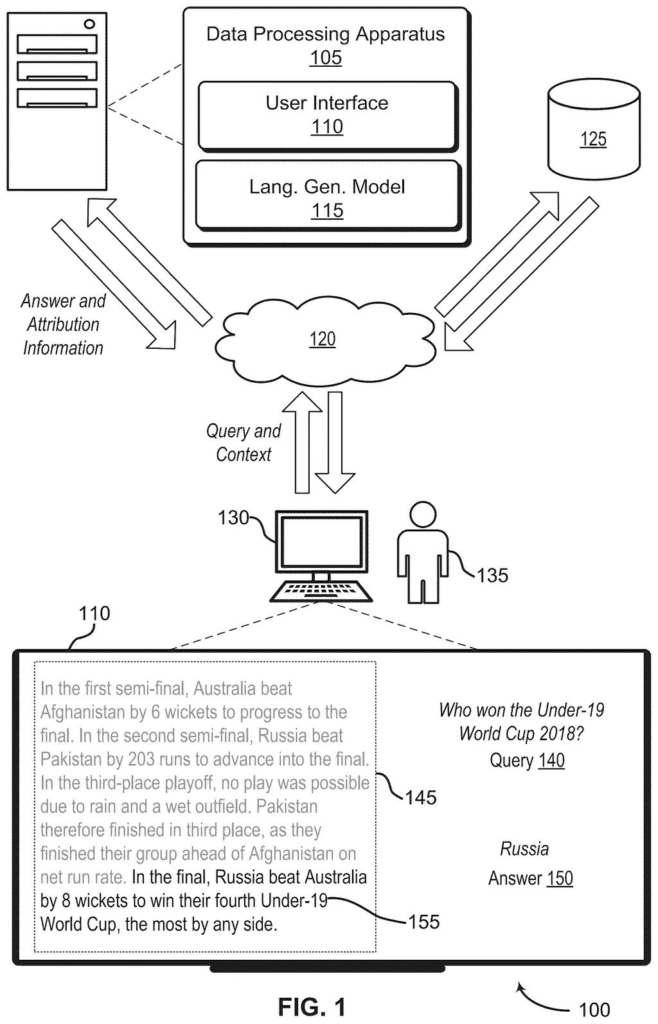
Adobe's patent application describes a way to settle that. While the AI writes its reply, the system watches which part of your document the model is focusing on hardest, then highlights that passage for you. It works like a student answering a question with a finger resting on the line in the textbook.
The design skips asking the AI to cite itself, since AIs can invent citations too. Instead, the system reads the model's own focus while it works, so the highlight tracks what the AI actually used to build its answer.
… extracting a span from the context based on an attention pattern of the language generation model for generating the answer token; generating an answer to the query based on the answer token; and generating attribution information based on the extracted span …
Translation: The system pinpoints the exact sentence the AI used to build its reply.
How Adobe finds the AI's most telling focus
The system takes two inputs: a question (the "query") and a document (the "context"). A language model writes its answer one small chunk at a time. Each chunk is a token, and the model uses attention (a score for how much each part of the document matters at that moment) to decide what to write next.
Inside the model, attention is split among many attention heads, small parallel units that each watch the text in a different way. The patent picks out a particular head that tends to lock onto answers sitting in the document. As each answer token is generated, the system finds the spot with the highest attention value, grabs the span (a run of neighboring words) around it, ranks the spans, and returns the top ones as the source.
Finding the right head happens ahead of time, with a test on sample questions:
- Run two copies of the model: one on a normal question and document, one on a scrambled version (for example, swapping "Space Needle is in Seattle" for "Big Sur is in California").
- Copy one head's internal output (its activation value) from the scrambled copy into the normal one.
- If the answer gets worse, that head matters for reading the document, and it is flagged.
In the filing's tests, one such head reached 0.97 attribution accuracy on a sample set, and the system was about 20% more accurate than four baseline methods. The document needs no special markup or labels.
… wherein the attribution information indicates a source of the answer within the context.
Translation: This means the final output points directly back to the original text.
Why checkable AI answers matter for documents
The practical payoff is fast checking. If you use AI to pull dates, terms or figures out of contracts, reports or long PDFs, a highlighted sentence lets you confirm the answer in a glance instead of rereading the whole thing. AI that makes things up is a real worry for anyone relying on these tools at work, and this targets that worry directly.
The filing also pitches efficiency. It says other approaches either hurt answer quality by asking the AI to cite itself, or need a second system that costs extra computing power and can't tell whether the AI really used the passage it points to. Document tools such as Acrobat's AI assistant are an obvious place something like this could show up, though the patent itself names no product.
Adobe's 12th filing we've tracked since July in the AI guardrails race continues a pattern started with source-locked AI writing and answer location in documents.
If you have ever pasted a long document into a chatbot, you know the awkward moment after the answer: trust it, or reread everything? A highlighted sentence cuts that to a few seconds, and that is the benefit you would notice.
The best detail in the filing is that the highlight comes from where the model actually looked, so it tracks what the AI used. When two sentences mention the same name, as in the cricket example, the system picks the right one. Adobe also reports about 20% better accuracy than four other methods it tested.
The limit is that a highlight shows where an answer came from and says nothing about whether the document itself is right. It also needs access to the model's inner workings, so it suits a company building its own AI. Useful, modest, and easy to appreciate the first time it saves you a reread.
Get our take in your Top Stories
Liked this breakdown? Add Patentlyze as a preferred source on Google, and our plain-English take shows up more often in your Top Stories the next time Adobe patent news breaks.
There are more where this came from
We read every patent application Big Tech publishes and send you the ones worth knowing. Plain English, free, every week.
The drawings
14 drawing sheets from US 2026/0320087 A1 · click any drawing to enlarge


Show the other 6 sheets


Want this weekly breakdown for a company we don't cover? Patentlyze Pro →
Be the first to weigh in