
Adobe Patents a System That Uses Competitor Search Rankings to Write Your Website Content
Adobe is patenting a system that watches where your competitors rank on Google, spots the gaps, and then uses AI to automatically generate content designed to close those gaps for your own website.
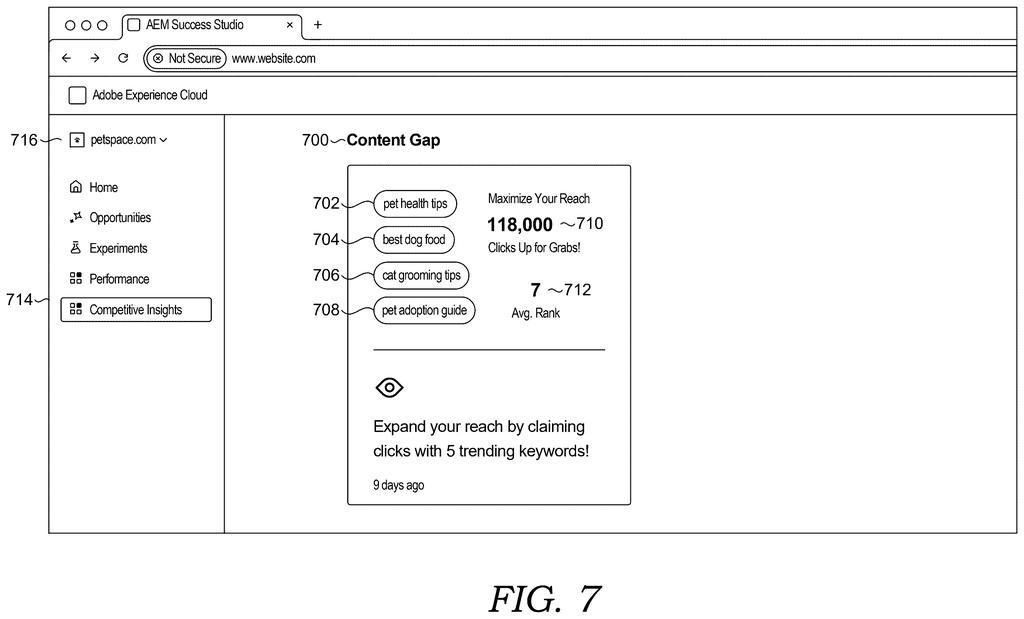
How Adobe's keyword-gap content tool actually works
Imagine you run a small online store. You know a bigger competitor keeps showing up above you in Google search results for certain product terms, but figuring out exactly which ones, and then writing content to compete, takes hours of work every week.
Adobe's patented approach would automate that entire loop. It pulls search ranking data for your website and your rivals across a set of keywords, compares the two, and flags the keywords where competitors are outranking you. Those flagged keywords then get handed directly to an AI writing tool, which generates web content built around them.
The output gets shown to you in a dashboard and can be dropped straight into your website. It's essentially a pipeline that connects competitive SEO research to AI-generated copy without you having to manage the steps in between.
obtaining a set of search result rankings for a target website and one or more competitors of the target website in association with a set of keywords; identifying, via a comparative analyzer, candidate performant keywords based on a comparison of search result rankings for the target website and search result rankings for the one or more competitors; …
Translation: The system compares how your site and rival sites rank for specific search terms.
How the comparative analyzer picks and passes keywords to AI
The system works in three stages. First, it collects search result rankings for a target website and one or more competitor sites across a shared set of keywords. Think of this as pulling a regular snapshot of who ranks where on Google (or any search engine) for the terms that matter to the business.
Second, a component the patent calls a comparative analyzer processes those rankings side by side. It identifies candidate performant keywords, meaning keywords where competitors are ranking noticeably better than the target site. These are the opportunities worth chasing.
Third, those keywords are fed into one or more generative AI models (the patent doesn't tie to a specific model), which produce content data, articles, page copy, product descriptions, or similar, built around those terms. The content surfaces in a user interface and can be pushed directly into the target website.
The claim is deliberately broad: it covers the storage media, the processors, the comparison logic, and the display interface as a unified system, which means Adobe is staking out the overall workflow, not just one piece of it.
The candidate performant keywords, or a portion thereof, are used to generated content data in association with the target website via one or more generative artificial intelligence (AI) models.
Translation: AI uses those identified keywords to automatically write new website material for you.
What this means for marketers and SEO software
SEO and AI content generation are already crowded categories, but combining them into a single automated pipeline is where the market is heading fast. Adobe's business software suite already touches content creation, analytics, and web publishing, so a patent like this fits squarely into Adobe Experience Cloud, the set of marketing tools aimed at enterprise customers. A built-in competitive keyword loop could give those tools a meaningful advantage over standalone SEO platforms like Semrush or Ahrefs that don't yet generate content natively.
For you as a marketer or small business owner, the practical promise is fewer tools to juggle. Instead of exporting keyword data from one platform, importing it into a writing tool, and then publishing the result somewhere else, this patent describes doing all three in one place. Whether Adobe ships it that way is another question, but the intent is clear.
This is a useful but not surprising patent from Adobe. Connecting competitive SEO data to AI content generation is the obvious next move for any company selling marketing software, and Adobe is smart to lock down the workflow architecture. It won't alarm competitors today, but it signals exactly where Adobe Experience Cloud's content tools are heading.
There are more where this came from
We read every patent application Big Tech publishes and send you the ones worth knowing. Plain English, free, every week.
The drawings
14 drawing sheets from US 2026/0228417 A1 · click any drawing to enlarge


Want this weekly breakdown for a company we don't cover? Patentlyze Pro →
Be the first to weigh in