
Adobe Patents AI Search Method That Maps Concept Connections to Find Related Documents
Most search engines look for the words you typed. Adobe is patenting a system that finds documents based on what those words are connected to, using a map of relationships between concepts to expand your search before it even finishes answering your first question.
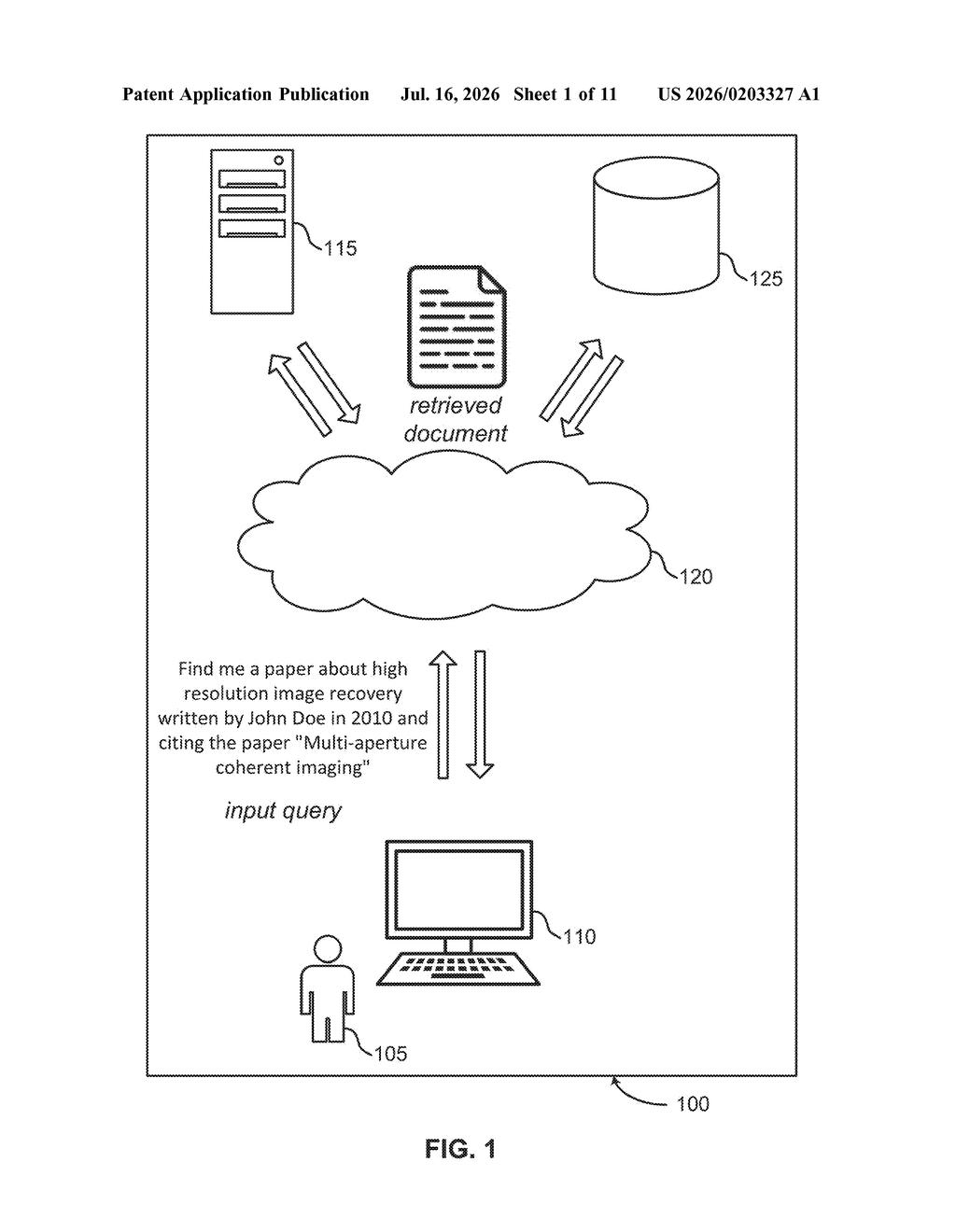
How Adobe's expanded search actually finds related content
Imagine you search for 'color theory' in a design library. A normal search returns articles that literally mention 'color theory.' But Adobe's patented approach would also grab that foundational paper on contrast ratios, or the typography guide that color theory connects to, even if you never asked for those things specifically.
Here's how: when you type a query, the system first finds a document that closely matches what you asked. Then an AI uses a knowledge graph (think of it as a web of related concepts, where each idea links to others by topic, category, or shared meaning) to figure out what else is connected to that first result. It rewrites your original question to include those connections and runs a second search.
The result you actually get back is that third document, the one the expanded search turns up. The idea is that a single query can surface content you didn't know to ask for but genuinely needed.
How the knowledge graph rewrites your original query
The patent describes a three-stage retrieval pipeline built around a language generation model (an AI that produces text, similar in class to the models behind chatbots) working alongside a knowledge graph (a structured database that stores not just documents but the typed relationships between them, such as 'is a subcategory of,' 'was authored alongside,' or 'shares a concept with').
- Stage 1 (initial retrieval): The user submits a query. The system fetches a first document that matches it using standard search methods.
- Stage 2 (query expansion): The language model reads that first document and consults the knowledge graph to find a second document that is meaningfully related. It uses both to write an expanded query that carries the broader conceptual context the original query implied but didn't state.
- Stage 3 (final retrieval): The expanded query is used to pull a third document, which becomes the actual response delivered to the user.
The approach is called knowledge-aware query expansion. By grounding the AI's rewriting step in a structured graph rather than letting it guess freely, the system aims to reduce the hallucination risk (where AI invents plausible-sounding but false connections) that plagues purely generative search approaches.
What this means for Adobe's document and creative tools
For Adobe, which manages enormous libraries of creative assets, templates, fonts, stock images, and documentation across products like Experience Manager and Creative Cloud, better document retrieval is a direct revenue concern. If enterprise customers can find the right asset or knowledge article faster, they stay inside Adobe's ecosystem longer.
More broadly, this patent points to a real tension in AI-powered search: pure keyword search is too literal, but purely generative AI search tends to make things up. Adobe's approach of anchoring the AI's expansion step to a pre-built knowledge graph is a practical middle path. Whether it works better in practice depends entirely on how well that knowledge graph is built and maintained, which is its own hard problem.
This is a solid, workmanlike patent that addresses a genuine limitation in enterprise search. The knowledge graph anchor is a smart constraint on the AI's tendency to go off-script, and the three-stage pipeline is clean enough to actually ship. It won't grab headlines, but it's the kind of filing that tends to show up inside a product update six to eighteen months later.
There are more where this came from
We read every patent application Big Tech publishes and send you the ones worth knowing. Plain English, free, every week.
Want this weekly breakdown for a company we don't cover? Patentlyze Pro →
Be the first to weigh in