
Adobe Files Patent for an AI That Learns Your Dog From a Few Photos
AI image tools can draw 'a dog on a beach,' but not your dog. Adobe's filing describes one model that learns a specific pet or object from about 3 to 5 photos, then both draws it in new scenes and answers questions about it.
What Adobe's pet-photo AI actually does
Ask an AI image tool for 'a dog on a beach' and you get a dog on a beach. Just not your dog. Today, teaching a big AI model one specific pet, mug, or building usually means retraining the whole thing, which is expensive and can make it forget other things it knew.
Adobe's filing describes a lighter route. You hand the system three to five photos of your object. It gives the object a made-up name, then stores two small sets of notes about it: one for drawing it, one for talking about it.
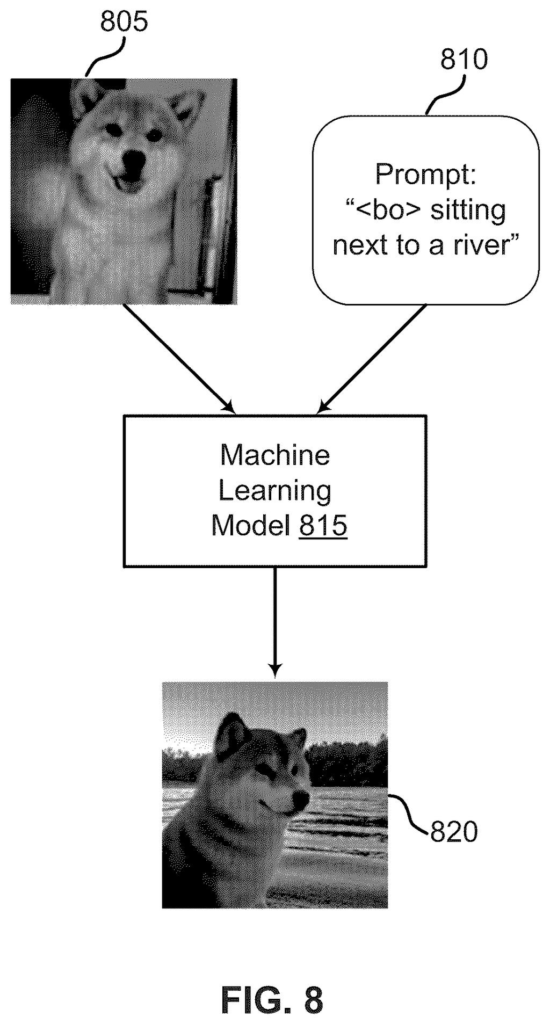
After that, a single model can do both jobs. Ask for 'my dog sitting next to a river' and you get a new picture of the same dog. Ask 'what should I pack for my dog on a trip?' and you get an answer about that particular dog.
… generating a set of custom tokens based on the input image, wherein the set of custom tokens includes an image generation token and an image understanding token; and generating, using a multimodal generation model, a synthetic image based on the image generation prompt and the image generation token …
Translation: The software creates special digital markers from your photos so the AI can understand and redraw your pet.
How one model draws and answers about your dog
The system takes a few photos of one object (the filing says typically 3 to 5) and builds a set of custom tokens. Tokens are the small numeric building blocks AI models use to read words and pictures. The set has three parts:
- A nonce token: a made-up name tag (the filing uses examples like ) that points to your specific object.
- An image generation token: stores what the object looks like, such as shape, color, and texture, so new pictures keep its identity.
- An image understanding token: stores descriptive knowledge so the model can answer questions about the object.
The model is also trained to self-prompt, meaning it first decides which set of tokens fits your request, then does the job. A request to draw uses a diffusion model (an image maker that starts from random noise and cleans it up step by step). A question about the photo uses a transformer model (an AI model that reads sequences, like sentences).
To train the drawing tokens, the system pulls in similar reference images, ranks them by how closely they match your photos, and splits them into groups. Closer groups get more tokens, so one token might capture 'a dog' while three capture 'a brown dog with smooth fur.' Only these small additions are trained, and the main model stays as it was.
Why personal AI images matter for Adobe's users
The practical payoff is personal images and answers without a heavy retraining job. If you have a few photos of a pet or a favorite object, a tool built this way could keep that exact thing consistent across new pictures and follow-up questions.
The filing frames it as cheaper and safer for the AI's existing knowledge than retraining everything, which suits an app where users supply only a handful of images. Adobe sells creative software, so tying drawing and describing into one personalized model fits the work its customers do. The filing says tests beat existing image tools but gives no numbers.
Adobe's 35th filing we've tracked in our controllable AI image work since May builds on earlier applications like the rubber duck boat motion one and the box path one.
The problem is real, and most people have run into it. You own one specific dog, mug, or sneaker, and AI tools only know the generic version. Teaching a giant model your one object the old way means retraining the whole thing, which costs a lot and can make it forget what it already knew.
Adobe's fix fits the size of that problem. It adds a small personal label for your object and leaves the big model alone. That fits real life, where you might have three to five photos of your dog.
The open question is quality. The filing says experiments show better results than existing image tools but gives no numbers, so whether your dog's face survives a trip to a river is unproven.
Get our take in your Top Stories
Liked this breakdown? Add Patentlyze as a preferred source on Google, and our plain-English take shows up more often in your Top Stories the next time Adobe patent news breaks.
There are more where this came from
We read every patent application Big Tech publishes and send you the ones worth knowing. Plain English, free, every week.
The drawings
20 drawing sheets from US 2026/0330719 A1 · click any drawing to enlarge


Show the other 12 sheets


Want this weekly breakdown for a company we don't cover? Patentlyze Pro →
Be the first to weigh in