
Adobe Files Patent for AI Video That Moves a Sailboat Like a Rubber Duck
Adobe's filing shows a rubber duck bobbing in a bathtub and a sailboat in a harbor moving in exactly the same way. The trick is a score that keeps the AI honest about where each spot on the object goes.
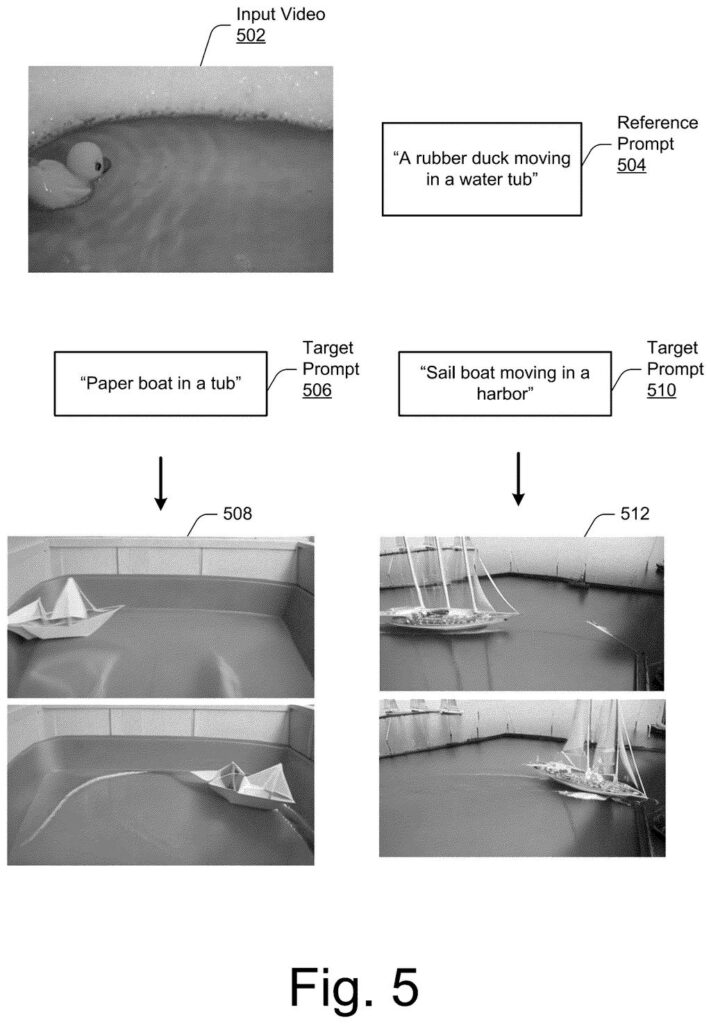
What Adobe's duck-to-sailboat video patent does
You've got a clip of a rubber duck bobbing across a bathtub, and you want that exact motion on a sailboat gliding through a harbor. You type "sailboat moving in a harbor" into an AI video tool, and the boat comes out close, but as the seconds tick by it slowly changes shape, loses its look, or starts to melt.
Adobe's patent application describes a fix. You give the AI your reference clip plus a short text description (or a picture) of the new subject. The system first follows a dense set of tiny points on the duck from frame to frame, like tracking the dots in a connect-the-dots drawing as it moves. Then, while it builds the new video, it keeps checking that the matching spots on the sailboat follow the same paths.
The result, in the filing's own example, is a sailboat that moves the way the duck did.
… generating, by the machine-learning model, a second digital video as having movement of the second object based on the reference movement of the first object, the generating using the correspondence loss as a guide for maintaining the spatial correspondence across a plurality of frames of the second digital video.
Translation: The AI creates a new video by forcing the second object to mimic the movement of the first object.
How point tracks keep the new video on course
The system takes two inputs: a reference video showing one object moving, and a prompt naming a new object. The prompt can be a text description or a picture of the new object. The filing pairs this with a text-to-video or image-to-video diffusion model (an AI that builds video by starting with random noise and cleaning it up step by step).
First, a tracking step uses optical flow (a way of measuring how each pixel moves between frames) to build point trajectories: paths showing where each spot on the reference object ends up from frame to frame.
Then comes the key piece, a correspondence loss (a score of how well the tracked points line up). The denoiser (the part of the AI that removes noise) pulls out features of the video, and the score is computed from those features and the tracked paths. The gradients of that score (which way to nudge things to improve it) update the working version of the video before each denoising step.
The model is also trained to minimize both the usual diffusion loss and this new loss. According to the filing, the result keeps the reference movement, including camera motion, while allowing changes to the object's shape, identity and background.
A machine-learning model determines point trajectories across the plurality of frames of the first digital video that track the reference movement of the first object.
Translation: An AI program maps out the exact path of movement across every frame of the original video.
Why video makers could care about motion transfer
If you have ever watched an AI video where a character's face slowly melts or an object changes shape mid-clip, you know the problem Adobe is describing. The filing says these models often let visual elements gradually change or degrade, and that typing out the exact motion you want in words is hard. Handing the AI a real clip to copy sidesteps that second problem.
For people who make videos, that could mean recording a simple movement and then asking for a different subject to perform it. The description names movie and visual effects work as the audience. It is a patent application, so it says nothing about whether or when Adobe would turn it into a product.
Adobe's 34th filing we've tracked since May in our controllable AI images work builds on earlier applications like the one on path-guided AI video and the one on editable AI poster pieces.
Claim 1 is wide. It asks for four things: a source video plus a prompt naming a new object, point tracks across the source frames, a score of how well those tracks line up, and a generated video steered by that score. It never names the type of AI model, the tracking method, or how the score is applied.
Those details show up in the later claims, which bring in diffusion models (the family of AI that builds video by cleaning up noise), a specific tracking technique, and updates at every step. Claim 18 narrows the idea to a diffusion model with a text or image prompt. The broad idea sits in claim 1, and the narrower fallback positions sit behind it.
If granted as written, claim 1 would reach any video generator that tracks points on a reference clip and uses how well they line up to keep a new subject moving the same way. That is a lot of ground for a technique built to fix one visible flaw, so expect the narrower wording to matter most.
Get our take in your Top Stories
Liked this breakdown? Add Patentlyze as a preferred source on Google, and our plain-English take shows up more often in your Top Stories the next time Adobe patent news breaks.
There are more where this came from
We read every patent application Big Tech publishes and send you the ones worth knowing. Plain English, free, every week.
The drawings
12 drawing sheets from US 2026/0330733 A1 · click any drawing to enlarge


Show the other 4 sheets


Want this weekly breakdown for a company we don't cover? Patentlyze Pro →
Be the first to weigh in