
Adobe Patents an AI That Rewrites Your Prompts Before Generating Images
Typing a good AI image prompt is harder than it looks. Adobe is patenting a system that fixes your prompt for you before the image even starts generating.
What Adobe's prompt-rewriting AI actually does for you
Imagine asking an AI to generate a product photo, typing something like "shoe on white background," and getting a muddy, off-brand result. The problem usually isn't the image generator itself. It's that your description wasn't specific or detailed enough to steer it in the right direction.
Adobe's patent describes a system that steps in between your words and the image generator. You type what you want, and a trained AI model reads your description, figures out what's missing or vague, and rewrites it into a much richer prompt before passing it on.
The key detail is that this rewriting model was trained on high-quality examples of content that met specific creative standards, so it knows what a "good" prompt looks like for a given task. You still write the first draft; the AI polishes it before any pixels are drawn.
… forming, by the processing device, an enhanced prompt based on the enhancement features and a prompt refinement query, the forming using a prompt refinement machine-learning model implemented as a language model …
Translation: The system uses a language model to rewrite and upgrade your original text prompt.
How the two-model pipeline rewrites your prompt
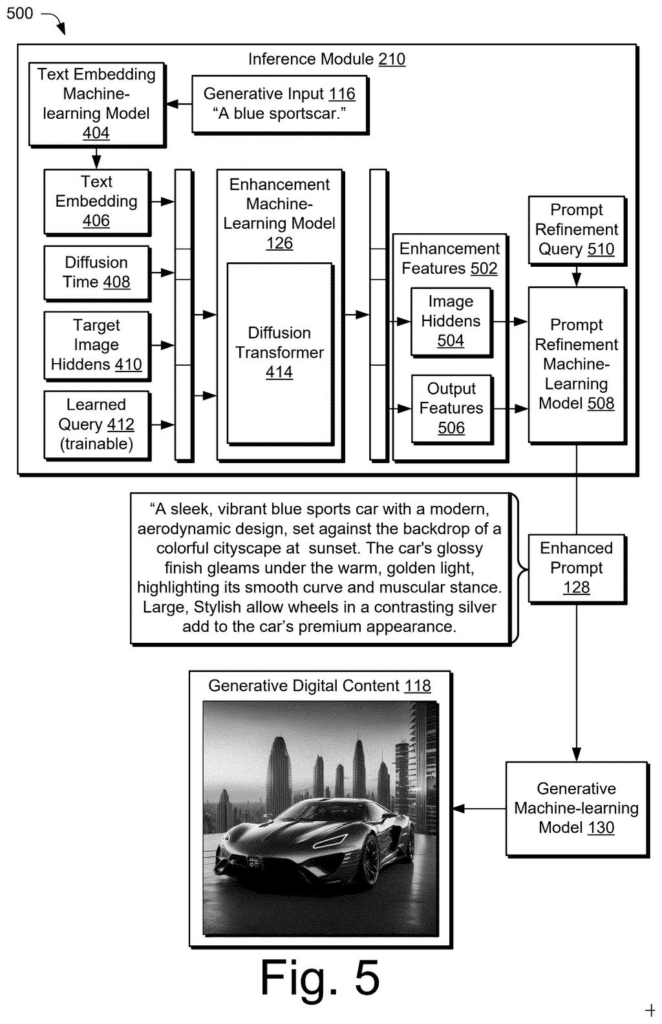
The patent describes a two-stage pipeline that sits between a user's text input and a generative AI image model.
Stage 1: Feature extraction. When you type a description, a first model called the enhancement machine-learning model reads it and pulls out what the patent calls "enhancement features." This model is built as a diffusion transformer (a type of neural network architecture that's good at understanding visual and semantic patterns). Think of it as a trained reader that recognizes what creative details are missing.
Stage 2: Prompt rewriting. Those extracted features are then handed to a second model, a prompt refinement model built on a standard language model, along with a "prompt refinement query" that essentially tells it what kind of output is needed. This model produces the final, enriched prompt.
- The enriched prompt is passed to a generative AI image model
- The output image is displayed in the user interface
- The user never had to write the detailed prompt themselves
Critically, the enhancement model is trained on digital content that already meets specific quality criteria, so it learns what "good" looks like for a given creative task rather than being a generic rewriter.
… by generating training data from high-quality digital content meeting specific criteria, a generative artificial intelligence (AI) system is configurable to train an enhancement machine-learning model to capture features pertaining to particular tasks or scenarios …
Translation: The AI learns how to improve prompts by studying a curated set of high-quality digital files.
What this means for Adobe's Firefly and creative tools
For anyone using Adobe's Firefly image generator or similar tools inside Photoshop and Illustrator, this kind of system could close the gap between what you imagine and what gets generated. Right now, getting consistently professional-quality results often requires learning a whole vocabulary of prompt tricks. A trained rewriter could absorb those tricks so you don't have to.
The broader implication is that Adobe is betting that the bottleneck in AI-generated creative work isn't the image model itself. It's the quality of the instructions going in. By making prompt quality automatic, they could make generative tools accessible to users who don't want to study prompt engineering, while also giving professional users a faster baseline to iterate from.
This is a sensible, practical patent rather than a flashy one. Adobe clearly sees prompt quality as a user-experience problem as much as a technical one, and training a dedicated model to fix it using high-quality creative examples is a reasonable approach. Whether it ships as a visible feature or runs in the background, it solves a real friction point that anyone who has used Firefly has run into.
There are more where this came from
We read every patent application Big Tech publishes and send you the ones worth knowing. Plain English, free, every week.
The drawings
9 drawing sheets from US 2026/0228262 A1 · click any drawing to enlarge


Want this weekly breakdown for a company we don't cover? Patentlyze Pro →
Be the first to weigh in