
Adobe Patents a System That Picks the Best Camera Angles Around a 3D Object
When a computer tries to work on a 3D model, it can waste enormous effort looking at the same surface from dozens of slightly different angles. Adobe's new patent describes a way to automatically figure out the minimum set of camera positions that still covers the whole object.
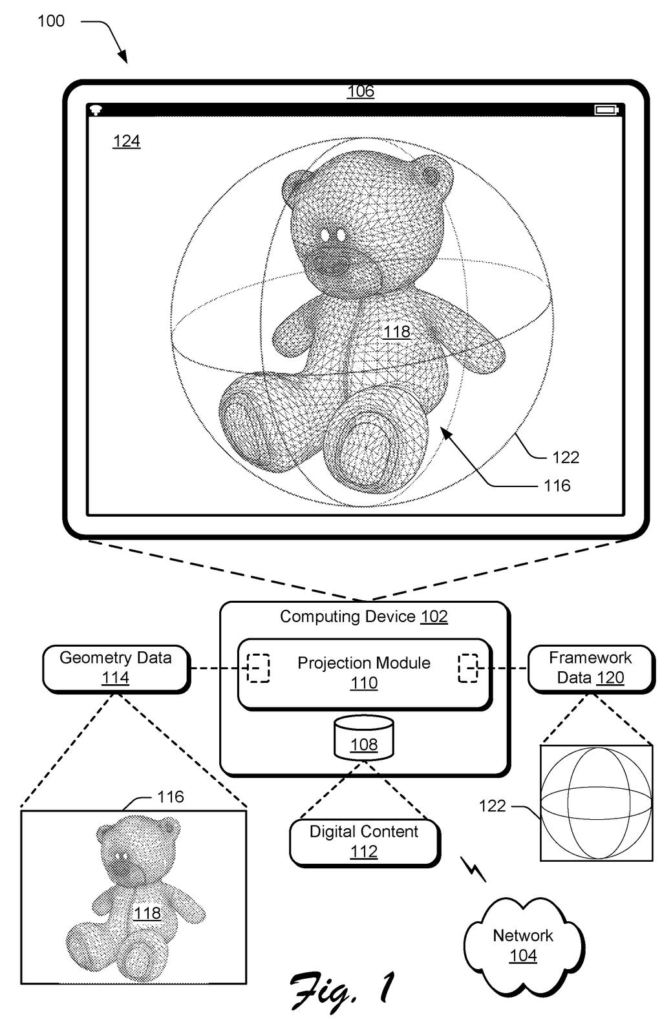
What Adobe's automatic viewpoint selection actually does
Ever tried to photograph every side of a sculpture without taking fifty nearly identical shots? That's the same problem computers face when they need to analyze or process a 3D object from multiple angles.
Adobe's patent describes a system that first studies the shape of a 3D object, then places a grid of candidate camera positions around it. From that grid, it automatically selects the smallest group of angles that still gives a complete view of the object's surface, without a lot of overlap. The leftover angles get dropped.
The result is that whatever digital work needs to happen on the object, whether that's applying a texture, running an AI analysis, or generating images, gets done more efficiently with less repeated effort. You'd notice the payoff as faster processing and less wasted computation inside design or AI tools.
… disposing a set of candidate viewpoints on the selected framework geometry about the three-dimensional object; determining a subset of activated viewpoints and a subset of inactivated viewpoints from the set of candidate viewpoints …
Translation: The software places a ring of potential camera angles around the 3D model and then filters them down to the best ones.
How the system trims redundant angles from a 3D object
The patent describes a four-step pipeline for choosing camera viewpoints around a 3D model.
- Shape analysis: The system examines the geometric characteristics of the object. Is it roughly spherical? Boxy? Flat? Based on that, it picks a matching framework geometry, essentially a standard scaffolding shape (like a sphere or a cube) to organize candidate camera positions around the object.
- Candidate placement: A set of candidate viewpoints is distributed across that framework, surrounding the object from many angles.
- Overlap pruning: Each candidate viewpoint is scored on how much new surface area it sees compared to the viewpoints already selected. If two cameras are looking at nearly identical surface patches, one gets deactivated. The process continues until the remaining active viewpoints together cover the whole outer surface with minimal redundancy.
- Digital operations: The trimmed, efficient set of viewpoints is then used to perform operations on the 3D object, such as texture synthesis, AI-based rendering, or analysis tasks.
The key technical idea is that the framework geometry adapts to the object's shape rather than applying a one-size-fits-all camera arrangement. A tall, thin object gets a different scaffold than a wide, flat one.
A subset of activated viewpoints is determined from the set of candidate viewpoints, the subset of activated viewpoints providing less of the overlapping surface data.
Translation: The system keeps only the camera angles that capture the object efficiently without wasting memory on duplicate views.
What this means for 3D artists and AI texture tools
For 3D artists and designers, slow processing on complex models is a real friction point. A tool that automatically selects the minimum viable set of camera angles means AI-assisted operations like texturing or style transfer can run faster, because the underlying system isn't grinding through redundant data. You'd feel this as tools that respond more quickly, or that can handle more complex models without hitting memory or time limits.
Adobe's bet on AI-assisted 3D creation shows up repeatedly in its recent filings. This patent fits that pattern: it's infrastructure work that makes AI operations on 3D content more practical, rather than a flashy user-facing feature on its own.
This is the 160th Adobe filing in our Adobe coverage since May, adding to work like cutting people from video and AI music to stereo audio.
The concrete payoff here is speed and efficiency in a part of 3D workflows that most users never see: how the software decides where to look at an object before doing anything with it. Get that decision wrong, and every downstream AI operation pays a tax in wasted computation.
This is infrastructure-level work. A designer using an Adobe tool won't open a menu called 'viewpoint selection'; they'll just notice that texturing a complex model takes less time, or that a feature works on objects it used to choke on. That's a real improvement, even if it's invisible.
The approach of matching the camera scaffold to the object's shape is a sensible engineering choice, not a dramatic one. It addresses a genuine inefficiency in how 3D AI pipelines are typically set up. Whether it ends up mattering in practice depends entirely on how well the shape-analysis step works on real, messy user models, and the patent doesn't say much about that.
There are more where this came from
We read every patent application Big Tech publishes and send you the ones worth knowing. Plain English, free, every week.
The drawings
11 drawing sheets from US 2026/0278938 A1 · click any drawing to enlarge


Want this weekly breakdown for a company we don't cover? Patentlyze Pro →