
Samsung Patents AI That Scrubs Unwanted Sounds Twice for Cleaner Audio
Most AI noise-removal tools leave behind faint ghost traces of the sounds they were supposed to erase. Samsung's new patent attacks those leftovers with a second cleanup pass that hunts down the harmonic echoes AI tends to miss.
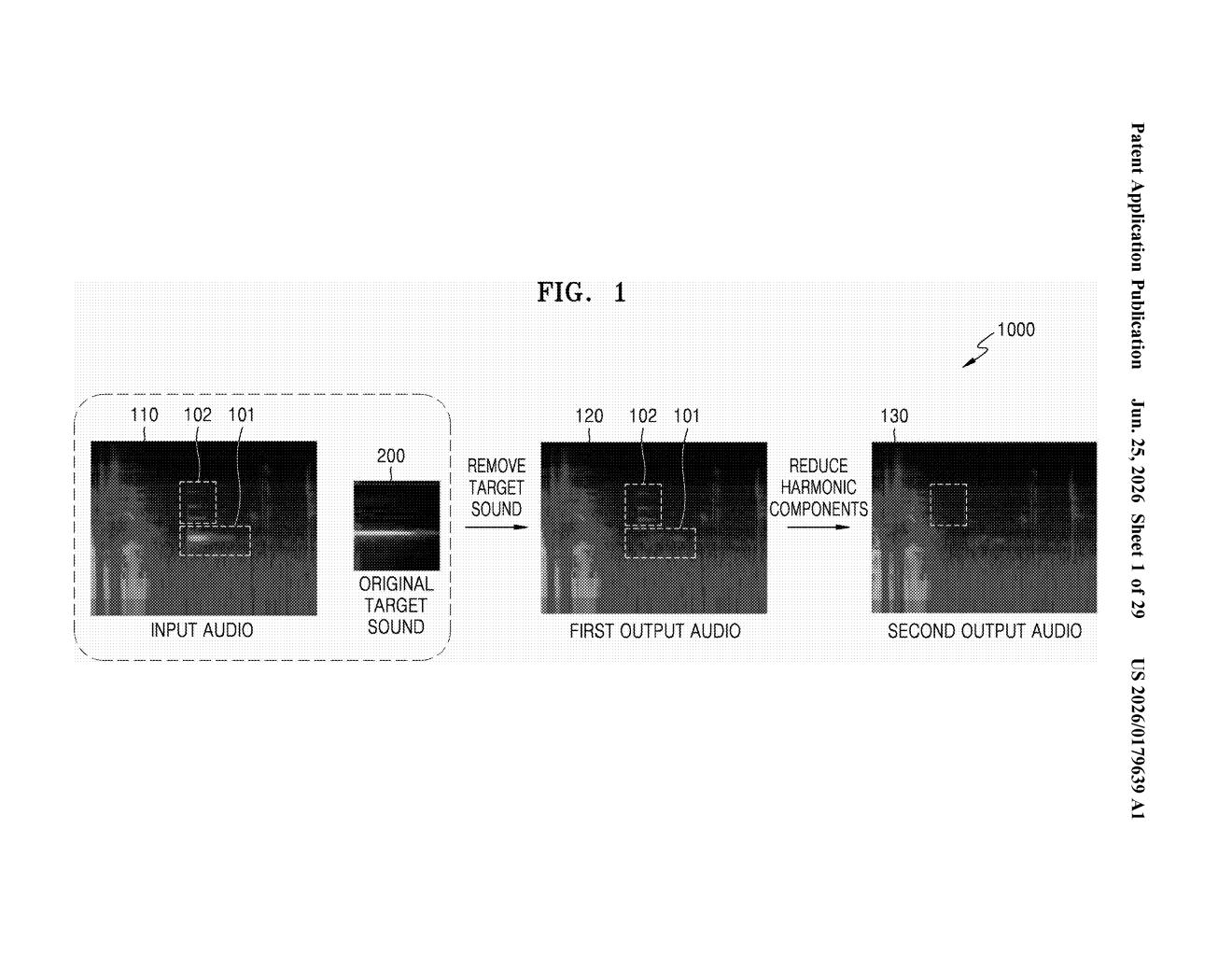
What Samsung's two-pass sound removal actually does
Imagine you record a video at a concert and then try to remove the crowd noise from your voice recording. A standard AI audio tool will scrub out most of it, but sounds like a persistent hum or a voice have a physical property called harmonics, which are faint multiples of the main tone. After the AI removes the obvious version of a sound, those harmonic echoes often survive, making the audio still feel slightly muddy or "colored" by the thing you were trying to remove.
Samsung's patent describes a system that runs two passes. The first pass is the usual AI model doing its best. Then the system subtracts that cleaned audio from the original to figure out what traces of the unwanted sound still linger. It uses those traces to build a profile of the sound's harmonic fingerprint, then goes back into the cleaned audio and turns those specific frequencies down.
The result should be audio that sounds like the unwanted sound was never there, not just quieted. This kind of cleanup matters most when you're recording vocals, calls, or video on a phone in a noisy place.
How the harmonic detection stage catches what AI misses
The patent describes a two-stage audio cleaning pipeline running on an electronic device.
- Stage 1 (AI removal): A neural network model takes the input audio and outputs a first cleaned version by suppressing the target sound (a voice, a specific noise, a musical instrument, etc.).
- Stage 2 (Residual analysis): The system subtracts the cleaned audio from the original to produce what it calls residual audio, which is essentially the leftover fingerprint of the sound that wasn't fully removed.
- Harmonic estimation: The device analyzes that residual to estimate the harmonic components (the overtone frequencies that are mathematically related to the main pitch) of the target sound.
- Targeted attenuation: Those specific harmonic frequencies are then identified inside the first cleaned audio, and their magnitudes are reduced to produce a final, second output.
The key insight is that AI models trained on broad audio data often suppress the loudest, most obvious version of a sound but miss the harmonics, which are quieter and spread across multiple frequencies. By using the residual as a guide, the system knows exactly which frequencies to hunt down rather than broadly suppressing frequency bands and risking damage to the wanted audio.
What this means for Galaxy devices and audio quality
For anyone who records video or takes calls on a Samsung Galaxy phone, better noise removal means less time correcting audio in post-production apps and fewer frustrating calls where background noise bleeds through. The approach is particularly relevant for Galaxy AI audio features, which Samsung has been expanding across its devices.
On a broader level, this patent signals that Samsung is thinking about AI audio processing as a layered system rather than a single-model output. That architectural thinking, running a cleanup check on the AI's own work, could apply to voice calls, video recording, hearing aid features in earbuds, or live interpreter modes. The on-device framing also suggests this is built for real-time or near-real-time use, not cloud processing.
This is a sensible engineering improvement, not a flashy AI announcement. The idea of using the residual signal to catch what a model missed is a well-grounded signal-processing approach applied to a real problem people encounter every day. It's worth watching because it fits neatly into Samsung's ongoing push to make Galaxy AI audio features actually work in noisy real-world conditions.
There are more where this came from
We read every patent application Big Tech publishes and send you the ones worth knowing. Plain English, free, every week.
Want this weekly breakdown for a company we don't cover? Patentlyze Pro →