
Amazon Patent Reveals AI Chatbot Guidance System for Autonomous Vehicles on Complex Roads
When a Zoox robotaxi gets confused, what if it could just ask an AI chatbot for help and get a written answer back? That's essentially what this patent describes.
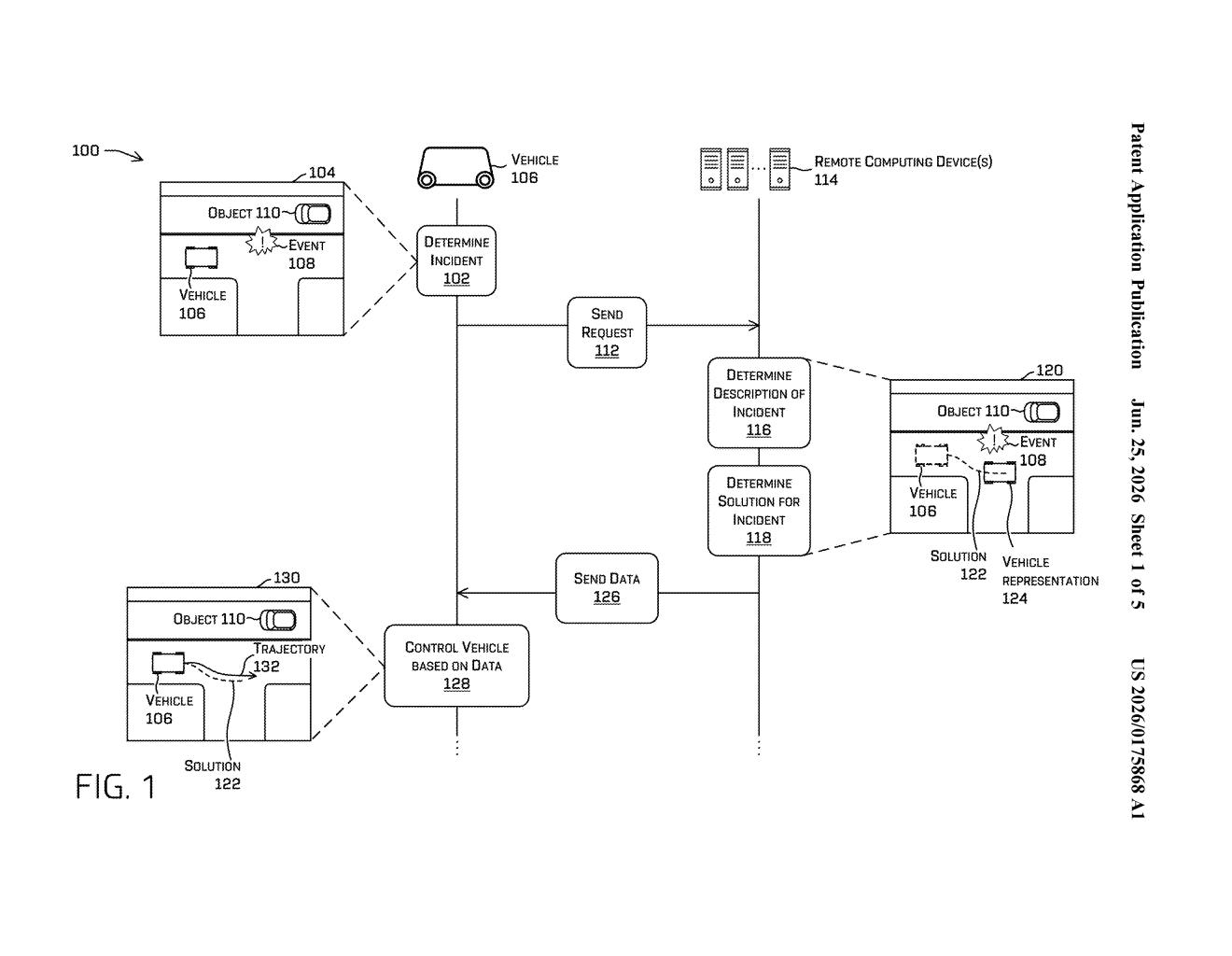
How Zoox's self-driving cars phone home for help
Imagine you're being driven by a self-driving car and it hits a situation its normal software can't handle: a construction zone blocking the road in an unexpected way, or an unusual vehicle stopped at an intersection. Right now, that kind of edge case might cause the car to freeze or call a remote human operator.
Zoox is patenting a different approach. Instead of looping in a human, the car sends its camera images, sensor readings, and map data to a large language model (the same kind of AI that powers chatbots like ChatGPT). The AI reads all that information together, figures out what's happening, and writes back a plain-text explanation of how the car should handle it.
That written answer then gets fed back into the car's navigation system, which uses it to plan a route forward. The car doesn't wait for a person to intervene; it asks an AI, gets a written answer, and moves on.
How the MLLM reads the scene and writes back directions
The patent describes a server-side system that acts as an emergency consultant for autonomous vehicles. When a vehicle's onboard software flags a situation it can't resolve on its own, it sends a help request to a remote computing device running a multimodal large language model (MLLM), meaning an AI that can process both images and text at the same time.
The remote system pulls together several data sources:
- Camera and sensor data from the vehicle itself
- Map data for the surrounding area, pulled from a database linked to the vehicle
- Any other contextual information the vehicle has collected
All of this gets fed into the MLLM, which outputs a text description of how the vehicle should respond. That description (for example, "the blocked lane requires merging left before the intersection") is transmitted back to the car.
The vehicle's planning component (the software layer responsible for calculating actual driving paths) reads that text and uses it to generate a concrete trajectory. The key idea is that the language model doesn't directly steer the car; it produces a natural-language interpretation of the scene that the car's existing planning software can act on.
What this means for the future of self-driving fallback systems
Self-driving vehicles today still rely heavily on human remote operators when edge cases appear. This patent points toward a system where an AI handles that fallback role, potentially making robotaxi fleets faster and cheaper to operate without a large team of standby humans watching screens.
For you as a passenger, the practical difference would be fewer unexplained stops and shorter delays when the car encounters something unusual. Whether this actually reduces reliance on human oversight depends on how reliable the language model's outputs are in real, high-stakes road situations, which is a genuinely open question in the industry.
This is a meaningful technical bet, not a routine filing. Using a language model as a real-time fallback advisor for a moving vehicle is a meaningful architectural choice, and it signals that Zoox sees AI reasoning as a credible substitute for human remote operators. The hard part is proving the system is reliable enough to trust at road speed.
There are more where this came from
We read every patent application Big Tech publishes and send you the ones worth knowing. Plain English, free, every week.
Want this weekly breakdown for a company we don't cover? Patentlyze Pro →