AMD
AMD · AI / ML · Filed Dec 30, 2024 · USPTO published Jul 2, 2026 · Jul 2 release
AMD's New Patent Lets Your PC Tell You Exactly What It Needs to Run Faster
Imagine your computer watching itself struggle through a game or video edit, then popping up a message saying 'you need more RAM, and here's exactly how much.' That's what AMD is working on.
- Publication number
- US 2026/0187313 A1(US20260187313A1)
- Applicant
- ADVANCED MICRO DEVICES, INC.
- Filed · Published
- Dec 30, 2024 · Jul 2, 2026
- Inventors
- Aryaman Gadia, Sruthi Paturi, Sai Kumar Anisetti, Sujith Philip
- Status when we published
- Waiting for an examiner
- Document
- 20 claims
- US classification
- 703/21
What AMD's AI upgrade advisor actually does
Right now, figuring out why your PC feels slow is mostly guesswork. You might search forums, run benchmarks, or just buy a new graphics card and hope for the best. AMD wants to take that guesswork away.
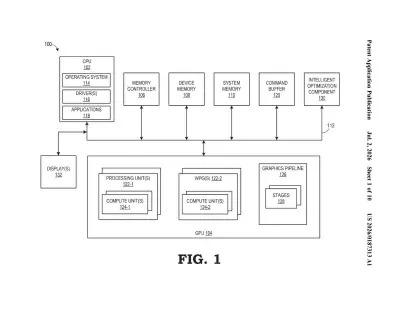
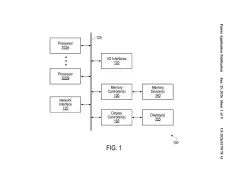
The patent describes an AI system built into your computer that watches how your machine handles specific apps, then compares that against what your current hardware can actually do. If it spots a bottleneck, it generates a concrete recommendation: upgrade this component to hit this performance target.
The result shows up right on your screen. Instead of a cryptic performance graph, you'd get something closer to: 'To run this app at your target settings, consider upgrading your GPU.' It's the kind of advice a knowledgeable friend with your exact PC specs would give you.
How the inference engine reads your PC and your apps
The system works in three steps, all happening inside the machine.
- It measures performance: The processing system tracks real metrics (frame rates, load times, render times) while an application is actually running.
- It encodes the context: Two separate 'encoded representations' are created: one describing your current hardware configuration, and one describing the application being run. Think of these as compressed fingerprints the AI can read.
- It runs an inference engine: A trained machine learning model takes all three inputs (hardware fingerprint, app fingerprint, and your target performance goal) and produces a specific hardware upgrade recommendation.
The 'target change in performance metric' input is notable. You tell the system what you want to achieve (say, a faster render time or higher frame rate), and the model factors that goal into its output. It's not just diagnosing a problem; it's solving for a specific outcome.
The recommendation then surfaces on a connected display, making it a user-facing feature rather than a background diagnostic tool.
What this means for everyday PC buyers
For most PC users, hardware decisions are expensive bets made with incomplete information. You might spend money on a CPU upgrade when your real bottleneck is memory bandwidth, or buy a faster GPU when the app you care about is almost entirely CPU-bound. An embedded AI advisor that knows your exact configuration and your exact workload could meaningfully cut down on those expensive mistakes.
For AMD specifically, this is an interesting strategic move. If this system ships inside AMD's own software stack (think Adrenalin or a future system utility), it puts AMD in a position to influence which components you buy next. A recommendation from your own PC carries more weight than an ad.
Source: US 2026/0187313 A1 at the USPTO (PDF). Full patent text and figures are in the official publication.
Get our take in your Top Stories
Liked this breakdown? Add Patentlyze as a preferred source on Google, and our plain-English take shows up more often in your Top Stories the next time AMD patent news breaks.
Add Patentlyze on Google
One click.
There are more where this came from
We read the new patents from Big Tech, carmakers and more and send you the ones worth knowing. Plain English, free, every week.
More from AMD
All 119 AMD patents →
More in AI / ML
All 2,745 AI / ML patents →
IBM
IBM Patents an AI System That Pre-Reserves Temporary Storage Before Apps Ask for It
Samsung
Samsung Patents a Method to Stop Computers Wasting Effort Teaching Themselves New Tasks
Amazon
Amazon Patents a System for Locking AI Model Weights Behind Cryptographic Keys
IBM