
Adobe
Adobe · AI / ML · Filed Nov 14, 2024 · USPTO published May 14, 2026 · May 14 release
Adobe Patents a Split-Layer AI Relighting System for Photos
Changing the lighting in a photo after the fact sounds simple, but shadows on your subject and shadows on the background follow completely different rules. Adobe's new patent tackles that by relighting them separately.
- Publication number
- US 2026/0134589 A1(US20260134589A1)
- Applicant
- ADOBE INC.
- Filed · Published
- Nov 14, 2024 · May 14, 2026
- Inventors
- Junuk Cha, Jae Shin Yoon, Mengwei Ren, Krishna Kumar Singh, Seunghyun Yoon, He Zhang, Yannick Hold-Geoffroy, HyunJoon Jung
- Status when we published
- Waiting for an examiner
- Document
- 20 claims
- US classification
- 345/589
- Examiner
- WELCH, DAVID T (Art Unit 2613)
What Adobe's separate foreground/background relighting does
Imagine you shot a portrait in harsh noon sunlight, but you want it to look like a golden-hour studio shoot. The problem isn't just 'make it warmer' — the light hitting your subject's face behaves differently than light bouncing off the wall behind them. Treating both as one flat image almost always produces something that looks fake.
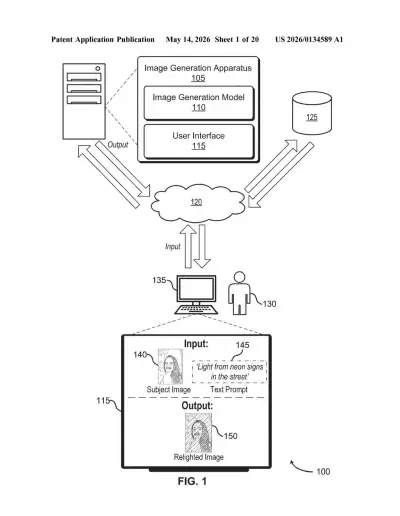
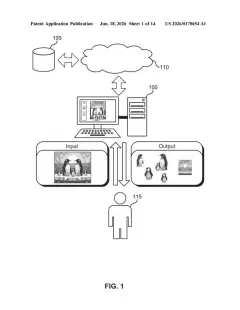
Adobe's patent describes a system that splits that job in two. It takes your photo and a 'lighting input' (think: a description or reference image of the lighting you want), then runs the foreground — the person or object — through one relighting process, and the background through another. Each gets lit correctly for what it actually is.
Once both layers are done, the system composites them back into a single image where everything looks like it was shot under the same light. The goal is a result that's physically plausible — not just 'brighter' or 'warmer,' but correctly lit from a consistent direction and intensity.
How Adobe's model splits and recombines lighting layers
The patent describes a pipeline with three main stages: foreground relighting, background relighting, and compositing.
At the input stage, the system takes two things: a source image (the photo you want to relight) and a lighting input that encodes the desired lighting condition — this could be an environment map (a 360° image of a lighting environment), a text description, or a reference light probe image. The lighting input tells the model what kind of illumination to simulate.
The image generation model then produces two separate outputs:
- Relighted foreground image — the subject (person, product, object) rendered under the new lighting, with accurate cast shadows, specular highlights, and diffuse shading.
- Relighted background image — the scene behind the subject, independently lit to match the same lighting condition.
Finally, the two layers are combined — composited together — to produce a single relighted image. By separating the two layers, the model can apply different lighting physics to each: a person's skin has very different reflectance properties than a painted wall or a grassy field. This division-and-recombine approach is the core novelty the patent is protecting.
What this means for Firefly and product photography
For Adobe Firefly and tools like Adobe Express or Photoshop's generative features, this is the kind of unglamorous plumbing that makes AI image editing actually usable in professional workflows. Product photographers and e-commerce teams spend enormous time in post-production correcting lighting inconsistencies when compositing subjects onto new backgrounds. A system that handles both layers coherently could cut that to near zero.
The deeper implication is for synthetic media consistency: as generative AI floods the internet with photorealistic images, physically plausible lighting is one of the clearest signals of quality. Getting foreground and background to share a believable light source — automatically — raises the floor on what AI-generated or AI-edited images look like to the human eye.
Source: US 2026/0134589 A1 at the USPTO (PDF). Full patent text and figures are in the official publication.
Get our take in your Top Stories
Liked this breakdown? Add Patentlyze as a preferred source on Google, and our plain-English take shows up more often in your Top Stories the next time Adobe patent news breaks.
Add Patentlyze on Google
One click.
There are more where this came from
We read the new patents from Big Tech, carmakers and more and send you the ones worth knowing. Plain English, free, every week.
More from Adobe
All 270 Adobe patents →
More in AI image & video
All 226 AI image & video patents →
Nvidia
Nvidia Patent Teaches Video AI to Copy Motion From Reference Clips
Google
Google Patents a Tap-to-Add Word Suggestion Tool for AI Image Generators
Nvidia
Nvidia Patents an AI Upscaling Method That Looks at Images from Overlapping Angles
Nvidia