
Intel Patent Boosts AI Video Upscaling Through Smarter Codec-Aware Processing
AI video upscaling looks great, but it's expensive to run on every single frame. Intel's new patent describes a system that only fires up the AI where it will actually make a visible difference.
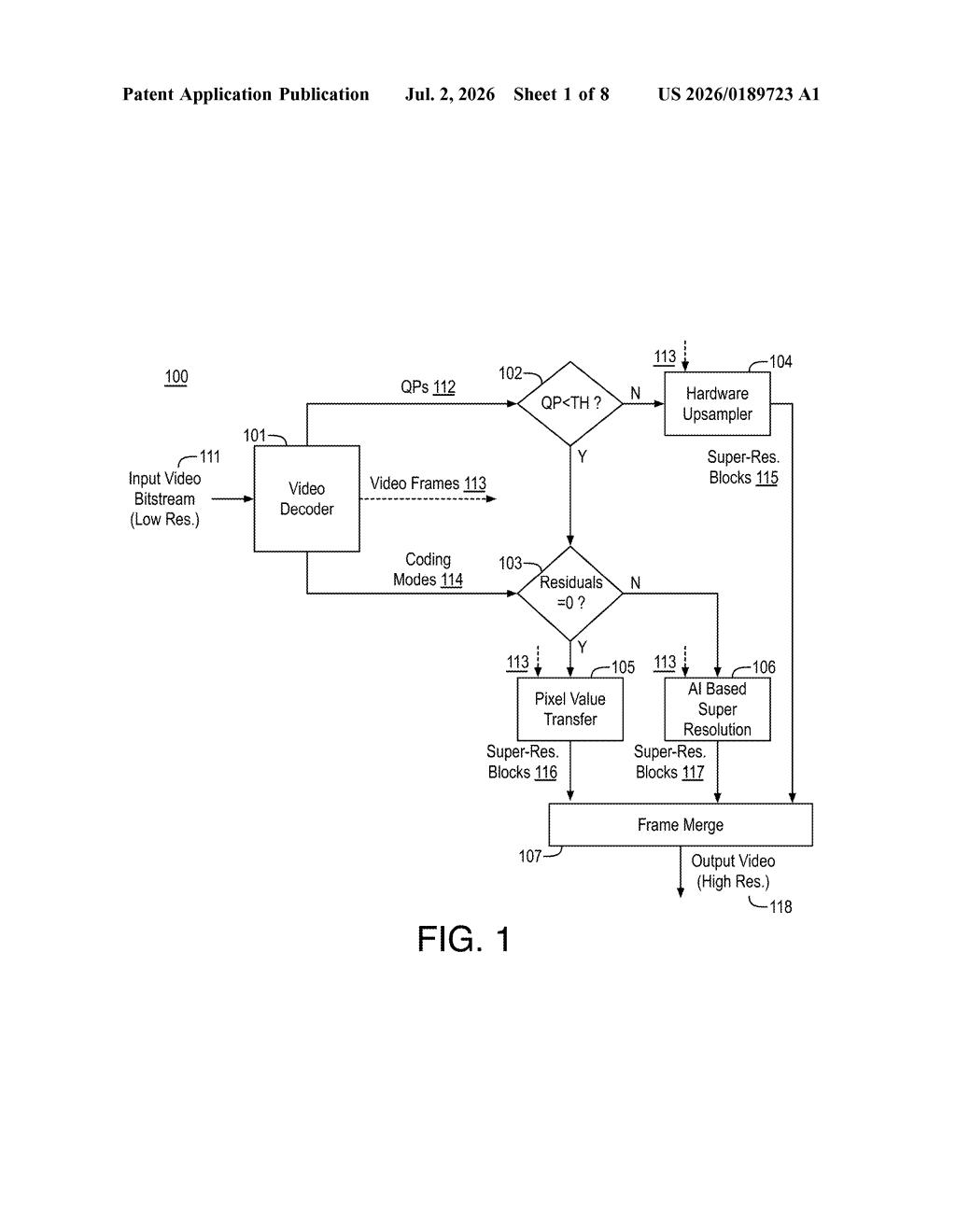
How Intel's selective AI upscaling actually works
Imagine trying to sharpen a blurry photo. If part of the photo is already in focus, spending extra time sharpening that section is wasted effort. Intel's patent applies that same logic to video.
When a video plays, it's made up of compressed chunks. Some chunks carry lots of detail; others are basically placeholders that say 'this part looks the same as before.' Intel's system reads those compression clues before deciding whether to run AI upscaling at all. The AI only kicks in on the chunks where it will actually improve picture quality.
For chunks that are already high-quality or haven't changed, the system uses a much cheaper, traditional upscaling method instead. The end result is a sharper, higher-resolution video that uses far less processing power to produce it.
How the system picks AI or bypass per video block
Video files are compressed using codecs (software that squishes video down to a manageable size). During compression, the codec makes decisions about every small block of the image: some blocks get a lot of detail encoded, while others are marked as 'skip' blocks (meaning nothing changed since the last frame) or heavily compressed with a high quantization parameter (a setting that controls how aggressively the codec tosses out fine detail).
Intel's patent proposes reading those codec decisions as metadata and using them to route each block down one of three paths:
- High-quality, non-skip blocks in low-compression frames: run through a deep learning neural network for full AI upscaling.
- Skip blocks in low-compression frames: bypass the AI entirely, since the block hasn't changed and AI processing would be wasted.
- Heavily compressed frames: use traditional (non-AI) upscaling, because there isn't enough source detail for the AI to work with anyway.
The outputs from the AI path and the traditional upscaler path are then merged together into a single higher-resolution video. The claim is that the final video looks as good as full AI upscaling, but at a fraction of the compute cost.
What this means for real-time AI video on your device
Real-time AI video upscaling has been a hardware-heavy feature. Running a neural network on every block of every frame demands serious GPU or dedicated AI accelerator resources, which is why it's mostly been limited to high-end PCs or streaming server infrastructure. If Intel can make selective upscaling work well, it opens the door for the feature to run on laptops, tablets, or even integrated graphics chips without draining the battery or choking the processor.
For you, that could eventually mean higher-quality video playback on lower-powered devices, or smoother real-time enhancement in video calls and streaming apps. It's not a flashy consumer feature on its own, but it's the kind of efficiency work that enables flashy features later.
This is disciplined engineering rather than a headline grabber. Intel is essentially teaching a video pipeline to work smarter about when AI is worth the cost, which is exactly the kind of problem that needs solving before AI upscaling becomes a mainstream, always-on feature. It's worth tracking if you follow Intel's GPU or media-processing roadmap.
Get our take in your Top Stories
Liked this breakdown? Add Patentlyze as a preferred source on Google, and our plain-English take shows up more often in your Top Stories the next time Intel patent news breaks.
There are more where this came from
We read every patent application Big Tech publishes and send you the ones worth knowing. Plain English, free, every week.
Want this weekly breakdown for a company we don't cover? Patentlyze Pro →