
Amazon Patents an AI That Builds 3D Models From a Single Product Photo
Creating a 3D model of a physical object normally requires expensive equipment and hours of manual work. Amazon is patenting a way to do it from a single flat photo, using an AI trained to infer what the sides and back of an object look like.
What Amazon's one-photo 3D model system actually does
Imagine you're browsing Amazon and you want to spin a product around, look at it from underneath, or see what it looks like from behind. Right now, that requires a seller to photograph the item from dozens of angles and pay someone to stitch those shots into a 3D model. Most sellers just don't bother.
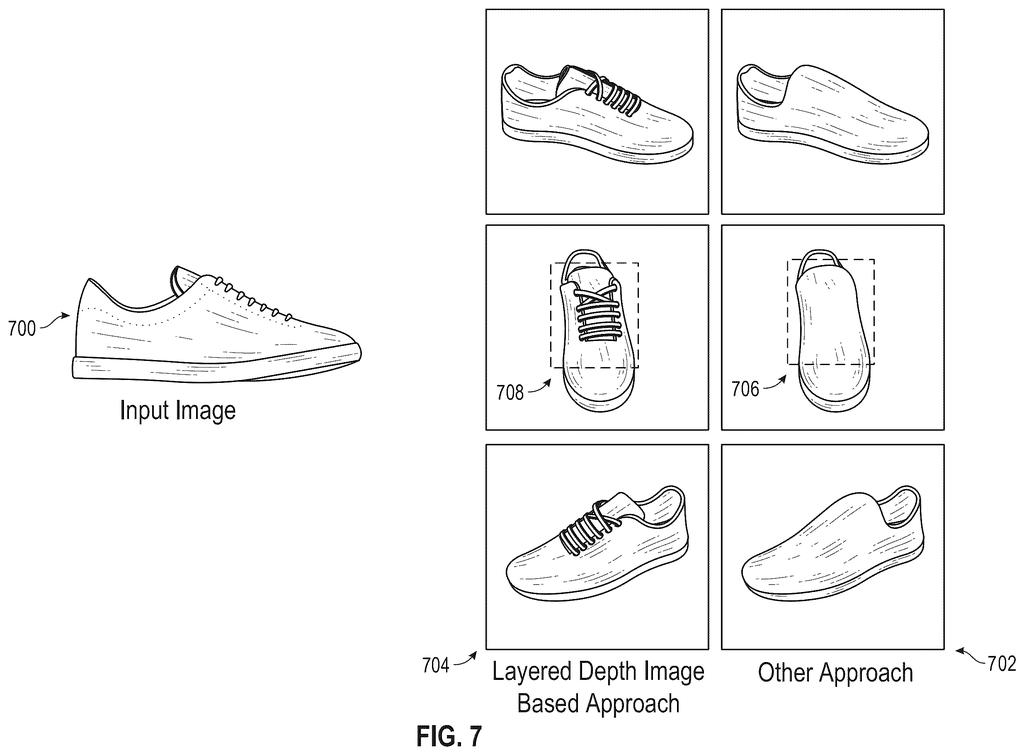
Amazon's new patent describes an AI that takes a single ordinary photo of an object and figures out what the rest of it looks like. It does this by learning from thousands of existing 3D models during training, so it can make educated guesses about depth and hidden surfaces it can't actually see.
The result is a full 3D model generated automatically, no special camera rig, no manual modeling. For you as a shopper, that could eventually mean being able to rotate and inspect almost any product on the site, not just the ones where a seller had the time and budget to produce 3D assets.
generate, via a neural network, a first set of layered depth images from a first input image of a first object; generate a first three-dimensional model from the first set of layered depth images; …
Translation: The AI creates layered depth pictures from a flat photo to build a 3D model.
How layered depth images reconstruct hidden object surfaces
The system works through a technique called layered depth images (LDIs). A regular photo captures one flat layer of an object, basically what's facing the camera. An LDI stacks multiple depth layers on top of each other, capturing not just the front surface but also what's behind it at various depths. This lets the system represent parts of an object that are hidden from the original camera angle.
During training, Amazon's neural network learns from a large library of existing 3D models. For each model, the system derives what the layered depth images "should" look like, and uses those as training targets. The network learns to predict those layers from a single 2D input image.
At inference time (when it's actually being used on a new photo), the process is:
- Feed in a single photo of an object
- The neural network predicts multiple layered depth images covering different surfaces and depths
- Those layers are assembled into a complete 3D model
The training loop in the patent is self-correcting: it renders the predicted 3D model back into a 2D image using a virtual camera, compares that render to the original photo, and uses the difference (the loss) to adjust the network's internal parameters (weights and biases). This pushes the model toward predictions that are geometrically consistent, not just visually plausible.
The system generates a three-dimensional model with layered depth images based on an input two-dimensional image.
Translation: The technology turns flat 2D pictures into 3D digital objects using depth layers.
What this means for online shopping and product visualization
The real bottleneck in 3D commerce isn't the display technology, it's producing the 3D assets in the first place. A professional 3D scan or photogrammetry session costs hundreds of dollars per object and requires physical access to the item. That makes 3D product views a luxury reserved for high-margin goods. A system that generates a usable 3D model from a single stock photo collapses that cost almost entirely.
For Amazon specifically, Amazon keeps filing on AI-driven product visualization, this kind of automation could apply across tens of millions of product listings. For you as a buyer, it raises the prospect of interactive 3D views on everyday items, the kind of confidence-building feature that currently reduces returns on furniture and apparel when sellers do invest in it.
This is the 70th Amazon filing in our Amazon coverage since May, adding to a body of work that includes an AI video-quality fix and a polite lane-change scorer.
The problem this addresses is real and expensive. Producing 3D assets at catalog scale is one of the genuine unsolved headaches in e-commerce, and the gap between what consumers want (spin the product, see the bottom, check the back) and what sellers can afford to provide is wide.
The approach, predicting layered depth from a single image, is a reasonable bet on a hard problem. Single-image 3D reconstruction is an active research area and far from solved, especially for objects with complex geometry or surfaces that are mostly occluded in the input photo. The patent does not make strong claims about accuracy, which is appropriate.
What's notable is the self-supervised training loop: using a virtual camera to render the output and compare it to the input is an elegant way to create training signal without needing manually labeled ground-truth data. Whether the results are good enough for real shoppers to trust is a separate question the patent doesn't answer.
There are more where this came from
We read every patent application Big Tech publishes and send you the ones worth knowing. Plain English, free, every week.
The drawings
11 drawing sheets from US 2026/0278972 A1 · click any drawing to enlarge


Want this weekly breakdown for a company we don't cover? Patentlyze Pro →
Be the first to weigh in