Apple
Apple · AR / VR · Filed Jan 7, 2026 · USPTO published May 14, 2026 · May 14 release
Apple Patents a System That Builds 3D Models of Real Objects Using Depth and Image Data
Apple is patenting a way to scan a physical object — say, a chair — and automatically reconstruct it as a clean, part-by-part 3D model. The trick is combining two very different kinds of sensor data to get both the geometry and the fine details right.
- Publication number
- US 2026/0134621 A1(US20260134621A1)
- Applicant
- Apple Inc.
- Filed · Published
- Jan 7, 2026 · May 14, 2026
- Inventors
- Boyuan Sun, Bin Liu, Feng Tang, Peng Wu, Ye Cong
- Status when we published
- Waiting for an examiner
- Document
- 20 claims
- US classification
- 345/419
- Parent application
- Continuation of 18/119,792 (filed Mar 9, 2023)(18119792)
What Apple's part-aware 3D scanning actually does
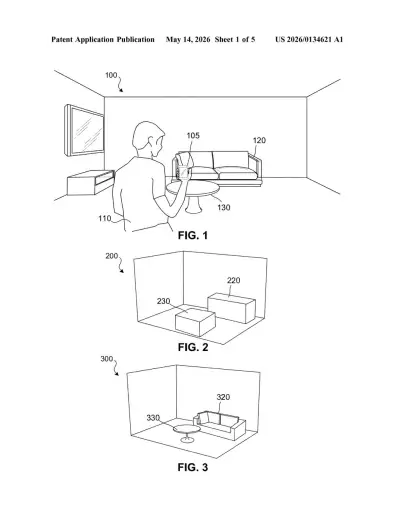
Imagine you point your iPhone or Vision Pro at a chair in your living room, and it doesn't just take a photo — it builds an accurate 3D model of that chair, broken down into legs, seat, and backrest, each piece correctly shaped and positioned.
That's essentially what this Apple patent describes. It uses depth sensor data (a 3D point cloud — basically a cloud of millions of measured dots in space) to figure out where each part of an object is and how big it is. Then it uses a regular 2D camera image to recognize finer details, like whether chair legs are star-shaped, straight, or crossed.
By combining those two sources, the system can generate a compact but accurate 3D model of the object — not a raw mesh of millions of triangles, but a smarter, structured representation built part by part. That kind of model is much easier to work with in augmented reality or room-planning apps.
How Apple fuses point clouds with 2D image attributes
The patent describes a pipeline with three main stages that run on a device with a processor (think iPhone, iPad, or Apple Vision Pro).
- 3D point cloud input → part segmentation and bounding boxes: The depth sensor produces a point cloud — a spatial map made of millions of 3D coordinate dots. The system segments that cloud into individual parts of the object (e.g., the seat vs. the legs of a chair) and fits a 3D bounding box (an invisible box that snugly wraps each part) to capture its position, size, and orientation.
- 2D image input → attribute recognition: A standard camera image of the same scene is analyzed to identify part-specific attributes — qualitative descriptors like the shape type of chair legs (star-shaped, straight, or crossed). These are things that a point cloud alone might not capture cleanly due to noise or low resolution.
- Fused 3D representation: The geometry from the point cloud (where things are, how big) and the attributes from the image (what shape or style) are combined to generate a structured 3D model. Each part gets a shape representation that fits inside its bounding box and reflects its recognized attribute.
The result is a relatively lightweight, semantically meaningful model rather than a raw photogrammetric mesh — which makes it far more useful for downstream tasks like AR placement, furniture recognition, or scene understanding.
What this means for Apple's AR and spatial computing push
For Apple, accurate real-world 3D reconstruction is core infrastructure for spatial computing on Vision Pro and for AR features on iPhone and iPad. If your device can scan a room and build clean, part-aware 3D models of the furniture in it, you get much more convincing AR overlays, better object interaction, and smarter scene understanding — things like knowing a chair has wheels, or that a table has a glass top.
This also ties into the broader trend of semantic scene understanding: moving beyond raw geometry to models that know what objects are and what their parts do. That's the foundation for features like room planning in the Home app, virtual try-before-you-buy furniture placement, or future robotics applications where a device needs to interact with real objects intelligently.
Source: US 2026/0134621 A1 at the USPTO (PDF). Full patent text and figures are in the official publication.
Get our take in your Top Stories
Liked this breakdown? Add Patentlyze as a preferred source on Google, and our plain-English take shows up more often in your Top Stories the next time Apple patent news breaks.
Add Patentlyze on Google
One click.
There are more where this came from
We read the new patents from Big Tech, carmakers and more and send you the ones worth knowing. Plain English, free, every week.
More from Apple
All 748 Apple patents →
More in AR / VR
All 718 AR / VR patents →
Apple
Apple Patents a Laser Sensor That Knows When Your Headset Slips
Apple
Apple Patents a Context-Sensitive UI That Shows Different Controls Per Screen Region
Qualcomm
Qualcomm Patents a System for Streaming 3D Scenes That Shift With Where You're Standing
IBM