
Apple Files Patent for an AI App Builder That Shows Its Plan Before Writing Code
Apple's patent has an AI show its homework before it writes an app: a map of screens, a list of data, and a layout sketch you can change first.
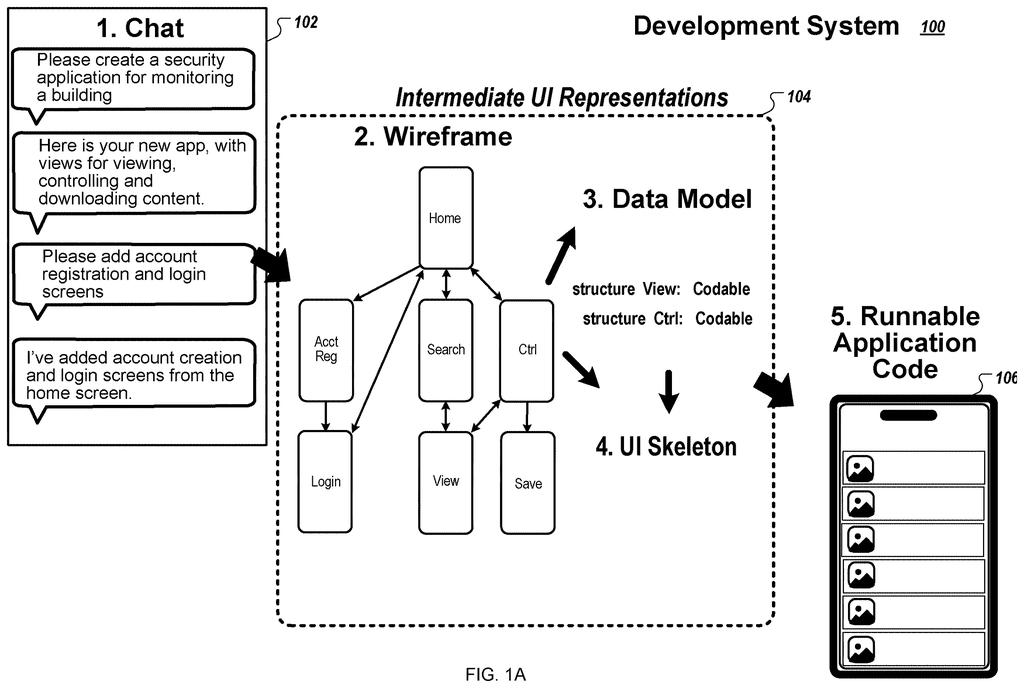
What Apple's plan-first app builder does
Imagine you ask an AI helper to build an app that shows every device on your home Wi-Fi. It writes a huge pile of code in one go, and you realize it forgot the sign-up screen. Now you have to pick through all of it to fix one missing piece.
Apple's patent describes a different order of work. First, the AI drafts a plan you can read: a map of the screens with arrows showing how you move between them, a list of the information the app will handle, and a bare-bones sketch of each screen.
You can change any of it by typing something like 'add sign up to the flow' or by editing the plan directly. The system adjusts whatever else is affected, and only then does it write the real code.
… a navigation flow wireframe that identifies a plurality of views for the application, at least some views being selectable to trigger another view from the plurality of views …
Translation: The system maps out screen layouts and how users will navigate between them.
How the screen map, data list and layouts connect
The core claim covers a development tool that shows a programmer several rough drafts of an app, all generated from a typed request (a prompt). The patent calls these drafts intermediate elements and names three:
- Navigation flow wireframe: a map of the app's screens with arrows showing which screen leads to which, stored behind the scenes as a graph in a text format called JSON.
- Data model: the kinds of information the app handles, such as a book or a restaurant reservation, tied to the screens that use them.
- User interface skeleton: a bare-bones, code-like sketch of each screen's layout and buttons, with button actions described in short text since real code comes later.
A navigation flow plan marks the transition points between screens, and the skeletons are built from it. The developer can type a follow-up like 'Please add sign up to the flow' or edit a draft directly, and the system updates whatever else that change touches.
Only after review does it write code. The filing also describes a design outline of colors and fonts, error checks on code sections before the full build, and an export step that finishes any missing code and compiles the app.
… causing generation of at least a portion of software code for the application using the navigation flow plan and the plurality of intermediate elements including the updated intermediate element …
Translation: The actual computer code is finally generated only after the user reviews and adjusts the initial blueprints.
Why a plan you can edit beats a code dump
If you have ever asked an AI tool for something and gotten back a lot of work you then had to untangle, this is the frustration the filing describes. For app builders, the pitch is a checkpoint: agree on the screens, the data and the layout first, then generate code once. The description says this can cut planning and prototyping time and lower the odds of errors, though it gives no measurements.
For you as an app user, the effect would be indirect: apps built this way would be sketched and checked before they were coded. The patent describes the tool for developers and names no product, so it is hard to say where it would show up. It does show how Apple pictures a person steering an AI that writes software.
Apple's sixth filing we've tracked since July in our AI agents acting for you watchlist builds on ideas like answering voicemail and booking and spotting room objects for Siri.
Anyone who has asked a chatbot to write a program knows the pain: you get a big pile of output, and one wrong early guess, like a missing screen, spreads into everything built on top of it. The filing's own description says it is easier to design an app's data in a planning stage than to rework it later.
That is a real cost, since fixing a foundation after the walls are up takes far more effort than redrawing a sketch. The remedy fits the problem at a sensible size: three small, readable plans, checked by a person, before any code appears.
It is a workflow idea, and the patent gives no figures on how much time it saves. Still, for anyone who has watched an AI build the wrong thing with total confidence, a plan you can edit first is an easy promise to understand.
Get our take in your Top Stories
Liked this breakdown? Add Patentlyze as a preferred source on Google, and our plain-English take shows up more often in your Top Stories the next time Apple patent news breaks.
There are more where this came from
We read every patent application Big Tech publishes and send you the ones worth knowing. Plain English, free, every week.
The drawings
9 drawing sheets from US 2026/0329558 A1 · click any drawing to enlarge


Show the other 1 sheets

Want this weekly breakdown for a company we don't cover? Patentlyze Pro →
Be the first to weigh in