
A New Apple Patent Sends Each Search to AI or Plain Rules, Whichever Fits
Ask your phone for a lobster roll near the Red Sox game and the answer might come from an AI model or from a plain rulebook. This Apple filing is about deciding which.
What Apple's AI-or-rules search sorter does
A fan outside Fenway Park asks their phone where to get a lobster roll before the Red Sox game. It sounds like one question, but it is really a few: where is the game, and what food is nearby?
You ask your phone things like this all the time, and the answer can come from very different machinery. Some questions need a big AI model that can untangle vague wording. Others are better handled by a plain set of rules, which is usually faster to run. This Apple patent application describes a system that looks at each question and decides which path it should take.
The decision can depend on how fast and how well each path is working right now, what kind of device you're using, who you are, and how much or what kind of information your question carries. Answers are then gathered, and weak or made-up ones are filtered out before you see anything.
… in accordance with a determination that the query should be processed using a second query processing pipeline, sending, to the second query processing pipeline for processing by the second query processing pipeline, the query without sending, to the first query processing pipeline for processing by the first query processing pipeline, the query …
Translation: If the search fits the second system, it goes there directly and skips the first one.
How a Lands End sunset question gets answered
At its core, the patent application covers a sorting step. A device, usually a server, receives a question and decides which of two different query processing pipelines (separate chains of software that each work out an answer) should handle it. The question goes to one pipeline without also going to the other. Some claims name the split directly: a model-based path (an AI model) and a rule-based path (fixed instructions written by people).
The filing says the choice can depend on:
- How fast or efficiently a given AI model or data source can respond
- What each part can handle right now
- The type of device asking, and the user behind it
- The amount, type, or form of information in the question
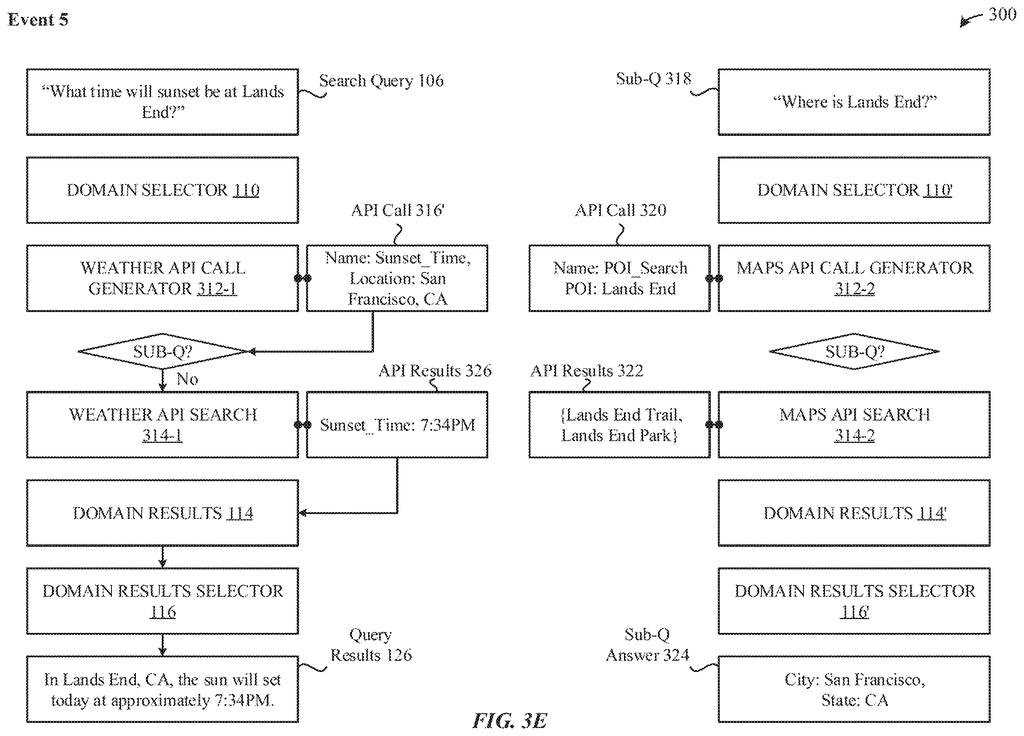
The description's main example is "What time will the sunset be at Lands End?" A weather component can look up sunset times but doesn't know where Lands End is, so it creates a sub-question for a maps component, which answers San Francisco. That answer fills a blank in the weather request, which returns 7:34 PM.
A final stage collects the results and filters out redundant or wrong ones, including AI hallucinations (confident answers a model made up). An optional explanation agent can say why a result showed up.
… (4) aggregating the results to produce aggregated results, (5) filtering the aggregated results to produce filtered results, and (6) causing the client computing device to display at least a portion of the filtered results.
Translation: The system combines the answers, cleans them up, and shows them on your screen.
What this means for AI-powered phone search
If you have ever waited on a voice assistant to answer something simple, this is the problem on the table. Sending every question to a large AI model can be slower to run, while a plain rulebook can answer "what time is sunset" in a blink. A system that picks the right tool for each question could make everyday searches on your phone, watch, or speaker faster, and save the heavy AI for requests that need it.
The filing also handles multi-step questions, where one answer feeds the next. Combined with filtering out made-up answers before they reach your screen, the aim is fewer dead ends and fewer confident wrong replies. The filing offers no performance numbers, so how much faster or more accurate it would be is unknown.
Apple's third filing we've tracked since October builds on one on offloading AI tasks and one on grading signal forecasts in our AI models in teams watch.
The shortest path from this filing to a real feature runs through software alone. No new chip or gadget is needed, just a server that takes your question, decides how to handle it, and sends back an answer.
What has to exist first is the decision-maker, the part that weighs speed, your device, and the size of your question to pick the right approach. The filing names those factors but gives no scoring method and no test results, which is the one missing piece that determines whether the whole thing saves time or just adds a step.
The claims are broad, covering any sorting between two different paths. You would never see it working, and that invisibility is exactly the point.
Get our take in your Top Stories
Liked this breakdown? Add Patentlyze as a preferred source on Google, and our plain-English take shows up more often in your Top Stories the next time Apple patent news breaks.
There are more where this came from
We read every patent application Big Tech publishes and send you the ones worth knowing. Plain English, free, every week.
The drawings
14 drawing sheets from US 2026/0320043 A1 · click any drawing to enlarge


Show the other 6 sheets


Want this weekly breakdown for a company we don't cover? Patentlyze Pro →
Be the first to weigh in