
A New Apple Patent Sorts Out Cellular Upload Conflicts for AR and VR Video
When a 5G network cuts in on your phone's reserved upload schedule, the phone has to keep its bookkeeping straight. Apple's filing sets out how to do that for the bursty video data that AR and VR apps send.
What Apple's 5G upload-override patent does
Imagine you're wearing a mixed-reality headset that streams what you see to a cloud server. Your phone's cellular connection has been given a repeating set of reserved upload slots, like a standing restaurant reservation, so each chunk of video has a seat waiting.
Now the network changes its mind and sends a one-off instruction that grabs one of those slots for something else. Your phone still has to keep a saved copy of what it sent, in case it must send it again, and a stopwatch decides how long that copy stays protected. The rules for that stopwatch got messy when one slot in a batch was overruled.
Apple's patent spells out a fix: restart the stopwatch for just the affected slot, set it so it finishes in step with the rest of the batch, and release it early if the network confirms the data arrived.
… receiving a dynamic grant that identifies a HARQ process and overrules the configured grant for a PUSCH transmission associated with the identified HARQ process; and restarting a configured grant timer for the identified HARQ process using a predetermined timer value.
Translation: A new network instruction can cancel a scheduled upload and restart its tracking timer with a set value.
How the phone restarts one overruled timer
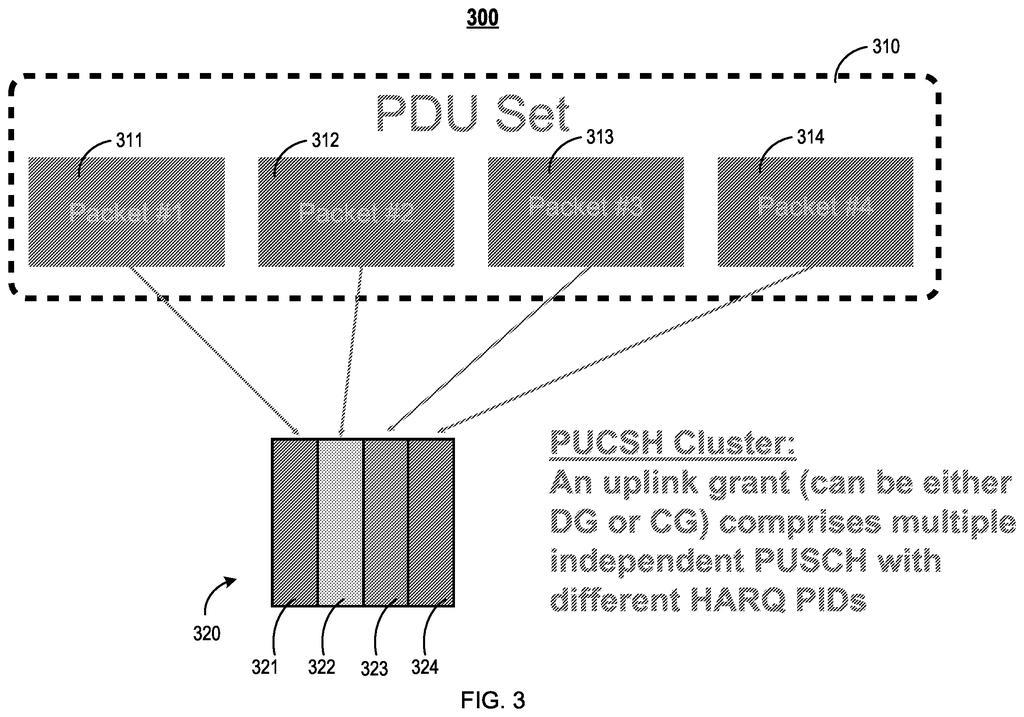
In 5G, the network can give a phone a configured grant: a repeating, pre-approved schedule of upload slots. For AR and VR traffic, the filing describes a PUSCH cluster (a group of several upload slots per cycle) that carries one set of related packets and absorbs late arrivals and varying packet sizes.
Each slot is tied to a HARQ process (a numbered buffer that keeps a copy of sent data until the network confirms it arrived). A configured grant timer protects that buffer. While it runs, the phone must not reuse that slot's resources for the same process, or it could overwrite data it may still need to resend.
The trouble starts when a dynamic grant (a one-off instruction sent to the phone's own network ID) overrules one slot. The filing says this can block processes unnecessarily, or block them even longer if the instruction arrives before the next cycle. The claims cover this sequence:
- Receive a configured grant that schedules several uploads, each with its own HARQ process.
- Start a set of timers, one per process.
- Receive a dynamic grant that names one process and overrules its slot.
- Restart that process's timer using a predetermined value.
The claims also cover setting that value to the time left in the original timer, so it ends with the rest of the batch. They add an offset (negative if the override lands after the original slot), and stopping the timer once the network confirms receipt. The filing also describes alternatives, such as using one shared timer, or banning the override entirely.
… processing a dynamic grant received on PDCCH for the UE's C-RNTI that overrules a configured grant for the PUSCH transmission cluster, and changing an association between the configured grant and the PUSCH transmission cluster for a predetermined amount of time.
Translation: The system handles sudden scheduling overrides by temporarily changing how uplink data clusters are linked.
Why AR and VR video needs tidy upload rules
You will never see a setting for this, but it lives in the radio rules that decide how smoothly your phone pushes live data upstream. The filing explains that AR and VR video is sent in sets of packets with a strict delay budget, and if a set runs late, the whole thing can be thrown away. Fewer blocked or wasted upload slots gives that data a better chance of arriving on time.
The filing is aimed at phones and other 5G devices, and it is written in the language of cellular standards. That points to a contribution to the rule-writing process more than a feature Apple would advertise. Clear timer rules help phone makers and network equipment makers handle the same edge case the same way.
Apple's 97th filing we've tracked since May in our AR glasses watchlist builds on work like one to reduce video stutter and one that reads your mood.
The problem here is small but real. Live video from a headset runs on a strict clock: if a batch of data arrives late, the whole batch gets thrown away, so a wasted upload slot can show up as a glitch or a delay.
Apple's fix matches that size. It adds a handful of precise timer rules for one narrow situation, and the filing even admits that the cleanest answer might be to forbid the override altogether. That candor tells you how fiddly this edge case is.
Most readers will never feel this directly. It is a rule-book patch for phone makers and network gear, and its value shows up as fewer hiccups, which nobody notices when things work.
Get our take in your Top Stories
Liked this breakdown? Add Patentlyze as a preferred source on Google, and our plain-English take shows up more often in your Top Stories the next time Apple patent news breaks.
There are more where this came from
We read every patent application Big Tech publishes and send you the ones worth knowing. Plain English, free, every week.
The drawings
24 drawing sheets from US 2026/0332316 A1 · click any drawing to enlarge


Show the other 16 sheets


Want this weekly breakdown for a company we don't cover? Patentlyze Pro →
Be the first to weigh in