
Apple Patents Mid-Air Gesture Control for Wireless Speaker Playback
Apple is patenting a way to control nearby speakers — volume, track skipping, pause, play — using nothing but hand gestures in the air, with a display that shows you what's happening in real time.
What Apple's air-gesture speaker control actually does
Imagine you're across the room from your HomePod and want to turn it down. Instead of reaching for your phone or shouting at Siri, you just wave your hand. Apple's new patent describes exactly that: a device with a camera watches for your hand movements and translates them into audio controls for a nearby speaker.
Swipe sideways to skip a track, pinch to adjust volume, point to select something from an on-screen menu. The device's display shows you feedback — a volume slider moving, text confirming the action — so you know it worked. The patent also covers wirelessly pairing a speaker just by gesturing at it, which is a neat trick.
The patent is broad enough to apply to several kinds of devices — glasses, a phone held up, or a headset — and several kinds of cameras including depth sensors and infrared. It's less about any one product and more about Apple staking out territory in gesture-driven audio control.
How the camera reads your hand and talks to speakers
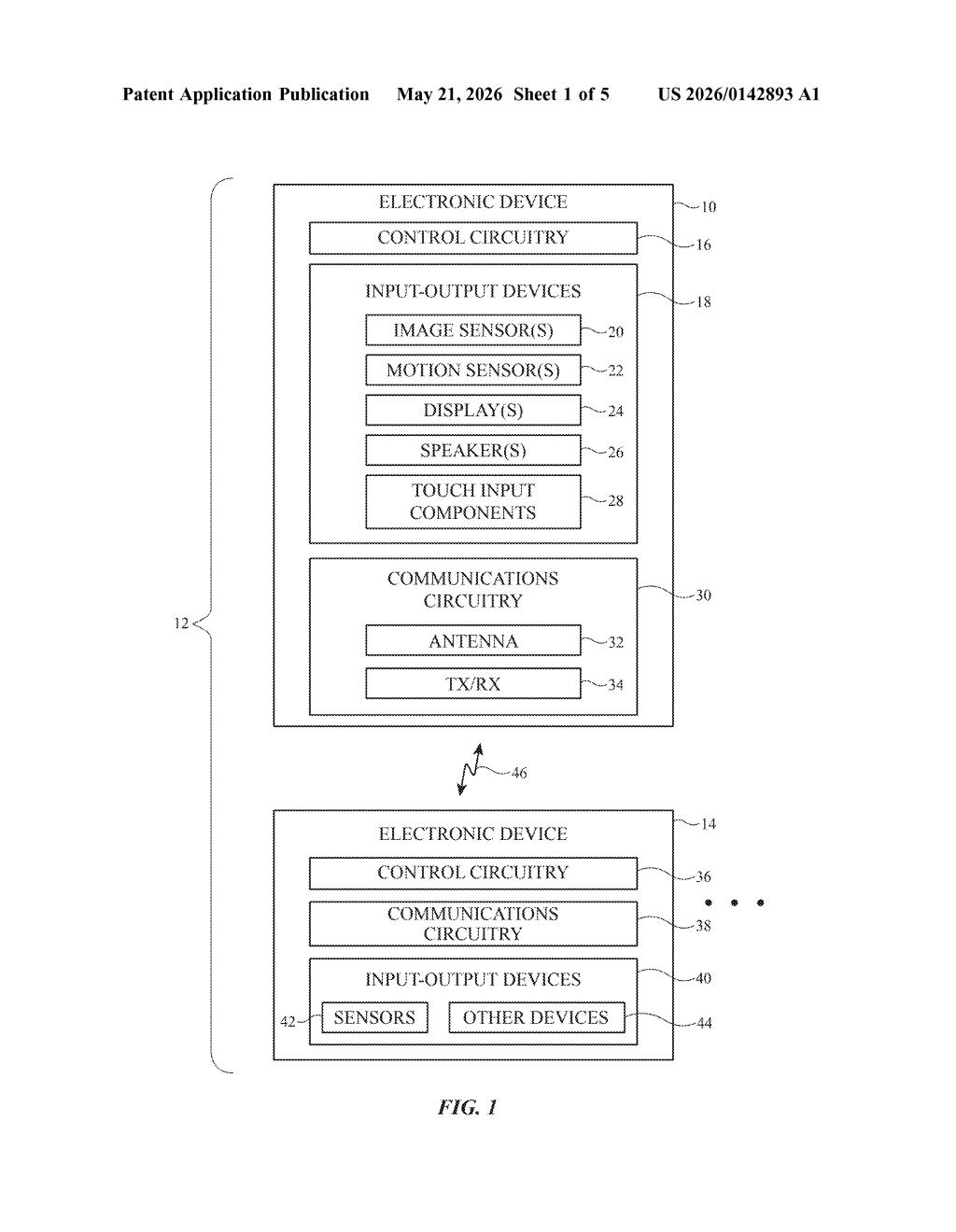
At its core, the patent describes a feedback loop between a camera, control circuitry, a display, and one or more external speakers.
The camera — which can be infrared, visible-light, depth-sensing, or 3D — captures the user's hand movements in the air. The control circuitry interprets gestures like swiping, waving, pinching, and pointing, then maps them to media playback commands:
- Volume adjustment (raise or lower)
- Track selection (skip forward or back)
- Pause and play
- Initiating wireless pairing with a speaker
The display overlays real-time feedback — a moving volume slider, a menu of options, or text confirmation — so the user knows the gesture registered. Audio can also be streamed to the speaker in response to a gesture, meaning a single gesture might both pair a speaker and start playing content.
A separate independent claim focuses specifically on a 3D depth-sensing image sensor, which suggests the system is designed to work in space (not just in-plane), making it well-suited for headset or glasses form factors where the user's hands are naturally in front of them.
What this means for Apple's Vision Pro and AirPlay ecosystem
If you use a Vision Pro or any future Apple headset, this is exactly the kind of interaction model Apple needs to make it feel natural to control the audio environment around you. Right now, adjusting speaker volume from inside a headset is clunky. This patent sketches a path where you glance at a HomePod, make a gesture, and you're done — no voice command, no app tap.
Beyond headsets, the same logic could apply to an iPhone or iPad held up toward a speaker. The patent's breadth covers multiple device types and camera technologies, which means Apple is planting a wide flag rather than describing one specific product. It's also worth noting that wireless pairing via gesture — point at a device to connect to it — has obvious appeal for a company that sells a sprawling ecosystem of speakers, earbuds, and TVs.
This isn't a flashy AI patent, but it's a genuinely useful interaction primitive that fills a real gap in spatial computing. The ability to gesture at a speaker and control it, with visual feedback overlaid on your view, is the kind of frictionless control that makes AR headsets worth wearing. The depth-sensing camera claim in particular signals Apple is thinking about this in a Vision Pro context, not just as a phone feature.
There are more where this came from
We read every patent application Big Tech publishes and send you the ones worth knowing. Plain English, free, every week.
Want this weekly breakdown for a company we don't cover? Patentlyze Pro →