
Apple Patents a Developer Dashboard That Benchmarks App Performance Against the Competition
Apple wants to tell app developers how their app stacks up against the competition without giving away anyone's exact numbers. It's a clever privacy balancing act baked into a developer dashboard.
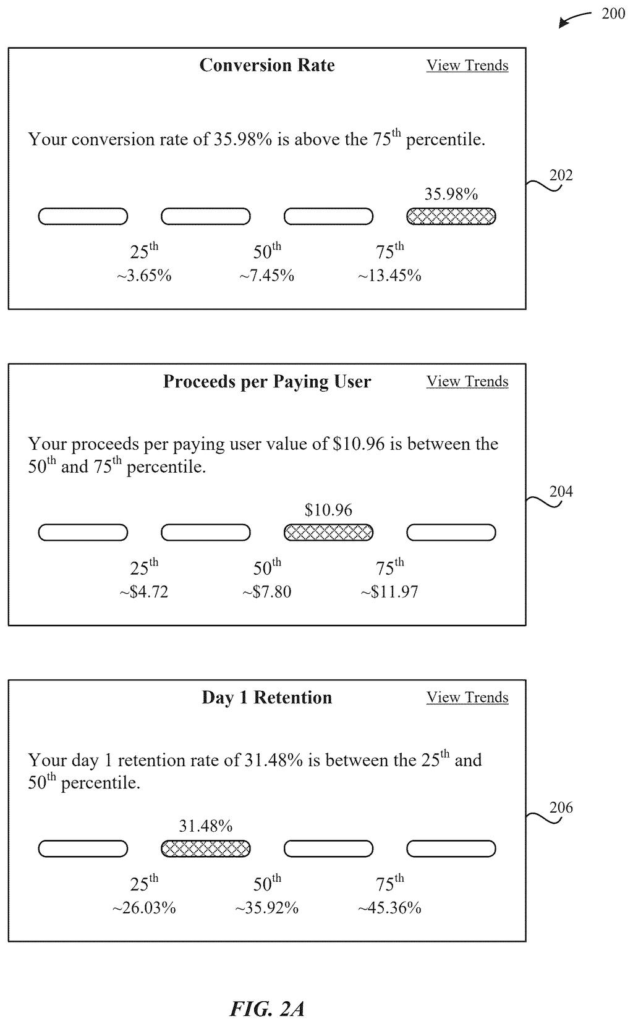
What Apple's app performance comparison tool actually does
Imagine you run a food delivery app and you want to know whether it loads faster or slower than your rivals. Right now, you can see your own app's speed numbers, but you have no idea where you stand in the broader market. Apple's patent describes a tool that fills that gap.
The idea is to show you a percentile ranking for your app, so you can see something like "your app is in the top 30% for launch speed." You get a real sense of where you stand, without Apple revealing the exact performance numbers from any competing app.
The clever part is the deliberate fuzziness. The dashboard intentionally obscures exactly where within a percentile band your app falls. So even if your app is in the 70th to 80th percentile, you won't know if it's at 71 or 79. It protects other developers' data while still giving you actionable context about your own.
How Apple hides exact competitor data while still ranking apps
Apple's system collects performance metrics (things like app launch time, crash rate, memory usage, or battery draw) from many apps on the App Store. When a developer requests a report for their own app, the system generates a percentile ranking by comparing that app's metric against the pool of data from all apps.
The user interface then displays two things side by side:
- A direct readout of the developer's own app metric (the raw number)
- A visual indicator showing which percentile band that number falls into, such as 60th-70th percentile
The key design choice is what Apple calls obfuscation of the point within the range. The UI intentionally does not show whether you're at the top or bottom of your percentile band. This prevents reverse-engineering competitors' exact data from the percentile boundaries.
The system is built around the concept of generating the percentile calculations centrally, using aggregate data from multiple apps, then surfacing just enough information to be useful to the individual developer without exposing the underlying dataset.
What this means for App Store developers tracking performance
For indie developers and larger studios alike, knowing whether your app is fast or slow in absolute terms is useful, but knowing whether it's fast or slow compared to similar apps is far more valuable. A 2-second launch time might be excellent for a game but poor for a calculator app. Percentile context makes the number mean something real.
From Apple's side, this patent addresses a genuine tension: developers want competitive benchmarks, but Apple also has obligations to protect data it collects from other developers' apps. The deliberate fuzziness of the percentile band is the mechanism Apple is patenting to thread that needle. If this ships as part of Xcode Organizer or App Store Connect, it could change how developers prioritize performance work.
This is a sensible, well-scoped idea for a developer tool that Apple almost certainly already has some version of internally. The patent is mostly about the specific UI treatment (showing a band, not a point) that protects third-party data. It won't make headlines, but for the developer community it's the kind of quality-of-life addition that actually changes daily decisions.
There are more where this came from
We read every patent application Big Tech publishes and send you the ones worth knowing. Plain English, free, every week.
The drawings
12 drawing sheets from US 2026/0220015 A1 · click any drawing to enlarge


Want this weekly breakdown for a company we don't cover? Patentlyze Pro →
Be the first to weigh in