
New Apple Patent Rethinks Camera Wiring and Stabilization
Inside every camera with optical image stabilization, there's a tiny platform that floats and shifts to cancel out shaky hands. Apple's new patent tackles a quiet engineering headache: how do you run power and data to that floating sensor without the wires fighting the motion system?
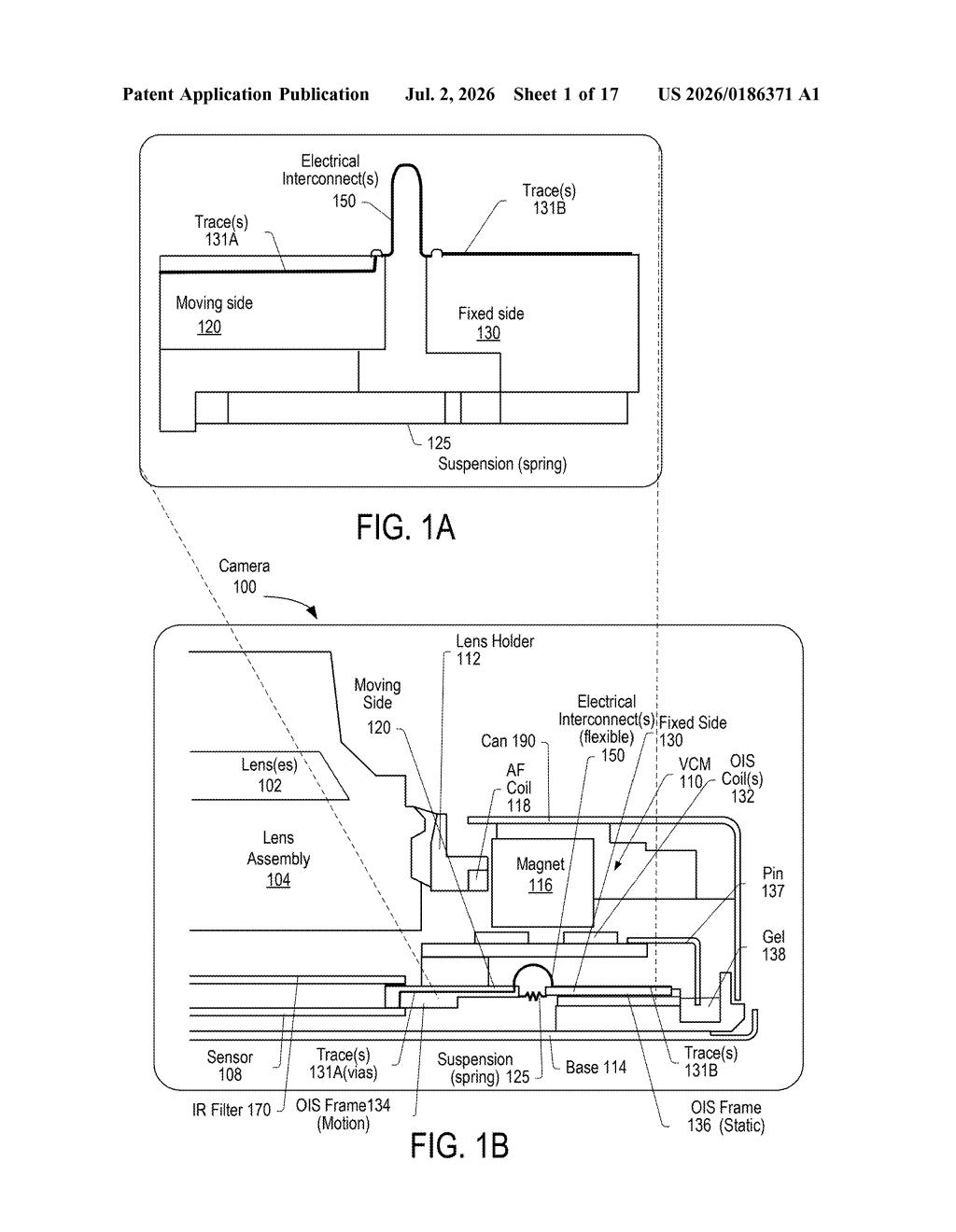
What Apple's camera stabilization wiring patent actually does
Imagine trying to talk on a phone while someone shakes your hand. The connection keeps getting disrupted. That's roughly the problem inside a sensor-shift camera: the image sensor has to move freely to cancel blur, but it also needs a constant electrical connection to send image data out.
Right now, the same flexible strip that holds the sensor in place often has to double as the electrical wire. Apple's patent splits those two jobs apart. A dedicated set of patterned, flexible arms handles the electrical side, while a completely separate suspension handles the physical support and motion.
The clever part is that the electrical arms are shaped so they all move together in a predictable way, like a choreographed fold, so they never accidentally touch each other or create resistance that would interfere with how the camera stabilizes your shot.
How the patterned flexure arms carry data without tangling
The patent describes an actuator module built around a sensor-shift camera design, where the image sensor itself moves (rather than the lens) to counteract hand shake or adjust focus.
The module has two main mechanical systems doing separate jobs:
- The suspension: a set of physical flexures (thin, spring-like supports) that hold the moveable sensor platform and allow it to float and shift when the actuator tells it to.
- The electrical flexure component: a physically separate set of flexible arms whose only job is to carry power, image data, and control signals between the moving sensor platform and the fixed, static portion of the camera.
The electrical flexure arms are shaped in a specific pattern so that when the platform moves, every arm deflects in a coordinated, predictable way (what the patent calls "deterministic" movement). This prevents any two arms from bumping into each other, which could degrade the electrical signal or create unwanted mechanical drag.
By keeping the electrical wiring off the suspension, Apple's design lets engineers tune each system independently. The suspension can be optimized purely for motion and load, without compromising for wire routing, and the electrical arms can be optimized for signal quality without worrying about structural load.
What this means for future iPhone camera shake correction
Sensor-shift stabilization is already standard in iPhone cameras, and the engineering tolerances inside those modules are extremely tight. When the same component has to be both a spring and a wire, trade-offs build up quickly: a suspension stiffened to handle wiring loads can fight the stabilization actuator, reducing how much correction the camera can apply.
Separating the two functions could allow Apple to push sensor-shift modules further, either correcting more aggressive motion, supporting higher-resolution sensors that produce more data, or shrinking the overall module. For you, that most likely translates to steadier video and crisper low-light photos in future iPhone generations.
This is deep-inside-the-box camera engineering, not a flashy feature announcement, but it's the kind of incremental mechanical refinement that determines whether the next iPhone camera is noticeably better in real use. The fact that Apple is patenting the specific arm-patterning logic suggests this is production-bound thinking, not a skunkworks experiment.
Get our take in your Top Stories
Liked this breakdown? Add Patentlyze as a preferred source on Google, and our plain-English take shows up more often in your Top Stories the next time Apple patent news breaks.
There are more where this came from
We read every patent application Big Tech publishes and send you the ones worth knowing. Plain English, free, every week.
Want this weekly breakdown for a company we don't cover? Patentlyze Pro →