
Apple Patents a Way to Match Your Room's Sound to the Recording's Room
When you put on headphones, the sound you hear was mixed in one room, but you're sitting in a completely different one. Apple has filed a patent for a system that figures out both environments and blends them so the audio feels like it belongs where you are.
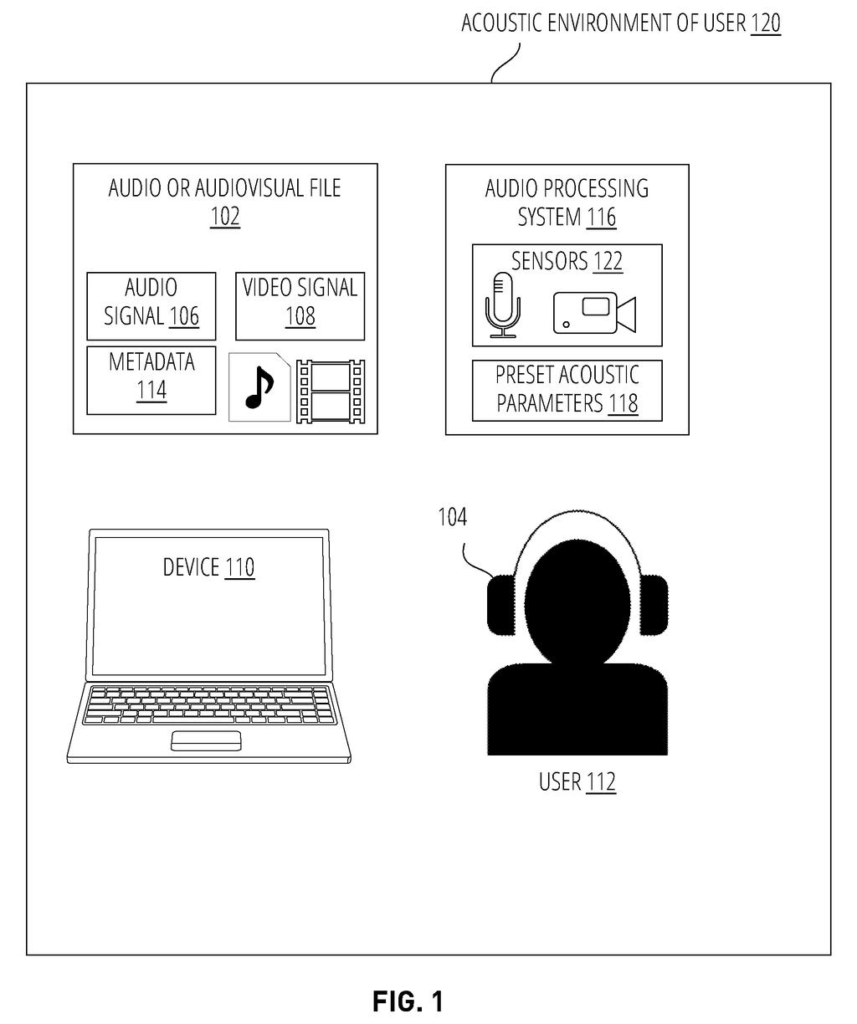
What Apple's virtual listening environment actually does
Every time you press play on a pair of headphones, two rooms are at war. The music was recorded and mixed in a studio, a concert hall, or someone's bedroom. You're sitting in your kitchen, your office, or a noisy airplane. Those two acoustic worlds don't naturally fit together.
Apple's patent describes a system that measures your current environment using microphones or other sensors on a headset, then figures out the acoustic character of the audio file itself, either by analyzing the audio or reading its metadata. It uses both pieces of information to choose a set of spatial filters, parameters that shape how sound reaches each ear.
The result is binaural audio, meaning sound crafted individually for your left and right ears, tuned to bridge the gap between where the recording was made and where you actually are. The goal is an experience that sounds natural and placed, not like two rooms fighting each other.
determining a first acoustic parameter based at least partially on 1 ) a second acoustic parameter of a desired acoustic environment of a user of the electronic device and 2 ) an acoustic environment of an audio file comprising audio signals …
Translation: The system figures out how you want a room to sound compared to the room where the music was recorded.
How the device blends two acoustic environments into one
The system works in three broad steps.
- Environment sensing: Sensors on the device capture signals from the user's physical space. The patent describes deriving one or more acoustic parameters from those signals, essentially a fingerprint of how sound behaves in your immediate surroundings (how much it echoes, how reverberant it is, how loud background noise is).
- Recording environment analysis: The system separately characterizes the acoustic environment baked into the audio file itself. That characterization can come from analyzing the audio signals directly or from metadata attached to the file, information a producer or mastering engineer may have embedded describing the room where the content was made.
- Preset selection and spatial rendering: The two acoustic pictures are combined to produce a first acoustic parameter (what the patent calls a preset), which feeds into spatial filters. Those filters perform binaural rendering, meaning they simulate how sound would arrive at each ear in a physically coherent space, and the resulting signals drive the headset's speakers.
The core claim is deliberately broad: any method that takes a desired-environment parameter, cross-references it with the audio file's environment, and uses the combination to drive binaural output falls inside it. The patent does not lock in a single sensing technology or a specific filter design.
The audio signals may be spatially rendered by applying spatial filters that include the one or more preset acoustic parameters to the audio signals, resulting in binaural audio signals.
Translation: Filters are applied to the sound so it feels like it is playing inside your specific room.
What this means for spatial audio on Apple headsets
For listeners, this is about comfort and immersion. Spatial audio that ignores your real surroundings can feel disconnected or unnatural, especially in quiet rooms where your ears have strong expectations about how sound should behave. A system that adapts to your environment in real time could make AirPods or Vision Pro feel more acoustically consistent, regardless of whether you're at a desk or on a train.
Apple has been filing around spatial audio and binaural rendering for several years, and this patent fits that pattern. For audio producers and streaming services, the metadata hook is notable: if file formats start routinely embedding acoustic environment tags, players that support this system could use them automatically, changing how mixing engineers think about what information to include in a final release.
This is the ninth filing in the Apple audio patents we cover since May, building on earlier applications about using sound to find orientation and a mic reading room noise.
Claim 1 covers any device that measures the acoustic shape of the room around a listener, compares that measurement to a description of the recording space embedded in the audio file, and then reshapes the sound through headphones to match. That scope is written to cover the whole category, not a specific technique: any sensors, any filters, any matching algorithm would qualify as long as those three steps connect.
In practice, that breadth means the claim would reach almost any headphone system built around the same logic, giving Apple legal standing over a wide range of adaptive audio products.
The most consequential piece is the embedded metadata, the idea that the audio file itself carries a description of where it was recorded so playback can respond to wherever you are listening. How much of that ground earlier researchers already covered will likely determine whether this claim survives scrutiny.
There are more where this came from
We read every patent application Big Tech publishes and send you the ones worth knowing. Plain English, free, every week.
The drawings
8 drawing sheets from US 2026/0281654 A1 · click any drawing to enlarge


Want this weekly breakdown for a company we don't cover? Patentlyze Pro →