
Apple
Apple · Software · Filed Jan 15, 2026 · USPTO published Aug 13, 2026 · Aug 13 release
Apple Patents a Lock Screen Clock That Changes Shape Around Your Content
Apple's lock screen clock could soon physically reshape itself, squishing or stretching, to make room whenever other content rearranges on the display, all without ever disappearing from view.
- Publication number
- US 2026/0236135 A1(US20260236135A1)
- Applicant
- Apple Inc.
- Filed · Published
- Jan 15, 2026 · Aug 13, 2026
- Inventors
- William M. Tyler, Lyam J. Bewry, Adam Grabowski, Andrew P. Clymer, Vincenzo Vuono, Marie Otsuka, William A. Sorrentino III, James J. Owen, Alan C. Dye, Christopher P. Foss, Bobby Martin JR., Shubham Kedia, Chanaka G. Karunamuni, Bruno Canales, Miquel Estany Rodriguez, Stephen O. Lemay
- Status when we published
- Waiting for an examiner
- Document
- 30 claims
- US classification
- 715/781
- Parent application
- Claims priority from a provisional application 63819893 (filed Jun 8, 2025)
What Apple's self-reshaping lock screen clock actually does
Today's iPhone lock screen keeps the time in one fixed spot and one fixed shape. If a notification slides in or content rearranges, the clock pretty much just moves out of the way. Apple wants to change that.
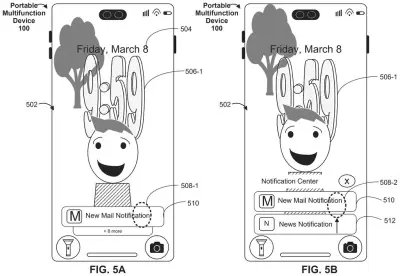
This patent describes a lock screen where the time display actually changes its proportions in response to whatever else is happening on screen. If content below the clock shifts position, the clock could get taller and narrower, or shorter and wider, fitting the new layout without vanishing. The time always stays visible; it just adapts its shape to the space it has left.
Think of it like water filling a container: the clock stays on screen no matter what, but its visual footprint flexes around the content next to it. It's a subtle change, but one you'd likely notice every time you glance at your phone.
… changing an aspect ratio of the indication of the current time of day while maintaining display of the indication of the current time of day in the first user interface, based on the change in the spatial arrangement of the first content.
Translation: The clock numbers will stretch or shrink to fit around your photo or other items on the screen.
How the clock's aspect ratio responds to content shifts
The patent describes a wake screen (the display you see when your device first lights up) that shows two things at once: some block of content, and a live clock showing the current time.
When a specific trigger event occurs, such as a notification arriving, a widget expanding, or a user interaction, two things happen simultaneously:
- The content block rearranges its position on screen.
- The clock display changes its aspect ratio (the ratio of width to height) to accommodate the new layout, while staying visible the whole time.
The key technical detail is that the clock doesn't simply move or hide. Its shape changes proportionally based on how the surrounding content has shifted. If content expands downward and crowds the clock horizontally, the clock might become taller and thinner to survive in the remaining space.
Apple's claim language is broad enough to cover any "computer system" with a display and input devices, which means this behavior could apply to iPhone, iPad, Apple Watch, or even Mac lock screens. The system is reactive: the aspect-ratio change is explicitly based on the change in spatial arrangement of the other content, so the two transformations are linked, not independent.
displays, via the one or more display generation components, a change in a spatial arrangement of the first content in the first user interface; and, displays, via the one or more display generation components, a change to the indication of the current time of day …
Translation: The system automatically moves your content and adjusts the clock display when it detects a specific user action.
What this means for iPhone and Apple Watch lock screens
For everyday iPhone users, this could make the lock screen feel noticeably more polished. Right now, iOS lock screen widgets and clocks can feel like they're fighting each other for space. A clock that gracefully reshapes itself, rather than getting pushed off or hidden, would let Apple pack more information onto the wake screen without the display feeling cluttered.
From a patent-strategy view, claim 1 covers a fairly specific but still broad behavior: any system that links a clock's aspect ratio change to a content rearrangement on the same screen. That's not trivially narrow. If granted, it could give Apple a meaningful claim over this particular interaction pattern across its whole device lineup. Apple's lock screen design has been a focus of iteration since iOS 16, and this filing fits that pattern of incremental but real refinement, sitting alongside the steady flow of new Big Tech patents covering display behavior and UI animation on mobile devices.
Source: US 2026/0236135 A1 at the USPTO (PDF). Full patent text and figures are in the official publication.
Get our take in your Top Stories
Liked this breakdown? Add Patentlyze as a preferred source on Google, and our plain-English take shows up more often in your Top Stories the next time Apple patent news breaks.
Add Patentlyze on Google
One click.
There are more where this came from
We read the new patents from Big Tech, carmakers and more and send you the ones worth knowing. Plain English, free, every week.
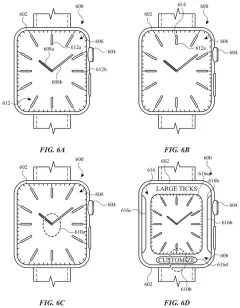
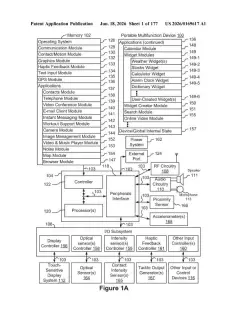
The drawings · 67 sheets
67 drawing sheets from US 2026/0236135 A1 · click any drawing to enlarge


Show the other 52 sheets


Sheets 61 to 67 are in the full USPTO filing.
More from Apple
All 748 Apple patents →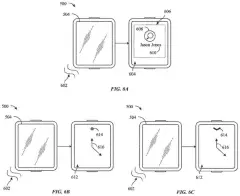
More in Software
All 816 Software patents →
Samsung
Samsung Patents a Clock Screen That Adjusts Your Medication Reminders Automatically
Samsung
Samsung Patents a System That Reads Your Screen to Control Connected Devices
Samsung
Samsung Patents a Two-Direction Lock Screen UI for Foldable Phones
Google