
Apple Patents a Fix for the Flickering Tinted Lenses in AR Headsets
Smart-tinted lenses in AR headsets can produce a subtle, irritating flicker when their control signal clashes with the rhythm of nearby lights. Apple's new patent describes a way to stop that from happening by constantly shuffling the signal's frequency.
What Apple's shifting-frequency tint driver actually does
Electronic tint layers in see-through AR headsets work by receiving a repeating electrical signal that holds the lens in a particular shade. The problem is that if the frequency of that signal is close to the frequency at which nearby lights (like fluorescent or LED bulbs) pulse, the two rhythms can collide and produce a visible shimmer. Your eyes pick it up even when you aren't looking for it.
Apple's patent describes a driver that never sits still on one frequency. Instead of locking in a fixed signal, it shuffles through a set of different frequencies over time, either randomly or on a preset schedule. Because no single frequency sticks around long enough to clash with an ambient light's pulse, the shimmer has no chance to build up.
The lens itself stays in the same tint state the whole time; only the electrical signal driving it changes. From your perspective, the shade looks steady, but the invisible flickering is gone.
… a driver that drives the tint layer using a drive signal, wherein the driver adjusts a frequency of the drive signal over time while the tint layer is in the first steady state.
Translation: The system constantly changes the electrical frequency powering the smart lens even when the tint level is not changing.
How the driver spreads its signal to kill flicker
The system has three main parts working together.
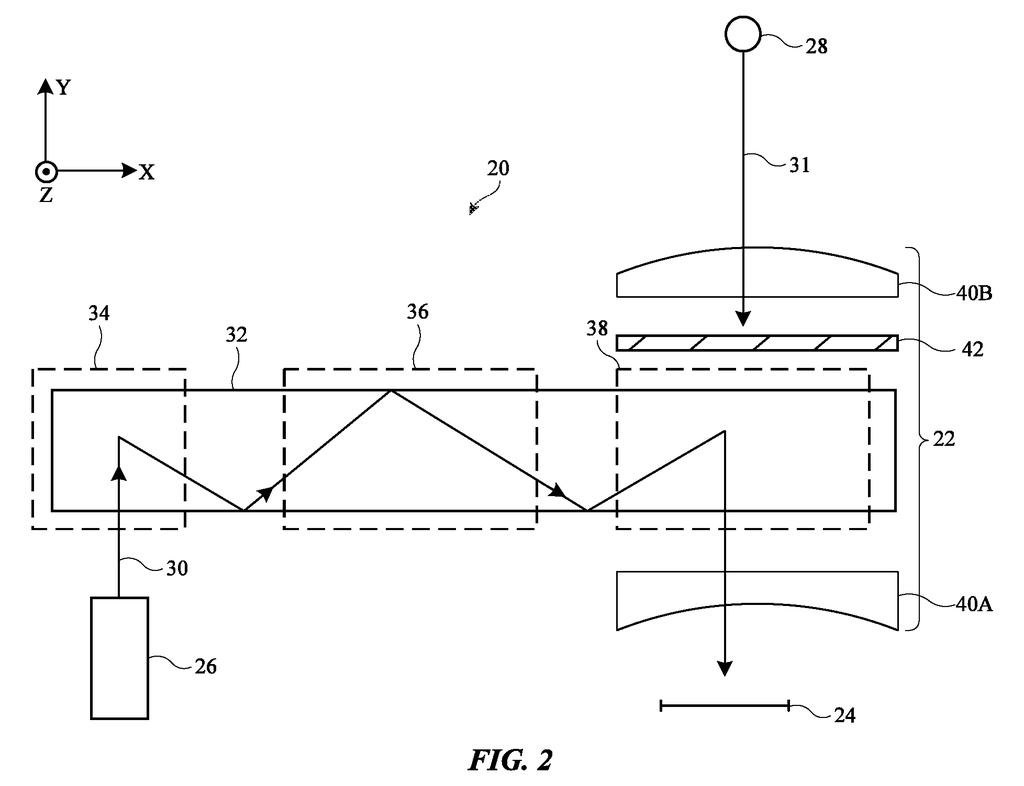
First, there is a tint layer inside the headset's lens assembly. This is an electronically switchable material that can be set to different levels of darkness to manage how much environmental light reaches your eye. It sits in what the patent calls a steady state, meaning it is holding a fixed shade rather than actively transitioning.
Second, a driver circuit sends a binary square wave (a signal that flips cleanly between two values at a regular rate) to keep the tint layer in that steady state. Normally such a driver would use one fixed frequency, but that fixed frequency can interact with the pulsing of ambient light sources, a phenomenon called beating (two repeating patterns at slightly different speeds producing a third, slower wobble that the eye sees as flicker).
Third, the driver applies spread-spectrum frequency modulation, meaning it cycles through a set of N different frequencies over time. The set can be stepped through randomly or on a predetermined schedule. Because the driver never dwells on any one frequency long enough for a sustained beat pattern to form with the ambient light, the perceived flicker is eliminated without changing the visual state of the lens.
Varying the first frequency may serve to mitigate flickering in the environmental light transmitted by the tint layer, such as in situations where the environmental light includes intensity modulations at a second frequency susceptible to beating with the first frequency.
Translation: Shifting this frequency prevents annoying visual strobing caused by the headset clashing with room lighting.
What this means for wearable AR comfort and usability
Flicker in a lens you are looking through all day is not a trivial annoyance. It causes eye strain and headaches, and for people with photosensitive conditions it can be a real barrier to using a device. In the context of a see-through AR headset, where the tinted lens is always in your field of vision, even mild shimmer becomes exhausting over time.
Apple's sustained push into AR optics and wearable display patents suggests the company is working through the fine details of making a headset people can actually wear for hours. A fix for electrically-driven flicker is exactly that kind of detail: invisible when it works, maddening when it doesn't.
This is the 39th Apple filing we've tracked on our Apple AR glasses watchlist since May, building on a patent for a three-chip wake-up system and one for virtual presentation venues.
Subtle flickering in a headset's see-through layer is the sort of discomfort that never announces itself. Users blame fatigue, or fit, or just decide the device isn't for them, without ever identifying the real cause. That silent dropout is one of the most expensive problems a wearable can have.
The cost is behavioral: a person who removes a headset after twenty minutes and doesn't put it back on is effectively a lost user, regardless of how capable the device is. Lighting conditions vary constantly in real homes and offices, and a tint layer that conflicts with common fluorescent or LED rhythms will cause problems for a large share of wearers in ordinary situations.
Varying the timing of the electrical signal so it never settles into a fixed rhythm addresses this directly, without requiring users to adjust their environment. The match between the size of the problem and the precision of the fix is what makes this worthwhile.
Get our take in your Top Stories
Liked this breakdown? Add Patentlyze as a preferred source on Google, and our plain-English take shows up more often in your Top Stories the next time Apple patent news breaks.
There are more where this came from
We read every patent application Big Tech publishes and send you the ones worth knowing. Plain English, free, every week.
The drawings
12 drawing sheets from US 2026/0254938 A1 · click any drawing to enlarge


Show the other 4 sheets


Want this weekly breakdown for a company we don't cover? Patentlyze Pro →
Be the first to weigh in