
IBM Patents a Self-Organizing System That Stops LLMs From Confusing Their Own Tools
When you give an AI assistant dozens of tools to choose from, it can get confused — reaching for the wrong one because two tools sound almost identical. IBM's new patent tries to fix that automatically, without a human having to rewrite every tool description by hand.
Why IBM's LLM tool-sorting patent actually matters
Imagine you're a manager with 50 employees, and several of them have nearly identical job titles. When you ask your assistant to route a task, they keep sending it to the wrong person. That's roughly the problem IBM is solving here — but for AI systems managing large libraries of software tools.
When a large language model (LLM) has access to dozens or hundreds of services — think APIs, databases, search tools — it navigates them using written descriptions. If two tools have descriptions that overlap too much, the model gets confused about which one to call. IBM's patent describes a system that automatically rewrites those descriptions to make each tool's identity clearer and more distinct.
The clever part is that the tools essentially talk to each other to negotiate their differences. Tools that are semantically too close together compare notes, and an LLM is used to redraft their descriptions so each one stands out. No human has to audit the whole library manually.
How IBM's semantic hyperspace reshapes tool descriptions
The patent describes a three-step process built around a concept called a semantic hyperspace — essentially a multi-dimensional map where every tool (called a microagent) gets placed based on how its description reads to an embedding model. Tools with similar meanings cluster together in this space.
Once the map is built, the system scans for clusters of microagents that sit too close together (meaning their descriptions are near-duplicates semantically). These are flagged as ambiguity risks — situations where the LLM routing decisions are likely to fail.
For each problematic cluster, the patent describes an intergroup communication step: the microagents within a cluster share context about what makes each service unique, and an LLM rewrites one or more of their descriptions to introduce clearer semantic separation. The updated descriptions get placed back into the hyperspace, and the map is regenerated — an updated semantic hyperspace.
Key components include:
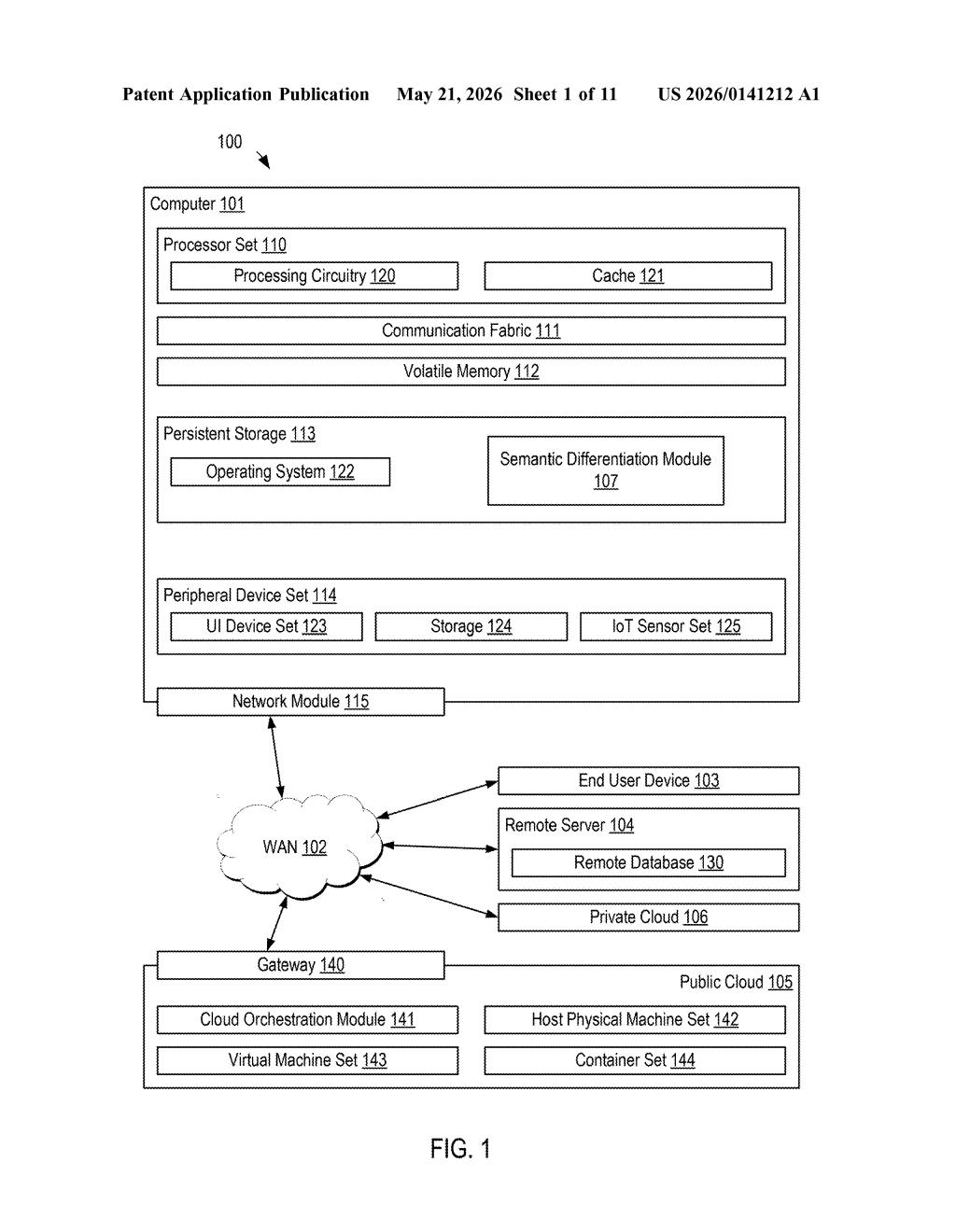
- A Semantic Differentiation Module that handles the mapping and clustering logic
- Microagent descriptions as the primary input/output (the text that tells the LLM what a tool does)
- An LLM used both to evaluate overlap and to generate improved descriptions
- Iterative refinement — the loop can presumably run again if new tools are added or descriptions drift back toward similarity
What this means for enterprise AI agents and tool sprawl
As enterprises pile more tools and APIs onto LLM-based agents, tool disambiguation quietly becomes one of the hardest operational problems. A model that misroutes calls to the wrong service doesn't just return a bad answer — it can trigger incorrect workflows, waste compute, or create compliance headaches. IBM is essentially proposing an automated librarian that keeps the tool catalog well-organized without constant human curation.
This is directly relevant to anyone building on frameworks like LangChain, IBM's own watsonx, or any agentic system where a model selects tools from a registry. If IBM embeds this into watsonx Orchestrate or a similar product, it could become a meaningful differentiator for large enterprises managing hundreds of internal services — exactly the customers IBM is courting.
This is a genuinely useful idea for anyone who has tried to maintain a large LLM tool registry and watched the model start making weird routing choices as the catalog grows. The 'let the tools negotiate their own descriptions' framing is elegant. Whether the patent holds up against prior work in embedding-based tool retrieval and automatic prompt optimization is a real question, but the application problem it addresses is concrete and the approach is well-scoped.
Get our take in your Top Stories
Liked this breakdown? Add Patentlyze as a preferred source on Google, and our plain-English take shows up more often in your Top Stories the next time IBM patent news breaks.
There are more where this came from
We read every patent application Big Tech publishes and send you the ones worth knowing. Plain English, free, every week.
Want this weekly breakdown for a company we don't cover? Patentlyze Pro →