Microsoft
Microsoft · AI / ML · Filed Dec 30, 2024 · USPTO published Jul 2, 2026 · Jul 2 release
Microsoft's New Patent Teaches AI Agents to Stop Talking Over Each Other
When you have dozens of AI agents running inside the same application, deciding which one should handle an incoming message is harder than it sounds. Microsoft is filing patents on how to do it well.
- Publication number
- US 2026/0189498 A1(US20260189498A1)
- Applicant
- Microsoft Technology Licensing, LLC
- Filed · Published
- Dec 30, 2024 · Jul 2, 2026
- Inventors
- Gokulraj Mohanasundaram, Juan Pablo Bottaro, Keren Baruch, Kevin Arcara, Shaban Halim, Raghavan Muthuregunathan, Karthik Ramgopal, Mathew H. Teoh, Jeffrey Wang
- Status when we published
- Examiner raised objections; the company can respond
- Document
- 20 claims
- US classification
- 709/238
- Examiner
- WAHID, MUSADDIQUE (Art Unit 2458)
What Microsoft's AI agent traffic cop actually does
Imagine a busy customer-service center where dozens of specialists sit side by side. When a call comes in, someone at the front desk has to decide instantly which specialist should take it, not by job title alone, but by knowing who has already been working on that customer's case. Microsoft's patent describes a system that does exactly this for software programs made up of multiple AI agents.
In a multi-agent application, several AI programs work in parallel, each handling a specific type of job. The patent covers a layer that watches all incoming events (messages, requests, data changes) and figures out which agent is the best fit to respond, based on what that agent has already been doing.
The key idea is that the routing decision isn't random or purely rule-based. It uses each agent's history to understand its current state, then sends the event to the agent most likely to handle it usefully. That agent then completes a follow-up task in response.
How the system matches events to agents using task history
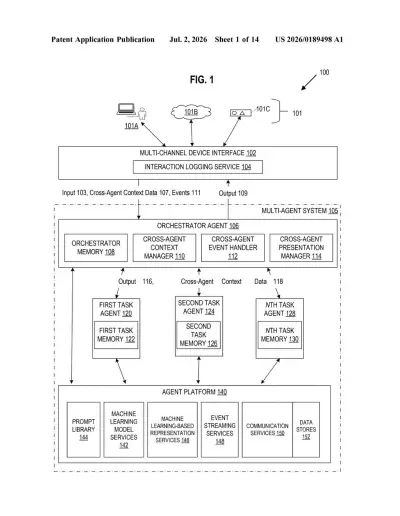
The patent describes a coordinator that sits above a pool of task agents (individual AI programs each responsible for a specific type of work) and manages an event stream (a continuous flow of incoming messages, triggers, or data updates).
The coordinator does three things in sequence:
- It watches the event stream for everything coming into the system.
- It checks each incoming event against the known state of each task agent, where that state is built from the agent's history of prior tasks, not just a static label.
- It routes the event to whichever agent's state best matches the event, and then collects that agent's output from the resulting task.
The phrase "state established using historical data" is the meaningful part here. Rather than a simple lookup table ("billing questions go to Agent B"), the system builds a richer picture of what each agent has been doing and what kind of work it is currently set up to handle. This lets the routing decision adapt as agents complete tasks and shift context.
The patent is written at a fairly abstract level, covering the coordination logic rather than the internal workings of any individual agent.
What this means for AI-powered business software
As companies build more complex AI workflows, they are moving from single-model chatbots toward multi-agent systems where many specialized AI programs collaborate. Microsoft's Azure and Copilot platforms are already pushing in this direction. The problem of orchestrating those agents cleanly, without events getting lost or routed to the wrong place, is a real engineering challenge, and this patent is a claim on one approach to solving it.
For you as an end user, the practical payoff would be AI-powered tools that handle context more reliably. An AI assistant that actually remembers which sub-system was working on your request, and hands off correctly instead of starting from scratch, is the goal this kind of infrastructure supports.
Source: US 2026/0189498 A1 at the USPTO (PDF). Full patent text and figures are in the official publication.
Get our take in your Top Stories
Liked this breakdown? Add Patentlyze as a preferred source on Google, and our plain-English take shows up more often in your Top Stories the next time Microsoft patent news breaks.
Add Patentlyze on Google
One click.
There are more where this came from
We read the new patents from Big Tech, carmakers and more and send you the ones worth knowing. Plain English, free, every week.
More from Microsoft
All 681 Microsoft patents →
More in AI assistant & agent
All 436 AI assistant & agent patents →
Salesforce
Salesforce Patents a Broker System for Spinning Up AI Agents Across Servers
Salesforce
Salesforce Patents Technology That Routes Tasks to the Correct Automated Assistant Instantly
Qualcomm
Qualcomm Patents a Way to Run Multiple AI Personalities in Parallel
Sony