
Qualcomm Patents a Way to Train AI Models Faster Over Noisy Wireless Networks
Training an AI model across thousands of phones simultaneously sounds chaotic — especially when half of them have weak signal. Qualcomm's new patent describes a system that groups devices by their connection quality and uses that structure to keep model updates accurate even when the wireless channel is a mess.
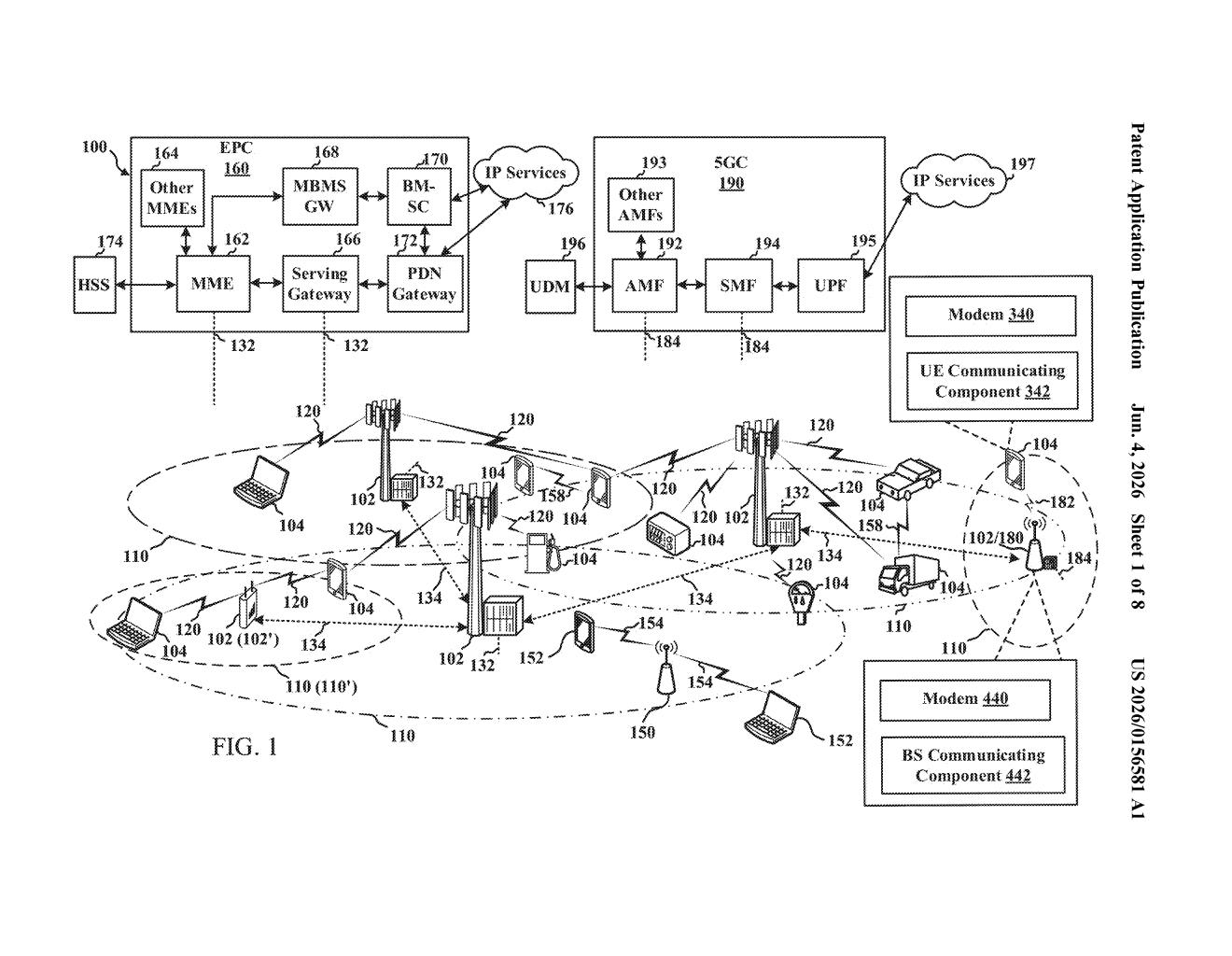
What Qualcomm's wireless AI training trick actually does
Imagine you're trying to crowdsource opinions from a stadium full of people, but some are whispering and some are shouting. If you just average everyone's voice, the loud ones drown out the quiet ones and your data is skewed. That's roughly the problem Qualcomm is solving here — but for AI training across phones.
Federated learning is a technique where many devices each train a tiny piece of an AI model on their own local data, then send their updates to a central server to be combined. The catch in wireless networks is that devices with weak signals send noisier, less reliable updates — which can corrupt the model. Qualcomm's approach sorts devices into groups based on their measured signal quality, then has each group transmit on its own slice of the wireless spectrum.
The receiving end — say, a base station — collects the combined signals from each group and normalizes them by power level, so every group's contribution is properly weighted. The result is a more accurate combined model update, even when some devices are sitting in a basement with two bars of signal.
How devices are grouped by signal strength to send model updates
The patent describes a protocol for over-the-air federated learning — a technique where devices don't send discrete digital packets, but instead transmit analog signals that naturally add together in the air, which is actually a feature rather than a bug. The base station receives the sum of all device signals at once, which is computationally efficient.
The key innovation is channel-aware UE grouping. UE stands for "user equipment" — basically any phone or wireless device. Instead of treating all devices equally, the system measures a signal metric (like received signal strength or channel quality) for each device and sorts them into groups, where each group covers a defined range of signal quality. Each group then transmits its neural network coefficient updates on assigned time and frequency resources (specific slots in the wireless spectrum).
On the receiving side, the apparatus:
- Collects combined analog signals from each UE group separately
- Normalizes each group's received signal by power (so strong-signal groups don't unfairly dominate)
- Aggregates the normalized updates into a single combined coefficient update for the neural network
The coefficient updates being transmitted here are the gradient or weight adjustments from local model training — the raw material that the central server uses to improve the shared AI model.
What this means for AI training on mobile and edge devices
Federated learning is increasingly important for AI that has to stay private — your phone trains on your data locally, and only model updates (not your actual data) leave the device. But making that work well over cellular networks at scale is genuinely hard, and noisy channels are a core unsolved problem. Qualcomm sits at the intersection of chipsets and wireless standards, so a patent like this is directly in their lane for next-generation base stations and 5G/6G edge AI deployments.
For you as an end user, the downstream effect is AI features that are more accurate and update faster — think predictive text, on-device voice recognition, or personalized health monitoring — without requiring your raw data to ever leave your phone. The grouping-by-signal-quality approach is a practical engineering detail, but it's the kind of thing that determines whether on-device federated learning actually works in the real world or remains a research demo.
This is a niche but legitimately useful piece of wireless systems engineering. Qualcomm isn't filing this for show — they build the modems and chips that would run exactly this kind of system in 5G and 6G base stations, so the IP has direct commercial relevance. It's not flashy, but channel-aware aggregation is exactly the kind of unglamorous problem that has to get solved before federated learning at scale ships in real networks.
There are more where this came from
We read every patent application Big Tech publishes and send you the ones worth knowing. Plain English, free, every week.
Want this weekly breakdown for a company we don't cover? Patentlyze Pro →