
Disney Files Patent for Security Cameras That Spot a Fall and Call for Help
A camera that sees a splash can't always tell a person from a dropped tool, so Disney's patent application has the system double-check its own guess against clues like who is reaching in and what it hears.
What Disney's fall-detecting camera system does
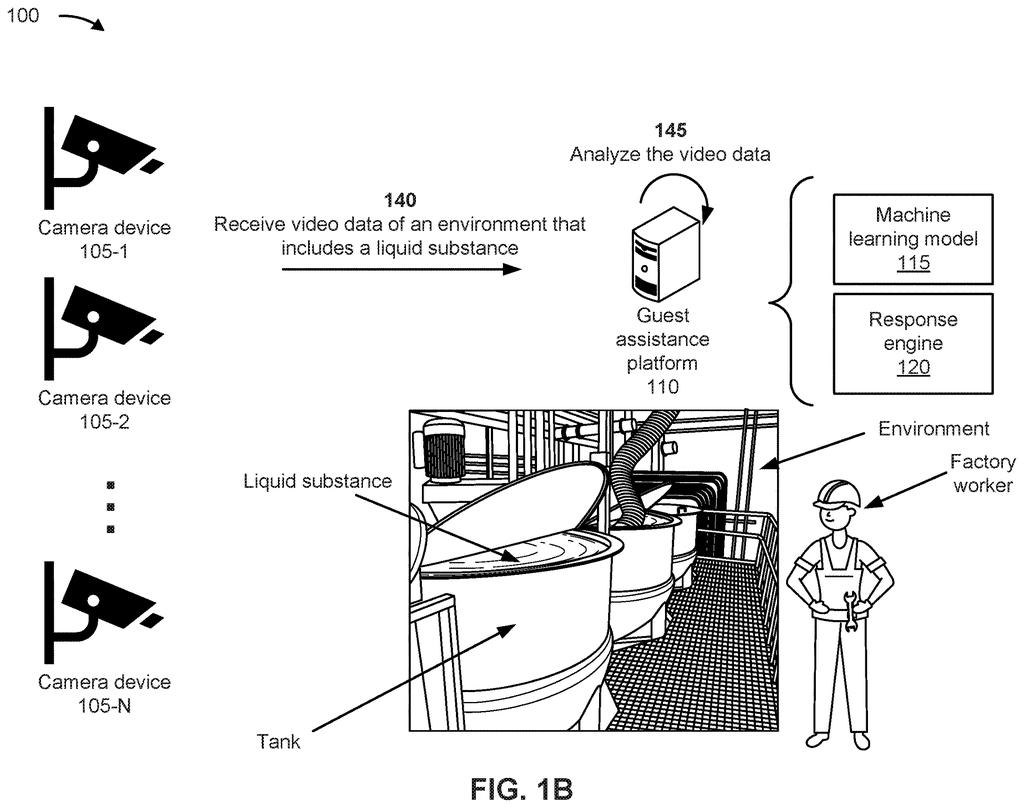
Today, security cameras mostly just record. A human operator flips between screens and has to notice, in the moment, that something has gone wrong. The patent's main example is a factory worker who falls into a deep tank of liquid, where the operator could miss it, or mistake a dropped object for a person and raise a false alarm.
Disney's filing has software watch the video instead. It spots a person, then notices when something happens to them, such as vanishing from view. The software also rates how sure it is. To firm up that rating, it hunts for backup clues: Did the person's belongings end up somewhere new? Did the headcount nearby drop? Did the microphone pick up a splash or a call for help?
If the rating clears a set bar, an alert goes to a device so someone can respond. You'd want that bar to be right: too low and people chase false alarms, too high and a real emergency slips through.
… generating, by the one or more processors, a notification to a client device to cause assistance to be provided to the first individual in response to determining that the modified measure of confidence satisfies the confidence threshold.
Translation: The system sends an alert for help once it is sure enough someone needs it.
How the system double-checks its own guess
The first independent claim covers a method. Software receives video of an environment, then uses a machine learning model (a program trained on many examples to recognize things) to find a person in one stretch of video and an event involving that person in a later stretch.
The model also produces a measure of confidence, a number for how likely its detection is right. The claim then adds confidence factors, extra clues that can raise that number. Any one of three counts:
- An item belonging to the person changes position relative to them, such as clothing or a tool ending up apart from its owner.
- The number of people in a region of the environment differs between the two stretches of video.
- Audio tied to the event, such as someone entering or a call for help.
These clues push the number up, giving a modified measure of confidence. If it meets a threshold (a cutoff set in advance), the system sends a notification to a client device (whatever screen or gadget receives the alert) so help can be provided.
Dependent claims add detail. The event can be a person in a liquid, fallen on the ground, or present in one stretch and absent in the next. The system can also estimate where the person is and send an assistance device (the description names a drone or buoy) once confidence passes a second, higher threshold.
What this means for camera-based safety alerts
The practical promise is speed and fewer false alarms. A person watching dozens of screens can miss a fall, and a system that checks its own doubt before alerting could cut down on wasted alerts as well. The filing's examples include a worker in a tank, someone falling from a docked boat into the water, and someone who has fallen on asphalt, concrete or dirt.
The description calls the system a guest assistance platform and says 'individual' can mean a guest, patron or passenger, but it names no Disney product or location. It also says the system can track people by traits like height and clothing without working out who they are, a detail that matters for any camera-based setup.
Disney's Enterprise AI eighth filing we've tracked since June follows earlier applications like one watching animals for alerts and one filtering crowd noise.
Almost all of this is software. The claims need cameras, a trained recognition model and a way to send an alert, and nearly every factory or dock already has the first and last pieces. The drone or buoy is an optional add-on that sits far down the road.
The harder part is accuracy where it counts. The filing itself says the model's confidence depends on light, weather, a blocked camera and how much training data it had, so each site would need its own tuning and its own cutoffs before anyone trusted an alert at 3 a.m.
The shortest route to a product is an alert that asks an operator to review a clip. That version needs no new hardware, and the filing already describes it. Whether anything like it ships under any name is a separate question, because the document names no product.
Get our take in your Top Stories
Liked this breakdown? Add Patentlyze as a preferred source on Google, and our plain-English take shows up more often in your Top Stories the next time Disney patent news breaks.
There are more where this came from
We read every patent application Big Tech publishes and send you the ones worth knowing. Plain English, free, every week.
The drawings
9 drawing sheets from US 2026/0321061 A1 · click any drawing to enlarge


Show the other 1 sheets

Want this weekly breakdown for a company we don't cover? Patentlyze Pro →
Be the first to weigh in