
Samsung Patents Earbuds That Can Record Two Different Users Separately
What if you handed one earbud to a friend for a quick translation session or interview — and your phone automatically knew to record both of you as separate voices? That's exactly the scenario Samsung's latest patent is designed to handle.
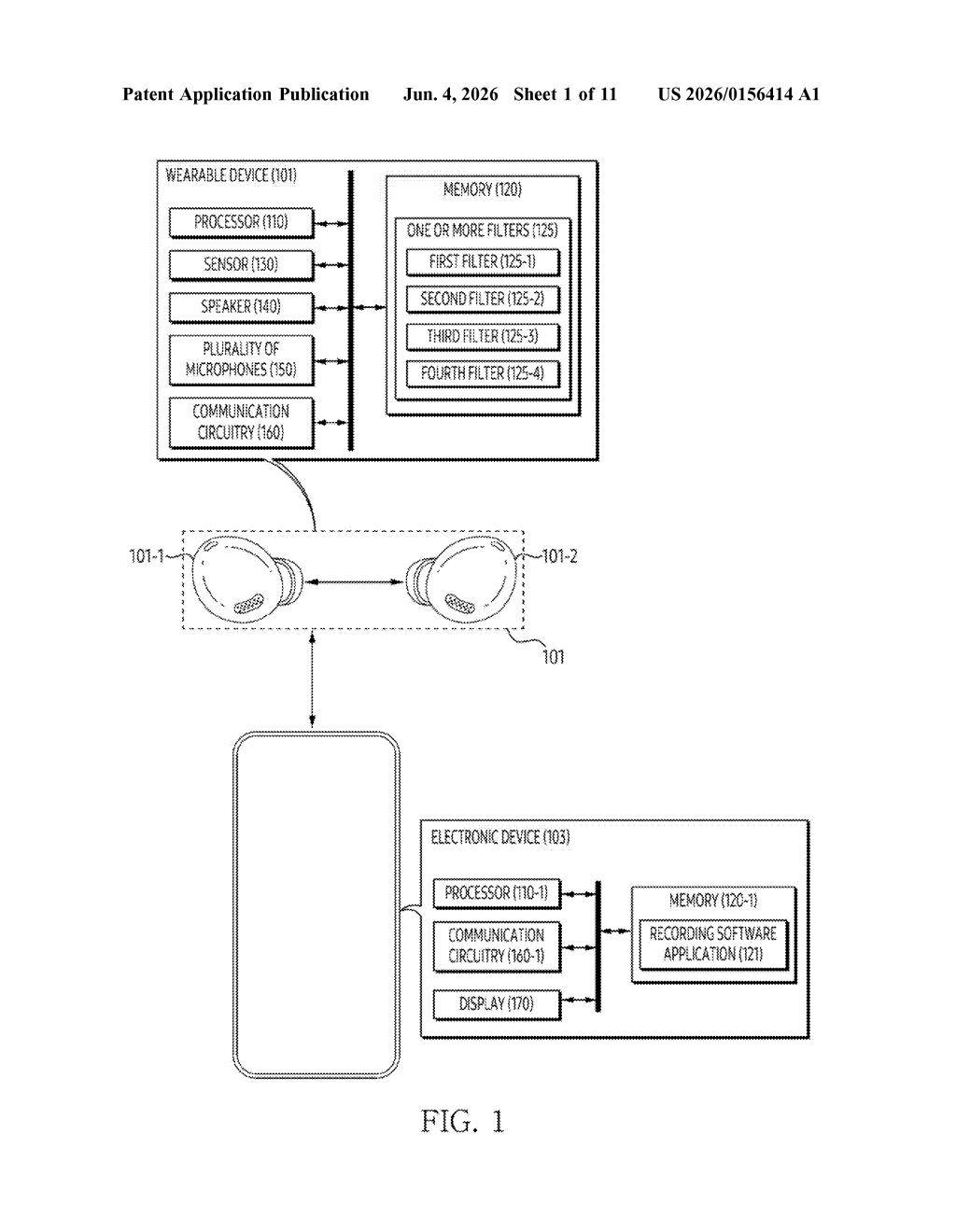
What Samsung's shared-earbud recording mode actually does
Imagine you're doing a quick interview and you hand one of your earbuds to the person you're talking to. Right now, your phone has no idea that's happened — it just keeps treating the audio like you're both on the same device. Samsung's new patent changes that.
The idea is that when two different people are each wearing one earbud from the same pair, the earbuds can detect that state and automatically switch into a special recording mode. Each bud picks up the voice of the person wearing it using the best-suited microphone on that side, applies a filter built for solo "mono" recording, and sends clean, separate audio back to your phone.
The phone (or another connected device) is the one telling the earbuds which filter to use — it sends a signal that sets the whole thing up. The result is a cleaner recording where each person's voice comes from their own earbud, rather than a messy mix picked up from across the room.
How the filter-switching system handles split-user audio
The patent describes a system where a paired set of earbuds — think Samsung Galaxy Buds — can be split between two wearers and still function intelligently as recording devices.
Here's the core mechanism:
- An external device (like a paired smartphone) sends a filter-selection signal to one or both earbuds, telling them which audio processing filter to apply.
- The earbud receiving the signal identifies which of its multiple onboard microphones is best suited for capturing a single voice in mono — important because earbuds typically have mics optimized for different tasks (noise cancellation, beamforming, wind rejection).
- It applies a "mono recording filter" — a processing mode specifically designed for capturing one person's voice clearly, as opposed to the usual stereo or active-noise-canceling configurations.
- The processed voice data is packaged and sent back to the phone as a second data signal.
The acceleration sensor (a motion detector built into most modern earbuds) likely plays a role in detecting the wearing state — whether the bud is in an ear or sitting loose — which helps the system know when the split-user scenario is active. The patent explicitly calls out the state where "the first earbud and a second earbud paired with the first earbud are worn by different users" as the trigger condition for this filter mode.
What this means for Galaxy Buds and shared listening
For everyday users, this could make earbuds genuinely useful as interview or translation tools — scenarios where passing one bud to another person is already common but audio quality suffers badly. Right now, that second bud is just picking up ambient sound on the wrong side of the room. A dedicated split-user recording mode would fix that.
For Samsung, this fits a broader pattern of making Galaxy Buds more capable as standalone productivity accessories, not just music players. The patent also hints at tighter integration between the earbuds and the host phone's intelligence — the phone decides which filter to load, which means the smarts live in the ecosystem, not just the hardware. That's a meaningful architectural choice for anyone thinking about how Galaxy AI might expand.
This is a genuinely practical idea that solves a real, specific annoyance — the 'I handed you one earbud and now the recording is terrible' problem. It's not flashy AI, but it's the kind of thoughtful system-level integration that separates a good audio ecosystem from a great one. Worth watching when Samsung's next Buds generation arrives.
There are more where this came from
We read every patent application Big Tech publishes and send you the ones worth knowing. Plain English, free, every week.
Want this weekly breakdown for a company we don't cover? Patentlyze Pro →