
Samsung Patents Indoor Navigation That Maps Your Location Using Wi-Fi Signal Patterns
GPS falls apart the moment you step inside a building. Samsung is working on a way to figure out exactly where you are indoors by comparing the Wi-Fi signals your phone hears right now to a pre-recorded map of what those signals should sound like from any given spot.
How Samsung's signal-fingerprint positioning actually works
Imagine you're trying to find a specific store inside a large airport or shopping mall. GPS usually can't help you there because satellite signals don't penetrate thick walls. Your phone has no reliable way to know whether you're at Gate B7 or standing by the food court.
Samsung's patent tackles this by turning Wi-Fi into a location tool. The idea is that every spot in a building has a unique "fingerprint" based on how strong the signal from each nearby Wi-Fi router or access point appears. Before you ever arrive, the system builds a map of those fingerprints. When you walk in, your phone scans the signals around it and compares what it hears to that stored map.
Once your phone finds a close-enough match, it knows where you are, because it knows exactly where the access point that matches your scan is physically located. No GPS required.
How the device matches its scan to the pre-mapped signal database
The patent describes a two-phase positioning system built around signal strength fingerprinting, a technique where the pattern of signal strengths from multiple access points at a given physical location is treated as a unique identifier for that spot.
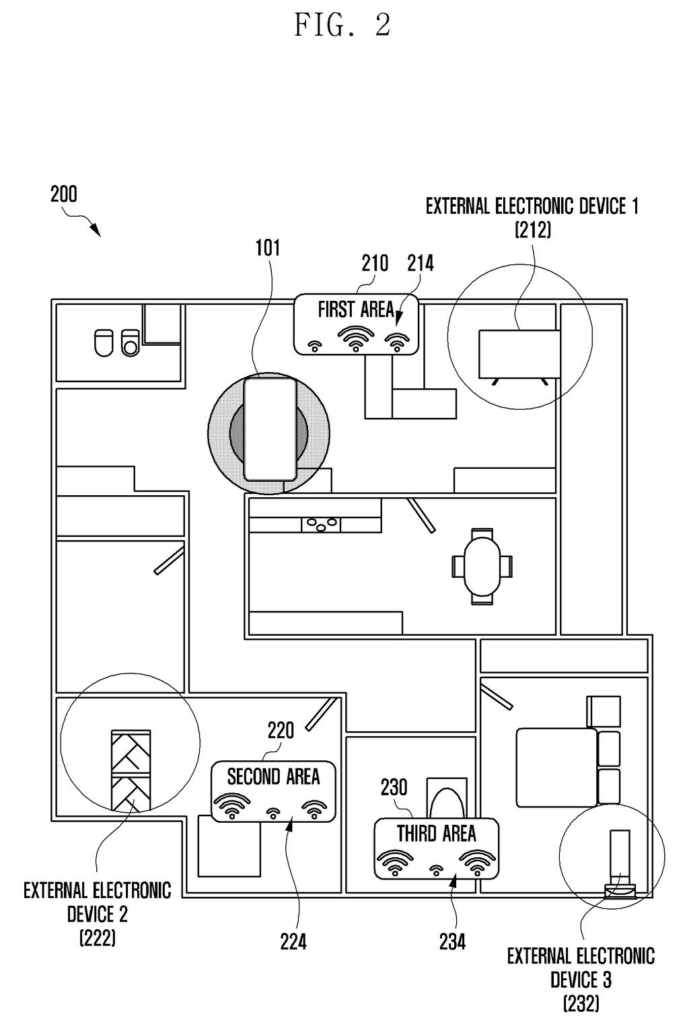
- Phase 1 (mapping): The system pre-collects what the patent calls "first signal strength patterns" for each of the external electronic devices (think Wi-Fi routers or similar access points) deployed across a space like an office, hospital, or transit hub. Each device's signal is recorded at known physical coordinates.
- Phase 2 (matching): When the user's device enters the space, it generates a "second signal strength pattern" by scanning the operating frequencies of those same external devices. This live snapshot captures how strong each nearby access point's signal appears at the user's current, unknown location.
- Phase 3 (lookup): The device compares its live scan against the stored map, finds the closest match, and infers its position from the known physical location of the matching access point.
The claim is broad enough to cover various wireless protocols, not just Wi-Fi, anywhere multiple fixed transmitters cover a defined space. The key innovation, as described, is the pattern-matching step that links a live scan to a pre-catalogued device location.
What this means for GPS-free indoor navigation
Indoor navigation is one of the last unsolved problems in everyday mapping. Google Maps and Apple Maps can get you to the right building, but once you're inside a multi-floor hospital or a sprawling convention center, they leave you on your own. A reliable, infrastructure-light fingerprinting system could change that without requiring expensive dedicated hardware like Bluetooth beacons or ultra-wideband chips in every ceiling.
For Samsung, this has obvious applications in Galaxy smartphones and smart home scenarios. If the system works well enough, your phone could guide you through an airport terminal or help a robot vacuum understand which room it's in, all by listening to signals that are already there.
Wi-Fi fingerprinting for indoor location is a well-established research area, so this patent is not breaking new conceptual ground. What matters here is whether Samsung's specific implementation, particularly the pattern-matching and scan-generation steps, is distinct enough to hold up. This reads more like Samsung staking a claim in a known space than revealing an entirely new approach. Still worth watching as a signal of where Galaxy device navigation features may be heading.
There are more where this came from
We read every patent application Big Tech publishes and send you the ones worth knowing. Plain English, free, every week.
The drawings
10 drawing sheets from US 2026/0222762 A1 · click any drawing to enlarge


Want this weekly breakdown for a company we don't cover? Patentlyze Pro →
Be the first to weigh in