
Sony Patent Uses Grayscale Data to Sharpen Event-Based Pixel Edges
Most camera sensors blur the edges of fast-moving objects. Sony is patenting a way to fix that by combining two completely different types of pixels on the same sensor chip.
How Sony's dual-pixel sensor keeps edges crisp on fast-moving objects
Imagine you're filming a car race, and every time a car speeds past, its outline goes blurry or streaky. That's a real limitation of how most camera sensors work: they capture light over a window of time, and motion during that window creates blur.
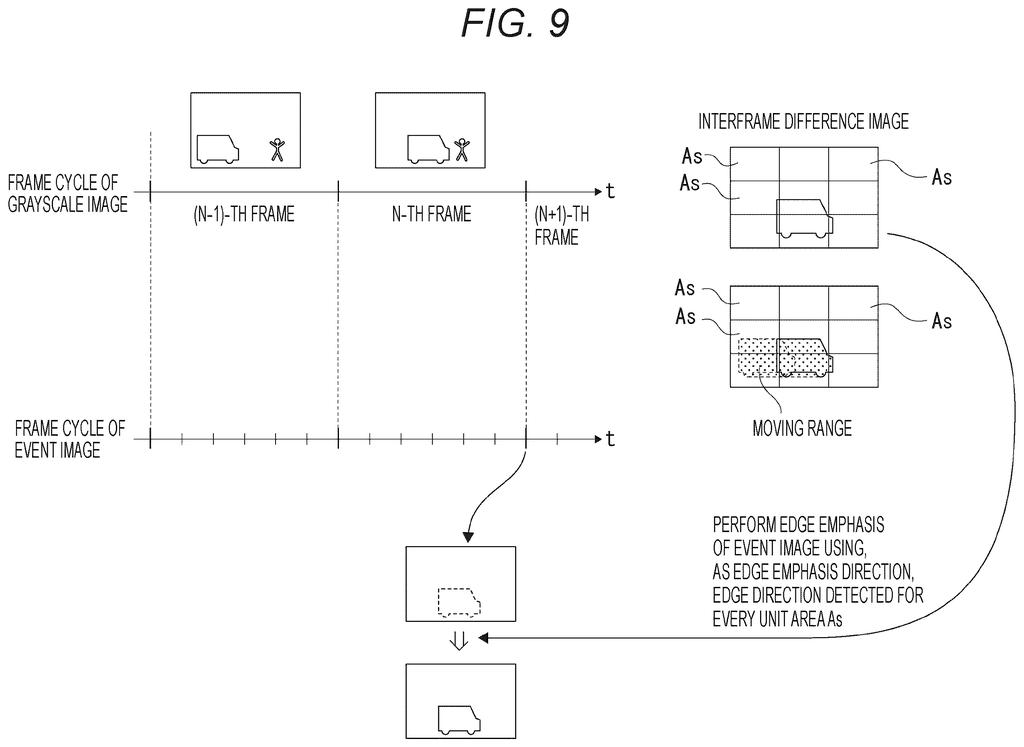
Sony's patent describes a sensor that uses two different kinds of pixels side by side. One type, called an event pixel, only fires when it notices a sudden change in light, like the edge of a moving object passing through its view. The other type captures a normal grayscale photo the way any regular camera does. The trick is that the grayscale image tells the system which direction an edge is running, and that directional information is used to clean up and sharpen the event pixels' output.
The result is a sharper, more accurate picture of where a moving object's edges actually are, even when things are moving fast. Think of it like using a ruler to guide a pencil stroke instead of drawing freehand.
How the event and grayscale pixel layers work together
The patent describes a signal processing device that takes input from two distinct pixel types built into the same sensor array.
- Event pixels work differently from normal camera pixels. Instead of capturing a full frame at regular intervals, each event pixel independently fires a signal the moment it detects a change in incoming light above a set threshold. This is sometimes called an event-driven or dynamic vision sensor approach, and it is extremely fast at detecting motion.
- Grayscale pixels work like a conventional camera, measuring the actual brightness at each point in the scene and building a standard image frame.
The core claim is an edge emphasis section that takes the raw event image and sharpens it using edge-direction information extracted from the grayscale image. In other words: the event pixels tell you that something is moving, but they can produce noisy or scattered output. The grayscale image tells you which way the edge of that moving object is oriented. Combining both lets the system produce a cleaner, directionally-aligned edge map.
This matters because event pixels on their own can produce patchy or scattered detections, especially along diagonal edges. Anchoring the sharpening to grayscale-derived edge direction helps correct that.
What this means for cameras tracking fast-moving subjects
Event-driven sensors are gaining serious attention in robotics, automotive cameras, and industrial machine vision because they can track motion far faster than conventional video cameras without generating massive amounts of data. The problem is their output is inherently noisy and hard to interpret without additional processing.
Sony is one of the world's largest image sensor manufacturers, supplying chips to Apple, other smartphone makers, and automotive camera systems. A patented method for cleaning up event sensor output using grayscale context could give Sony's sensors an edge in high-speed tracking applications, from driver-assistance cameras spotting fast-moving pedestrians to sports broadcasting systems. If you use a Sony-sensor-equipped camera or a smartphone with a Sony chip, this is the kind of low-level processing work that eventually shows up as sharper slow-motion video or more reliable object detection.
This is focused, unsexy engineering work on a genuinely hard problem in sensor design. Event cameras are a real and growing technology area, and the noise-cleanup challenge is a known bottleneck. Sony patenting a specific method for using grayscale edge direction to guide event image sharpening is a concrete, defensible technical contribution rather than a vague concept claim.
There are more where this came from
We read every patent application Big Tech publishes and send you the ones worth knowing. Plain English, free, every week.
The drawings
24 drawing sheets from US 2026/0220786 A1 · click any drawing to enlarge


Want this weekly breakdown for a company we don't cover? Patentlyze Pro →
Be the first to weigh in