
Qualcomm Patents a System That Lets Radar and Data Signals Share Wireless Airwaves
Your phone's cellular connection and a nearby radar sensor are fighting over the same wireless spectrum. Qualcomm's new patent describes a way for the radar to hand over airtime it isn't using so the network can move more data.
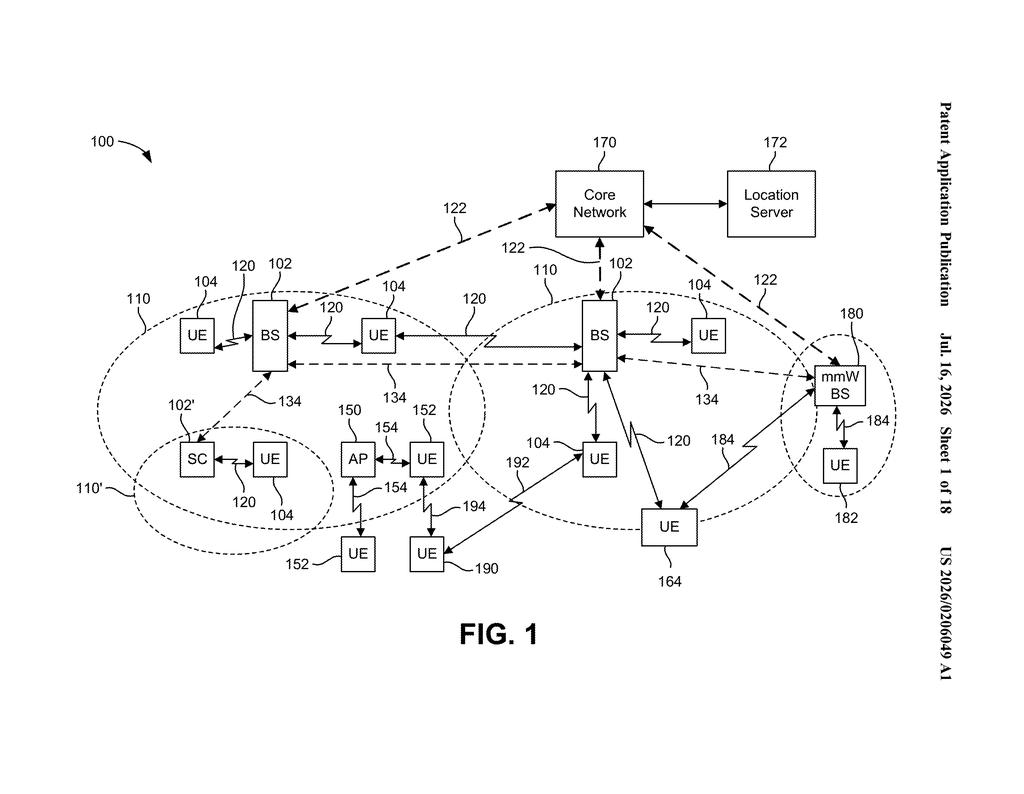
How Qualcomm's radar-sharing idea actually works
Imagine a radar sensor mounted on a road, a building, or a vehicle. It sends out radio pulses and listens for the echoes to detect objects nearby. But radar doesn't need to blast signals constantly. When there's nothing interesting to track, or when it already has a precise enough picture, it has spare radio capacity sitting idle.
Qualcomm's patent describes a system where the radar device checks how accurately it's doing its job. If its readings are good enough, it tells the cellular network: "I have spare airtime you can use for regular data traffic." The network then reassigns those radio resources to carry data instead, temporarily adjusting how the radar transmits or receives.
This matters because wireless spectrum is a finite, expensive resource. Getting radar sensors and cellular networks to share it automatically, without human re-tuning, is the kind of efficiency gain that becomes very important as more radar sensors go online in cities, cars, and factories.
How the radar receiver measures its own accuracy and renegotiates
The patent describes a feedback loop between a radar receiver (the device doing the sensing) and a network entity (think: a cellular base station or network controller).
Here's the sequence:
- The radar sends out a signal and catches the reflection off nearby objects.
- It calculates its own sensing measurement accuracy, essentially asking itself: "How precise is my current picture of what's out there?" It compares live measurements against its own performance benchmarks.
- If accuracy is already sufficient, the radar identifies sensing resources (specific radio frequencies and time slots) it doesn't need right now.
- It sends a control message to the network asking to repurpose those resources for data communications.
- The network responds with updated resource allocation signaling, adjusting transmission or reception parameters on the radar device for its next cycle.
The key technical detail is that the same physical radio hardware is doing both jobs. The patent covers reconfiguring the device's transmission and reception parameters on the fly, so it can flip between sensing mode and data-carrying mode within the same spectrum band.
What this means for connected vehicles and 5G networks
The practical stakes are about spectrum efficiency. Governments and carriers spend billions acquiring wireless spectrum, and every slice that goes unused is waste. As radar sensors become standard in self-driving vehicles, smart infrastructure, and industrial facilities, the overlap between sensing signals and cellular signals will grow into a serious engineering problem. Qualcomm's approach, if it works at scale, lets the same spectrum serve two purposes without requiring the two systems to be physically separate.
For you as a user, the benefit would be indirect: denser networks with more sensors don't have to mean slower data speeds or more spectrum congestion. This is also directly relevant to emerging standards like 5G NR with integrated sensing and communication, an area where Qualcomm is competing to set the technical baseline for how the whole industry does things.
This is a standards-positioning patent more than a consumer-facing invention. Qualcomm files these to establish prior art in areas where 5G and 6G spec bodies are actively writing rules. It's not exciting to read about, but being the company whose patent the spec cites is worth a lot. Watch for this to appear in 3GPP discussions on integrated sensing and communication.
There are more where this came from
We read every patent application Big Tech publishes and send you the ones worth knowing. Plain English, free, every week.
Want this weekly breakdown for a company we don't cover? Patentlyze Pro →
Be the first to weigh in