
Google
Google · AI / ML · Filed Nov 18, 2024 · USPTO published May 21, 2026 · May 21 release
Google Patents a System That Turns Ad Guidelines Into AI Training Data
Writing rules for what an AI is allowed to generate is one thing — turning those rules into usable training data is the hard, unglamorous part. Google's latest patent tackles exactly that.
- Publication number
- US 2026/0141247 A1(US20260141247A1)
- Applicant
- Google LLC
- Filed · Published
- Nov 18, 2024 · May 21, 2026
- Inventors
- Nargis Sakhibova, Sylvanus Garnet Bent III, Shahab Kamali, Max Moroz, Xinyu Li, Jessica Kim Au, Krishna V. Kottamasu, Nathan Christopher Kiraly
- Status when we published
- Waiting for an examiner
- Document
- 20 claims
- US classification
- 706/21
How Google auto-converts ad rules into labeled training sets
Imagine you work on a team that publishes thousands of ads a day, and every ad has to follow a long list of policies: no misleading claims, no certain images, no specific phrases. Normally, humans read those policies and then manually label example ads as 'passes' or 'fails' for each rule. That process is slow, inconsistent, and doesn't scale.
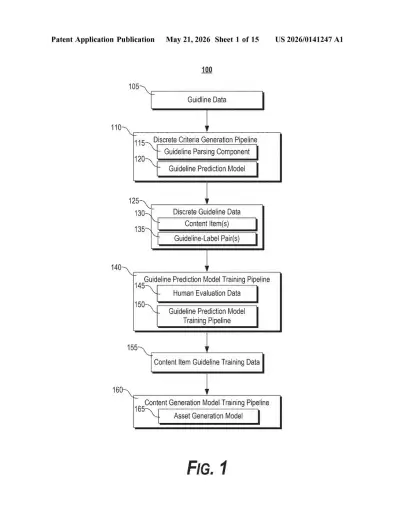
What Google is patenting is a pipeline that automates most of this work. An AI reads your policy document, breaks it into individual checkable rules, then scans an ad — text, image, or video — and stamps each rule with a 'satisfies' or 'violates' label. A human reviewer can then correct any label the AI got wrong.
Those corrected labels get folded back into a training dataset, which is then used to retrain the AI that actually generates ads. The loop closes: better-labeled data produces a better generation model, which produces ads that are more likely to pass the guidelines in the first place.
How the label-guideline feedback loop actually runs
The core of the patent is a human-in-the-loop data labeling pipeline with three distinct stages.
First, a machine-learned model reads guideline data — think a structured policy document — and parses it into a list of discrete, individually checkable criteria. Rather than treating 'our ad policy' as one monolithic blob, the system atomizes it into separate rules that can be evaluated one at a time.
Second, the system takes a piece of content (an ad asset: text copy, an image, or a video clip) and evaluates it against each discrete criterion, producing a label-guideline pair — essentially a row that says 'Rule #7: violates' or 'Rule #12: satisfies.' These pairs are surfaced to a human reviewer via a UI.
Third — and this is the key loop — if a reviewer disagrees with a label and corrects it, that correction is written into the training dataset. The system then uses this continuously updated, human-validated dataset to retrain the asset generation model (the AI that actually creates the ad content). The feedback from human corrections flows directly into making the generative model more policy-aware over time.
What this means for AI-generated ad content at scale
For Google, which runs one of the largest automated advertising systems on the planet, keeping AI-generated ad content aligned with constantly evolving policies is a real operational problem — not a theoretical one. This patent describes infrastructure for making that alignment self-improving: every human correction makes the next generation of ads slightly more compliant.
The broader implication is that this approach could generalize beyond ads to any domain where a company has written policies governing AI output — content moderation rules, brand guidelines, legal compliance checklists. If you're wondering how big platforms plan to keep generative AI output inside the lines at scale, this kind of automated guideline-to-training-data pipeline is a big part of the answer.
Source: US 2026/0141247 A1 at the USPTO (PDF). Full patent text and figures are in the official publication.
Get our take in your Top Stories
Liked this breakdown? Add Patentlyze as a preferred source on Google, and our plain-English take shows up more often in your Top Stories the next time Google patent news breaks.
Add Patentlyze on Google
One click.
There are more where this came from
We read the new patents from Big Tech, carmakers and more and send you the ones worth knowing. Plain English, free, every week.
More from Google
All 1,127 Google patents →
More in AI / ML
All 2,745 AI / ML patents →
Intel
Intel Patents a System That Splits AI Training Across Two Different Chip Types
Nvidia
Nvidia Patents a System That Reads Text Inside Images to Label AI Training Data
Nvidia
Nvidia Patent Explores Stacked Virtual Tokens to Transform AI Model Training
Qualcomm