
Patent: Google Files Technology That Helps AI Read Long Documents Faster
Every time a large AI model reads a sentence, it checks every word against every other word in the document. That gets expensive fast. Google's new patent describes a way to skip most of those checks without losing accuracy.
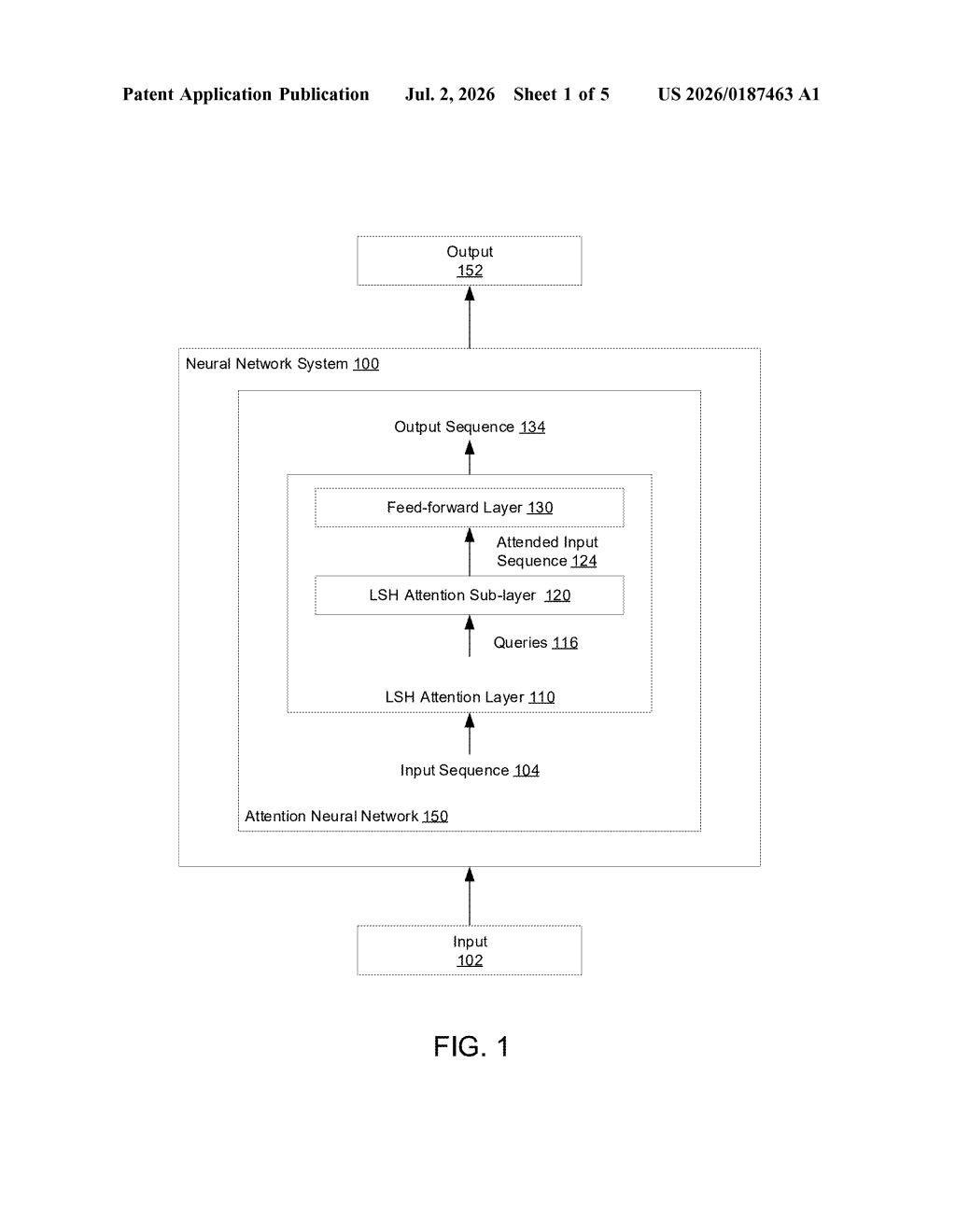
How Google's bucketing trick speeds up AI reading
Imagine you're at a party trying to find people who share your interests. Checking every single guest one by one would take forever. But if you sorted everyone into rooms by topic first, you'd only need to talk to the people in your room.
That's essentially what this Google patent does for AI language models. When a model reads text, it normally has to compare every word to every other word to figure out which ones are relevant to each other. For a long document, that balloons into an enormous number of comparisons. This patent describes a method that first sorts words into groups based on their mathematical similarity, then only runs those comparisons within each group.
The result is that the model can handle much longer pieces of text without the cost growing out of control. You'd notice this as a model that can read and reason about a long legal contract, a book chapter, or a lengthy email thread more quickly and with less computing power.
How LSH hashing creates and processes the segments
The patent covers a type of neural network layer called an LSH attention layer, where LSH stands for locality-sensitive hashing (a mathematical technique that assigns similar items the same short code, or "hash," so they end up in the same bucket).
Here's the basic flow:
- The layer receives a sequence of inputs, one for each position in the text.
- It converts each position into a "query" (think of it as a question: "what is this word related to?").
- It runs those queries through a hashing function that groups similar queries into segments.
- For each input position, attention (the mechanism that lets the model decide which other words to pay attention to) is only computed against positions in the same segment, not the entire input.
Standard attention mechanisms (the core operation inside Transformer-based models like GPT or BERT) have a cost that grows with the square of the input length, meaning doubling the text length quadruples the compute. LSH attention cuts that by limiting each position to attending only within its assigned group, making the cost grow much more slowly.
The patent also describes multiple "rounds" of hashing, so a word that landed in the wrong bucket in one round has a chance of being correctly grouped in another, which protects accuracy.
What faster attention means for long-document AI
The standard attention mechanism has been the main bottleneck preventing AI models from reliably processing very long documents. This patent directly targets that bottleneck. If you've ever watched an AI chatbot struggle or truncate a long paste of text, this is the kind of research that addresses why that happens.
Google has been working on this class of problem for years, and this filing is consistent with its broader push to make Transformer-style models practical at larger scales and lower costs. More efficient attention could mean cheaper inference for services like Google Search's AI overviews or Gemini when summarizing lengthy content, and it could make on-device AI more feasible where memory and compute are constrained.
This is not a flashy consumer-facing patent, but it's the kind of foundational infrastructure work that determines what AI products are even possible to build. The LSH attention concept has been around in research circles since at least the Reformer paper from 2020, and some of the named inventors overlap with that work, so this patent represents Google locking in intellectual property on a technique it helped pioneer. Whether that matters competitively depends on how broadly the claims hold up.
Get our take in your Top Stories
Liked this breakdown? Add Patentlyze as a preferred source on Google, and our plain-English take shows up more often in your Top Stories the next time Google patent news breaks.
There are more where this came from
We read every patent application Big Tech publishes and send you the ones worth knowing. Plain English, free, every week.
Want this weekly breakdown for a company we don't cover? Patentlyze Pro →