Google
Google · AI / ML · Filed Oct 11, 2024 · USPTO published Jul 2, 2026 · Jul 2 release
Google Combines Classical Physics and Machine Learning in New Weather Forecasting Patent
Google is patenting a weather model that doesn't force you to choose between old-school atmospheric physics and modern AI. It runs both at the same time, letting each handle the part it's best at.
- Publication number
- US 2026/0186166 A1(US20260186166A1)
- Applicant
- Google LLC
- Filed · Published
- Oct 11, 2024 · Jul 2, 2026
- Inventors
- Stephan Owen Steele Hoyer, Dmitrii Kochkov, Ian Langmore, Janni Yuval, Griffin Stuart Mooers, Peter Christian Norgaard, Jamie Alexander Smith, Michael Phillip Brenner
- Status when we published
- Waiting for an examiner
- Document
- 27 claims
- US classification
- 702/3
- Parent application
- National Stage Entry of PCT/US2023/035420 (filed Oct 18, 2023)(PCTUS2023035420)
What Google's hybrid weather forecasting system actually does
Imagine your weather app trying to predict rain five days from now. Traditional forecasting uses equations physicists worked out decades ago to model how air, heat, and moisture move around the planet. Those equations are reliable but incredibly expensive to compute. AI models, on the other hand, are fast, but they can drift off the rails when conditions get unusual because they learned from historical patterns, not physical laws.
Google's patent describes a system that runs both approaches simultaneously. A classical physics engine handles the large-scale atmospheric dynamics, the kind governed by well-understood equations about pressure and wind. At the same time, a neural network handles the messier, smaller-scale physical processes like clouds, rain formation, and turbulence that are notoriously hard to model with equations alone.
The two outputs get combined at every time step as the forecast moves forward into the future. The idea is that you get the dependability of physics where physics works well, and the pattern-matching power of AI where the equations fall short.
How the physics solver and neural network divide the work
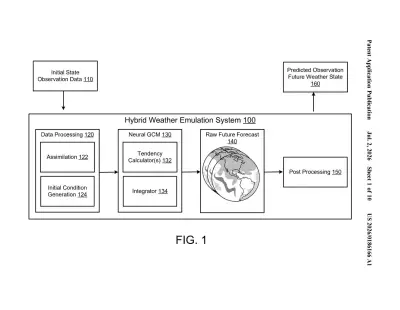
The system takes in observation data (temperature, pressure, humidity, wind speed at various altitudes) describing the current state of the atmosphere. It first encodes that snapshot into an internal representation the model can work with.
From there, the model steps forward through time. At each step, it runs two processes in parallel:
- A numerical solver that applies the primitive equations of the atmosphere (the classical differential equations governing large-scale fluid dynamics on a rotating planet) to calculate dynamical tendencies, meaning how the big physical variables want to change.
- A physical tendency neural network that takes the same internal representation and outputs physical tendencies, capturing the effects of sub-grid processes like convection, precipitation, and radiation that are too small or complex to model cleanly with equations.
Both sets of tendencies are combined and applied to update the internal representation. This loop repeats across many time steps. At the final step, the model decodes the representation back into a human-readable weather forecast.
The architecture is sometimes called a neural general circulation model (Neural GCM), a reference to the traditional general circulation models that have anchored meteorology for decades. The neural network here isn't replacing the physics engine; it's acting as a correction layer on top of it.
What this means for the future of weather prediction
Pure AI weather models like Google's own GraphCast have made headlines for beating traditional forecast centers on benchmark tests. But critics point out that purely data-driven models can produce physically inconsistent outputs, predicting temperature profiles or wind patterns that would violate basic atmospheric laws. A hybrid approach that keeps the physics engine in the loop could address that criticism while still capturing the speed advantages of neural networks.
For everyday users, better forecast models mean more accurate predictions beyond the three-day window where forecasts currently tend to degrade. For Google, it also represents a serious infrastructure bet: Google DeepMind has been competing directly with national meteorological agencies and private firms like The Weather Company for influence over how the world does weather prediction.
Source: US 2026/0186166 A1 at the USPTO (PDF). Full patent text and figures are in the official publication.
Get our take in your Top Stories
Liked this breakdown? Add Patentlyze as a preferred source on Google, and our plain-English take shows up more often in your Top Stories the next time Google patent news breaks.
Add Patentlyze on Google
One click.
There are more where this came from
We read the new patents from Big Tech, carmakers and more and send you the ones worth knowing. Plain English, free, every week.
More from Google
All 1,127 Google patents →
More in AI simulation
All 193 AI simulation patents →
Microsoft
Microsoft Patent: Two Coordinated Programs Help Computers Understand Object Locations
Disney
New Disney Patent Teaches 3D Image Software Where to Send Light Rays
Nvidia
Nvidia Patents a Way to Fill Terrain Gaps Around 3D Objects in Simulations
Microsoft