
Google Patents an AI That Reads Heart-Monitor Data by Rhythm and Pulse Rate
Google is filing patents in cardiac AI, and this one takes an unusual approach: instead of feeding a raw heart-monitor signal into a model all at once, it teaches the AI to separately understand the slow waves and the fast waves.
What Google's frequency-focused ECG model actually does
Imagine your doctor hands you a printout of your heartbeat, that wavy line on graph paper. Some of those waves are slow and broad, others are sharp and quick. They all carry different medical clues, and a doctor trained to read ECGs knows which part of the wave to look at for which condition.
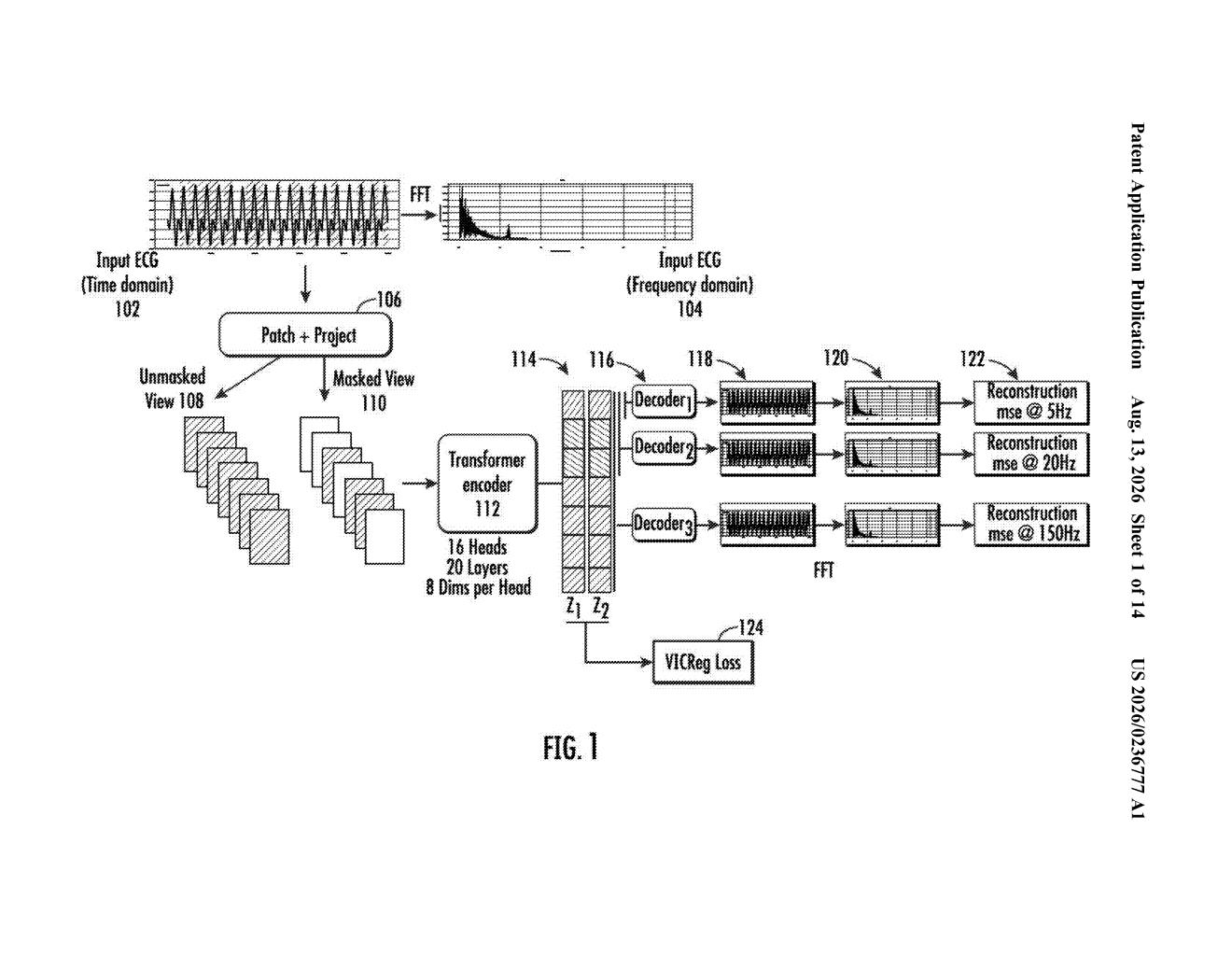
Google's patent describes a system that teaches an AI to do the same thing, but automatically. The model breaks the ECG signal into different frequency bands (think of it like separating the bass from the treble on a stereo), then stores what it learns from each band in a separate slice of its internal memory. A second model reads that organized memory and produces a prediction, like flagging an irregular rhythm or estimating a health risk.
The result is an AI that, in theory, reasons about your heart signal the way a specialist does: not as one undifferentiated blob of data, but as a set of distinct patterns that each mean something different.
a machine-learned encoder model configured to process an input electrocardiogram to generate, as an output of the machine-learned encoder model, at least a portion of a latent representation of the input electrocardiogram …
Translation: The system uses an AI model to turn raw heart data into a complex digital map that highlights hidden patterns.
How the encoder splits an ECG into frequency sub-bands
The system has two learned components working in sequence.
The encoder model takes in a raw ECG waveform and compresses it into a latent representation (a compact numerical summary the computer can work with). The key design choice is how that summary is organized: it is divided into multiple groups of numbers, each group responsible for capturing information from a different frequency sub-band of the original signal. Low-frequency sub-bands capture slow cardiac cycles; high-frequency sub-bands capture fine details like the sharpness of a QRS complex (the tall spike you see on any ECG trace, which reflects ventricular contraction).
The prediction model then reads that structured latent representation and outputs a clinical prediction. The patent does not restrict this to a single task, so the same framework could in principle support rhythm classification, disease risk scoring, or other downstream uses.
The core claim is that organizing the internal representation by frequency, rather than letting the model figure out its own arbitrary organization, produces a more useful and interpretable encoding. It is an architectural constraint imposed during training, not a post-hoc analysis step.
- Encoder compresses raw ECG into grouped numerical dimensions
- Each dimension group maps to a specific frequency band
- Prediction model reads those organized groups to produce an output
- The structure is baked into training, not added after the fact
Provided are computing systems and methods that can enhance the analysis and interpretation of electrocardiograms (ECGs) by employing a machine-learned model to generate latent representations of ECGs that encode frequency-based information contained in the ECG.
Translation: Google is using machine learning to better interpret heart monitor readings by analyzing the specific frequencies of the pulse.
What this means for AI-powered cardiac screening
ECG interpretation is one of the most active areas in medical AI right now, partly because ECG hardware is everywhere (hospitals, smartwatches, consumer patches) and partly because reading an ECG well still requires years of specialist training. A model that can screen for problems automatically at scale would be genuinely useful, especially in parts of the world where cardiologists are scarce.
The frequency-structured approach Google is patenting here trades flexibility for interpretability. By forcing the model to sort what it learns by frequency band, engineers can inspect which frequency ranges matter most for a given prediction, which makes the system easier to audit and, in a medical context, easier to trust. The cost of that constraint is that the model cannot freely mix frequency information if doing so would improve accuracy. Whether that trade is worth it depends heavily on how big the accuracy penalty turns out to be in practice, something the patent text does not quantify. Readers following Big Tech patent news in the medical AI space will recognize this filing as part of a broader pattern of companies trying to make neural networks explainable enough to satisfy clinical and regulatory scrutiny.
The frequency-decomposition approach is a deliberate architectural bet, and it carries a real cost: constraining how the model organizes its internal memory can hurt raw predictive performance compared to a model left to find its own optimal representation. Google is accepting that potential accuracy penalty in exchange for a representation that engineers and clinicians can inspect and reason about. That trade is defensible in a high-stakes medical context where a black-box answer is hard to defend to a regulator or a patient, but it will only look wise if the accuracy hit turns out to be small enough to preserve clinical usefulness. That is the number this patent does not provide, and it is the only number that will determine whether this architecture ships in anything real.
There are more where this came from
We read every patent application Big Tech publishes and send you the ones worth knowing. Plain English, free, every week.
The drawings
14 drawing sheets from US 2026/0236777 A1 · click any drawing to enlarge


Want this weekly breakdown for a company we don't cover? Patentlyze Pro →
Be the first to weigh in