
Google Patent Reveals AI That Learns User Preferences Without Accessing Personal Data
Google has filed a patent for a way to personalize its AI recommendations without the server ever receiving your personal data. Your phone does its own piece of the training, and only a privacy-protected summary gets sent back.
How Google's split AI keeps your data on your phone
You're scrolling your Google feed and every result feels oddly well-suited to you, but you've always wondered what Google actually knows about your habits to make that happen. The standard approach is for your activity data to travel up to a server, get folded into a big model, and come back as recommendations. This patent proposes splitting that work in two.
Your device handles the part of the AI that learns from your data locally, things like what you click, skip, or search. The server handles a separate chunk of the model trained on broad, non-personal data. The two halves talk to each other by exchanging compact summaries called embeddings, not the raw data itself. Before your phone sends its update back, the system adds deliberate statistical noise to the numbers, a technique called differential privacy, so Google can't reverse-engineer what you actually did.
The end result is that your recommendations improve based on your real behavior, but the server never sees your browsing history, your clicks, or your searches in identifiable form. It's a way to get personalization without the privacy cost that usually comes with it.
… the respective client-side updates comprise differential privacy noise; aggregating, by the server system, the respective client-side updates received from the plurality of client devices to generate an aggregated client-side update …
Translation: The system adds mathematical noise to user data to protect privacy before combining it with information from other devices.
How the server and phone train each other without sharing raw data
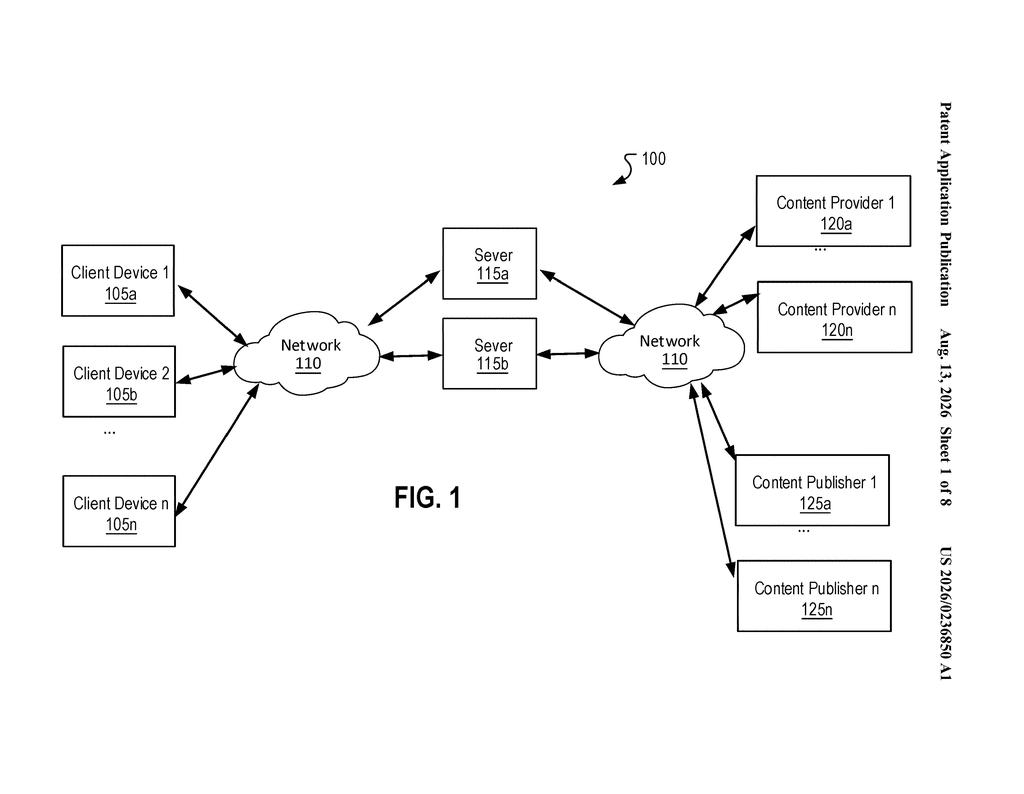
The patent describes a split machine learning architecture where a single recommendation model is divided into two cooperating halves: one lives on Google's servers, one lives on your phone.
The server's half is trained on general, aggregated data that doesn't belong to any specific user. It generates what the patent calls a server-side embedding, a compressed numerical representation of broad patterns (think: what topics are trending, what content categories are popular globally). That embedding is sent to client devices, but crucially the raw server-side training data that produced it stays on the server.
On the device, a client-side model takes that server embedding and combines it with your local activity data to generate its own embedding. The device then uses both embeddings together to update its own model weights. Once that local update is computed, the device transmits only the updated embedding back, not your underlying data.
Before transmission, the updates are wrapped in differential privacy noise (mathematically calibrated random interference that prevents anyone from deducing individual data points from the aggregate). The server pools updates from many users, strips away the noise through aggregation, and uses the result to improve its own half of the model. The two halves then alternate training rounds, each updating while the other's parameters are held fixed, a technique called alternating optimization.
receiving, first data including a current server-side embedding generated by the server-side machine learning model, wherein the first data received from the server does not include any server-side data used in generating the current server-side embedding …
Translation: The user's device receives a model update without ever seeing the raw data that the company used to create it.
What this means for your Google feed and data privacy
For you as a user, the practical payoff is a feed or search experience that adapts to your habits without requiring Google to store a detailed log of your individual behavior on its servers. This matters most in contexts where people are sensitive about what their activity reveals, health searches, political content, financial queries. The privacy protection here is structural, not just a policy promise: the architecture physically prevents the server from receiving your raw data in the first place.
The filing also signals where Google sees the regulatory pressure going. Data minimization rules in the EU and elsewhere are pushing companies toward approaches that limit how much personal data can be centralized. This kind of on-device training, combined with differential privacy, is one engineering response to that pressure. Google's AI and privacy new Big Tech patents show a steady push toward systems where personalization and data protection are built into the model design itself, not bolted on afterward.
The reader-impact case for this patent is straightforward: better recommendations without handing over more of your data is a concrete improvement in the daily trade-off you make every time you open a Google product. What makes this filing more than incremental is the combination of structural data separation and differential privacy in one training loop. Most privacy-in-AI efforts pick one or the other. Applying both simultaneously, and doing it in a way that still lets personalization improve over time, is the harder engineering problem this patent is trying to solve.
There are more where this came from
We read every patent application Big Tech publishes and send you the ones worth knowing. Plain English, free, every week.
The drawings
8 drawing sheets from US 2026/0236850 A1 · click any drawing to enlarge


Want this weekly breakdown for a company we don't cover? Patentlyze Pro →
Be the first to weigh in