
New Patent Fixes Eye Contact Problem in Hybrid Video Meetings
In almost every video call, everyone looks slightly off, staring at the screen instead of into the camera. Google's new patent describes a system that synthetically corrects that, generating a unique camera angle for each remote participant so everyone appears to be looking directly at each other.
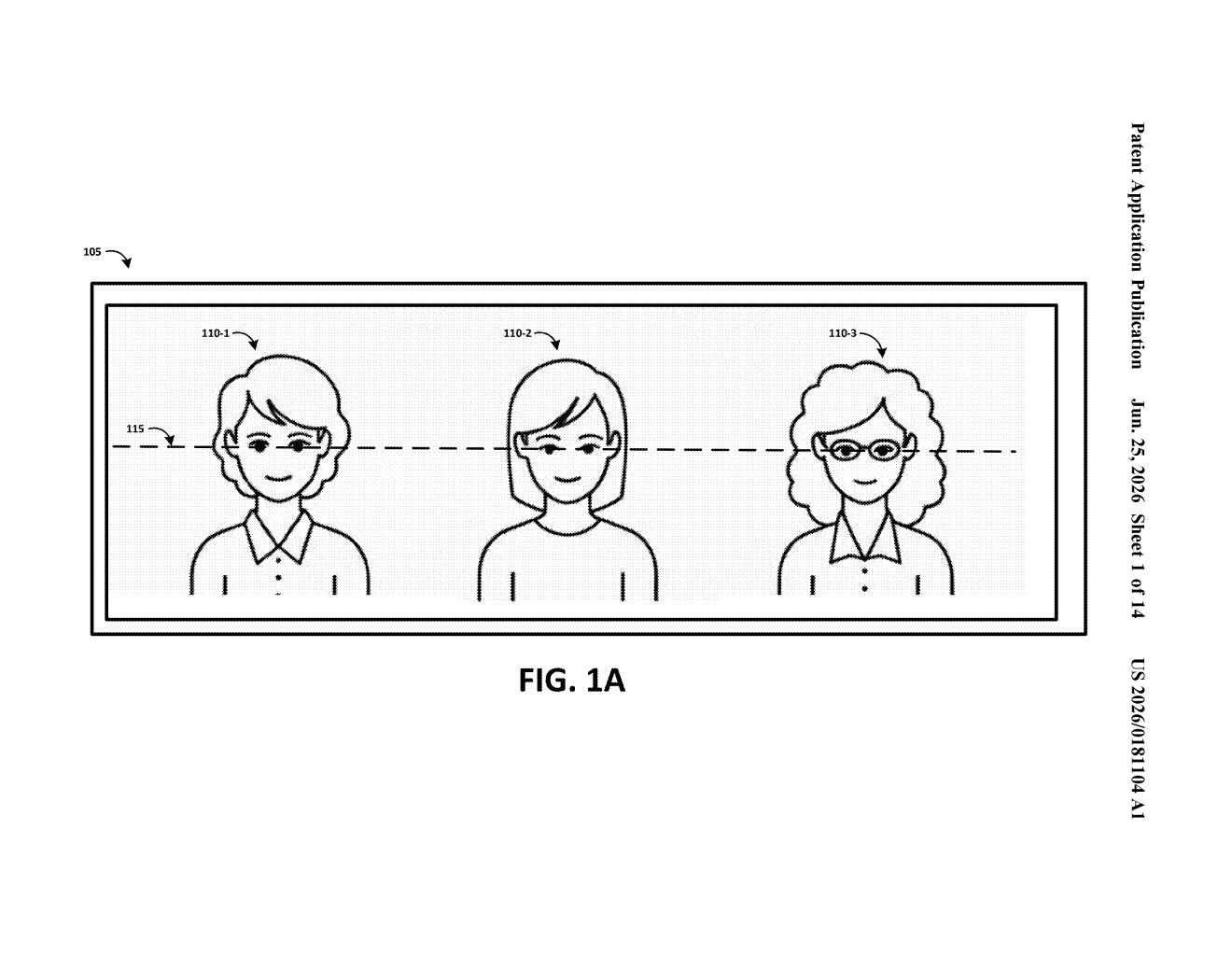
Why eye contact in video calls is so hard to fake
Imagine you're in a conference room with two colleagues joining remotely on a big screen. One person is displayed on the left side of the screen, another on the right. When you look at the person on the left, your eyes drift away from the camera, so to the person on the right, it looks like you're not paying attention to them. That awkward mismatch is one of the most persistent annoyances in hybrid meetings.
Google's patent describes a system that would fix this by creating a custom video feed for each remote participant. Instead of sending everyone the same camera shot of you, the system figures out where each remote person appears on your screen and generates a version of your video that looks like the camera was positioned right at their eye level and angle. So to each remote participant, it appears that you're looking directly at them.
The system also scales and shifts each remote participant's video so that their eyes always land at the same height on your screen, making the whole room feel more like a natural, in-person conversation.
How Google synthesizes a separate camera angle per remote participant
The patent outlines a multi-step process happening in real time during a video conference.
First, the system receives video feeds from all remote participants and resizes and repositions each one so that their eyes align with a consistent height on the local display. This means a tall person and a short person would both appear with their eyeline at the same vertical position on screen, keeping the visual geometry consistent.
Next, the system places each remote participant at a specific spatial location on the display, essentially giving each person a fixed spot in a virtual room layout.
The core innovation is in what happens with the local participant's camera. Rather than sending one video feed to everyone, the system calculates a virtual camera viewpoint for each remote participant individually. That virtual viewpoint is derived from where that specific remote participant appears on the screen. The idea is that if you are looking at someone who appears in the upper-left corner of your display, a camera positioned at that exact angle and height would make it look like you were making direct eye contact with them.
- The system generates a separate outgoing video stream for each remote participant
- Each stream reflects the synthetic camera angle aligned with that participant's on-screen position
- Each tailored stream is transmitted only to the corresponding remote participant
What this means for hybrid office meetings going forward
The eye contact problem has been undermining video calls since their invention, and it gets worse in hybrid settings where one person's gaze has to span multiple remote faces spread across a screen. A system that corrects this per-participant, in real time, could make large hybrid meetings feel genuinely more natural.
For Google, this fits neatly into its Google Meet product line and its ongoing investment in meeting-room hardware like the Google Meet Series hardware kits. If this capability shipped in a future version of Meet, it would give Google a concrete differentiator over Zoom and Microsoft Teams in the enterprise hybrid-meeting market, where eye contact and presence are increasingly selling points.
This is a genuinely useful idea solving a real, widely felt problem. The technical approach, generating a separate synthesized video stream per remote participant, is non-trivial and suggests Google has done some serious engineering work here. Whether it requires bespoke camera hardware or can run on existing setups will determine how widely it actually ships.
There are more where this came from
We read every patent application Big Tech publishes and send you the ones worth knowing. Plain English, free, every week.
Want this weekly breakdown for a company we don't cover? Patentlyze Pro →