
Google Patent Speeds Up Video Encoding With Parallel Compression Threads
Compressing video is slow, sequential work. Google's new patent describes a way to split that work into parallel lanes that still share what they learn from each other, cutting encoding time without sacrificing prediction quality.
What Google's parallel video compression patent actually does
Imagine a factory assembly line where each worker has to wait for the person before them to finish before they can start. That's roughly how traditional video compression works: each chunk of a video frame waits for the previous chunk to be processed. It's accurate, but slow.
Google's patent describes a way to run many of those compression steps at the same time, across multiple "lanes" of work called wavefronts. Each lane covers a different slice of the video frame, and as one row finishes, it passes along what it learned (a statistical model of which patterns are most likely) to the next row in its lane. That keeps the predictions sharp even though the work is happening simultaneously.
The practical upside is faster encoding, especially for high-resolution video, without needing to throw out the smart probabilistic guessing that keeps file sizes small. It's the kind of plumbing improvement that makes your YouTube stream start faster or your video call look sharper.
How wavefronts share probability data across tile rows
The patent describes a video encoding method aimed at increasing parallelism (doing more compression work at the same time) without losing the accuracy benefits of probability modeling, which is how modern codecs predict what data is redundant and can be compressed away.
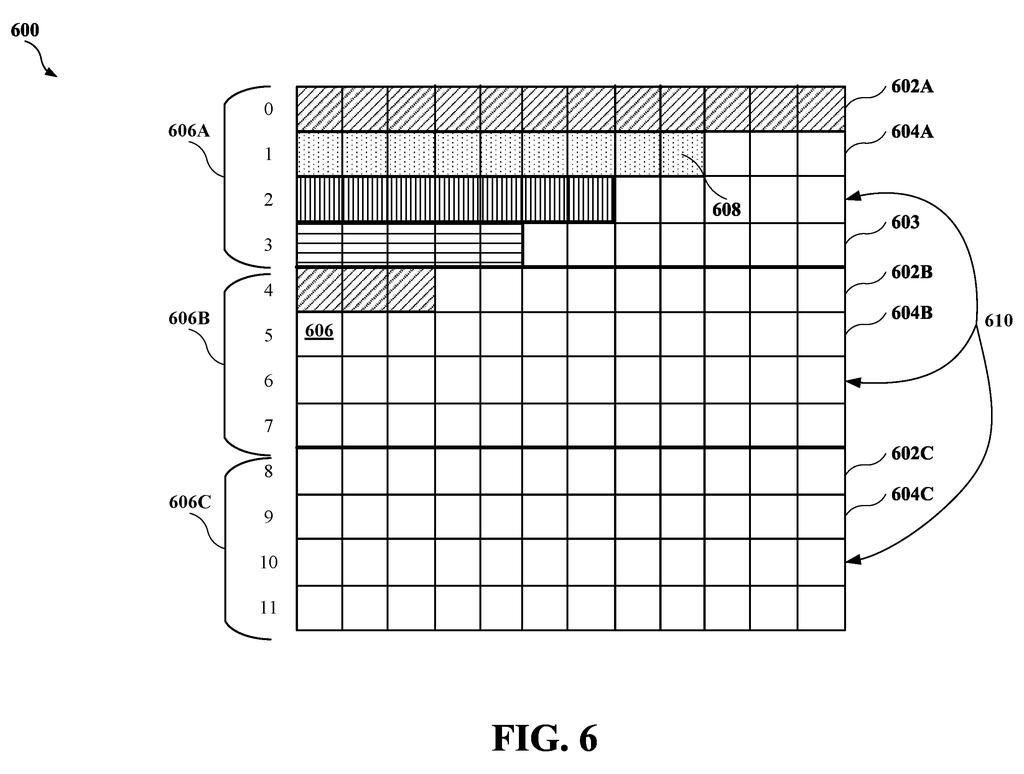
A video frame is divided into a tile, and that tile's rows are organized into two overlapping structures:
- Wavefront groups: consecutive rows of coding units (small blocks of pixels), treated as a local sequence.
- Wavefronts: rows drawn at regular intervals across all the wavefront groups, so row n from every group belongs to the same wavefront and can be processed together.
For each wavefront, a probability model is initialized at the start. As each subsequent row is encoded, the model updates using the "finishing probability values" from the row just above it. This means each parallel thread benefits from what the previous row learned, even though multiple threads are running simultaneously.
The key tension in parallel video encoding is that probability models normally depend on prior data, making parallelism hard. This approach threads the needle by structuring which rows share which probability states, allowing parallel execution while preserving meaningful statistical context.
What this means for video streaming and real-time encoding
Faster video encoding is a big deal for anyone who uploads, streams, or video-calls at scale. Google runs YouTube, Google Meet, and large parts of the cloud transcoding infrastructure that other services rely on. Shaving encoding time directly affects how quickly videos appear online and how much compute those operations cost.
This patent sits in the codec-optimization layer that rarely makes headlines but has real downstream effects on video quality, latency, and server costs. If this approach makes it into a production encoder like VP9 or AV1, you might notice faster upload processing on YouTube or crisper real-time video in Meet, even if Google never announces it by name.
This is unglamorous but genuinely useful infrastructure work. Parallel entropy coding has been a known hard problem in video compression for years, and the specific approach here, threading probability state through wavefront-structured rows, is a real engineering contribution rather than a paper patent. Whether it ships into a Google product soon depends on codec roadmaps, not patent timing, but it's worth tracking.
There are more where this came from
We read every patent application Big Tech publishes and send you the ones worth knowing. Plain English, free, every week.
The drawings
9 drawing sheets from US 2026/0222602 A1 · click any drawing to enlarge


Want this weekly breakdown for a company we don't cover? Patentlyze Pro →
Be the first to weigh in