
Google Patents a Method for Tracking Eye Movement Through Reflection Changes
Instead of scanning your entire eye many times per second, Google's new patent describes a camera that only wakes up when something in your eye's reflection actually changes. It's a small shift in approach that could mean a lot for battery life in AR headsets.
What Google's reflection-based eye tracking actually does
Imagine a security camera that records footage 24 hours a day versus one that only saves a clip when it detects motion. The second camera uses far less storage and power. Google's new patent applies that same idea to tracking where your eyes are looking inside a headset or AR glasses.
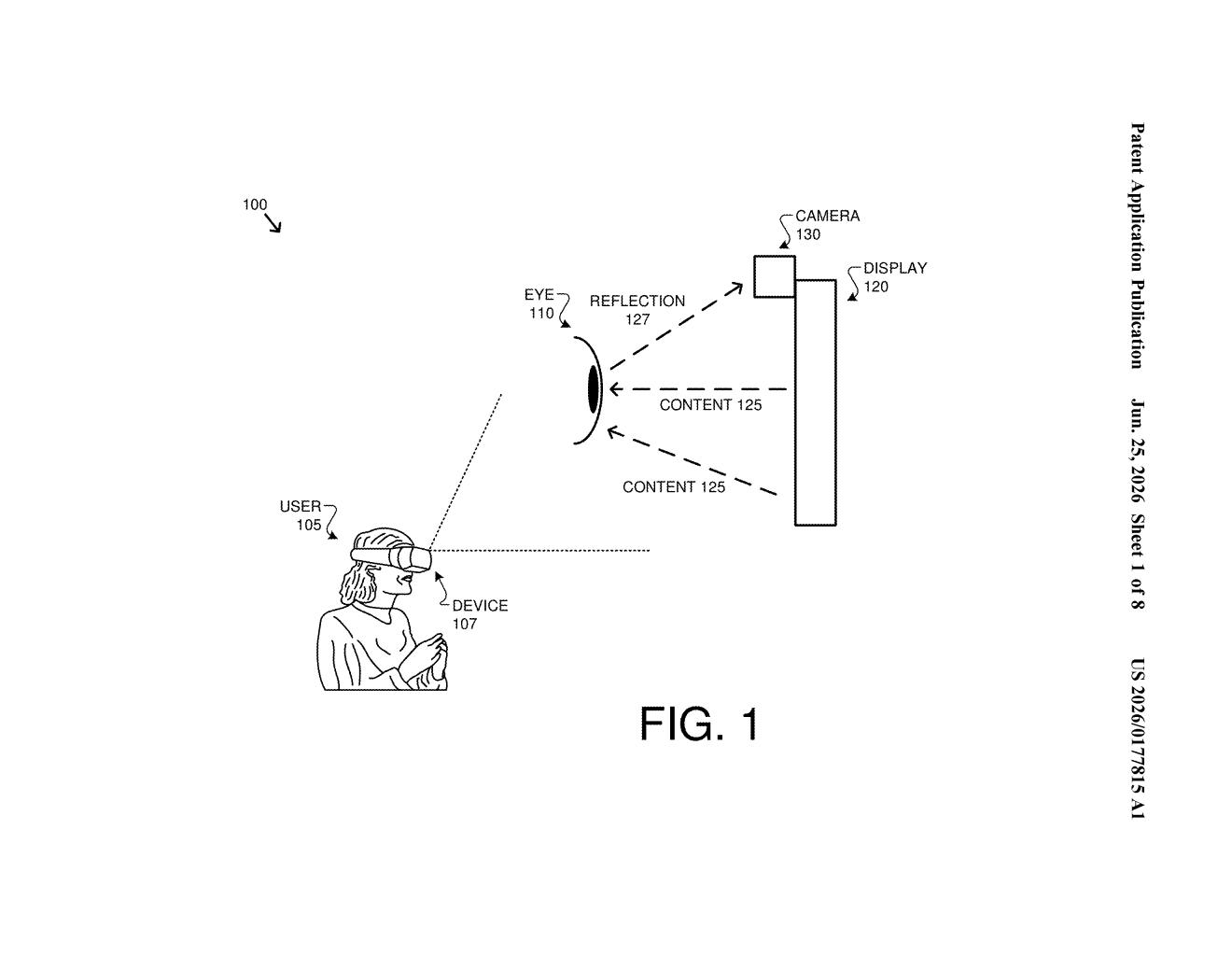
Instead of constantly photographing your whole eye at a high frame rate, the camera in this system watches the tiny reflection on your eye's surface and only reacts when individual pixels in that reflection change. A shift in your gaze causes the reflection to shift, and those changed pixels are the signal the system needs.
The result is a leaner, more efficient way for a device to know where you're looking, without burning through the battery to do it.
How the camera catches pixel changes in your eye's surface
The patent describes an eye-tracking system built for extended reality (XR) devices, meaning headsets or glasses that overlay digital content on the world or display fully virtual environments.
A small camera inside the device points at the user's eye and captures the reflection off the eye's surface (the cornea). Rather than processing every full frame of that reflection continuously, the camera is designed to operate asynchronously, meaning it doesn't work on a fixed clock tick. Instead, it flags individual pixels the moment they change, rather than waiting for the next scheduled frame.
This approach is borrowed from a sensor design called an event camera (sometimes called a dynamic vision sensor), which fires signals per pixel on change rather than capturing uniform snapshots. The patent applies that concept specifically to reading eye movement:
- Content is shown on the XR display.
- The camera watches the reflection on the eye.
- When pixels in that reflection shift, the system interprets the change as eye movement.
- Direction and magnitude of the gaze shift can then be inferred from which pixels changed and by how much.
The claim is intentionally broad, covering the core method rather than a specific hardware implementation.
What this means for AR glasses and eye-tracking efficiency
Eye tracking is already built into headsets like the Meta Quest Pro and Apple Vision Pro, and it's central to how those devices render graphics efficiently (a technique called foveated rendering, where only what you're directly looking at gets drawn in full detail). The problem is that eye tracking is power-hungry, and power is the one resource AR glasses have the least of.
If Google can track your gaze by monitoring only the pixels that change rather than processing full frames, it could cut the computational and energy cost of eye tracking significantly. That matters most for lightweight AR glasses, where a bulky battery isn't an option. This patent fits squarely into the kind of low-power sensing work you'd expect from a company building toward thinner, all-day-wearable AR hardware.
This is a genuinely sensible piece of engineering for the AR space, not a flashy concept. Event-camera-style sensing for eye tracking is a logical answer to one of the real bottlenecks in wearable AR: you need to know where the user is looking, but you can't afford the power budget to find out. Google filing this now, as competition in AR glasses heats up, is a meaningful signal about where their hardware priorities are.
There are more where this came from
We read every patent application Big Tech publishes and send you the ones worth knowing. Plain English, free, every week.
Want this weekly breakdown for a company we don't cover? Patentlyze Pro →