
Google Patents a Faster Way to Crunch Private Data Without Exposing It
Google wants computers to work on your private data without ever seeing it, and it has a speed trick: rebuild the data for a split second inside a sealed-off piece of a chip, do the slow part there, then scramble the answer again.
What Google's sealed-chip privacy patent does
Ever tried to keep a secret by tearing a note in half and handing each piece to a different friend? Neither friend can read it alone, but together they can. Google's patent builds on that idea to protect private data while computers do math on it.
The catch is that doing math on torn-up data is slow. Sorting a list, for example, takes many rounds of back-and-forth between the computers holding the pieces. So Google's filing adds a sealed-off area inside a chip, a bit like a vault with no windows. The pieces go in, get glued back together, and the slow work happens in there.
Then the vault tears the answer back into pieces and sends them out again. Nobody outside ever sees the whole thing, but the answer comes back faster. The filing's main example is picking which ad to show you based on private information about your interests.
… combining, within the TEE, the first secret share of the one or more data items and the second secret share of the one or more data items to reconstruct a plaintext value of each of the one or more data items …
Translation: The secure hardware temporarily reassembles the hidden pieces back into readable data to do the math.
How the secret pieces get rebuilt inside the chip
The patent combines two privacy tools. Secure multi-party computation (MPC) has a group of servers, often run by different companies, each hold one random-looking piece of the data, called a secret share, and work out answers together without any server seeing the original. A trusted execution environment (TEE) is a walled-off area of a processor where code and data are isolated from everything else on the machine.
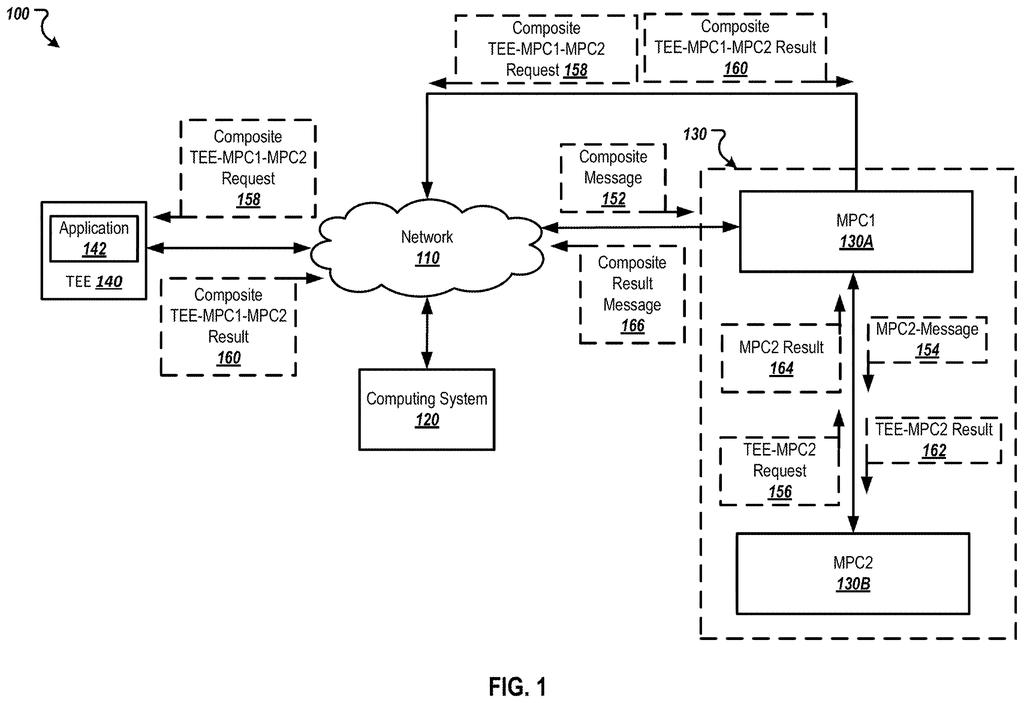
MPC is safe but slow, especially for jobs like sorting that need many round trips between servers. The main claim hands those jobs to an application inside the TEE:
- The TEE receives one secret share from each MPC server.
- Inside the TEE, it combines the shares to rebuild the plain values.
- The application runs its computation, such as sorting or a vector dot product (multiplying two lists of numbers and adding up the results).
- It splits the output into fresh shares and sends one back to each server.
Dependent claims add refinements. One server can bundle both shares into a single message, with the other server's share encrypted so the bundler cannot read it. The TEE can also prove its identity with encrypted credentials, with a chain of trust that starts at the CPU maker. The description's main example sorts the bids for candidate ads and returns only the position of the winner.
Methods, systems, and apparatus, including computer programs encoded on a computer storage medium, for using cryptography, secure MPC, and a TEE to perform computations in ways that preserve data privacy and protect the security of data of each party that is involved in the computation process.
Translation: This system uses special encryption and secure hardware to crunch numbers without letting anyone see the underlying data.
Why faster private ad matching matters to you
For you, the payoff would be invisible. Ads and other content get picked in milliseconds when a page loads, and this design aims to keep your interests hidden from the servers doing the picking while still keeping up with that speed. Your device splits your group memberships into pieces, so no single server sees them in plain form.
For Google and its partners, the appeal is a privacy promise that does not cost speed. The description says the pairing keeps the same privacy guarantees as MPC alone while using fewer processor cycles and less network traffic. The sealed area is only as trustworthy as the chip behind it, which is why the filing includes a check and a fallback to MPC alone if the check fails.
Google's 64th filing we've tracked since May builds on earlier applications like a locked startup vault and searchable but private cloud storage in our keeping data on your device watchlist.
Slow privacy protection tends to get switched off. Splitting data into pieces keeps it safe, but ad systems have milliseconds to decide, and sorting torn-up data takes many rounds of messages between computers.
Moving the slow steps into a sealed chip area matches that problem well, because it targets the exact operations, sorting and multiplying lists of numbers, that cause the delay. The price is trust: you now depend on chip hardware to keep the vault sealed, and the filing admits as much by adding a credential check and a fallback.
The problem is narrow, and so is the fix. For anyone building private ad systems it is a sensible answer, and for everyone else it will stay invisible.
Get our take in your Top Stories
Liked this breakdown? Add Patentlyze as a preferred source on Google, and our plain-English take shows up more often in your Top Stories the next time Google patent news breaks.
There are more where this came from
We read every patent application Big Tech publishes and send you the ones worth knowing. Plain English, free, every week.
The drawings
5 drawing sheets from US 2026/0352439 A1 · click any drawing to enlarge


Want this weekly breakdown for a company we don't cover? Patentlyze Pro →
Be the first to weigh in