
Google's New Patent Fills Every Ad Slot on a Page Without Exposing Who You Are
Google is patenting a way to fill every ad slot on a page in a single trip — without any one server ever seeing the full picture of who you are. It's a notable engineering answer to one of the ad industry's biggest post-cookie headaches.
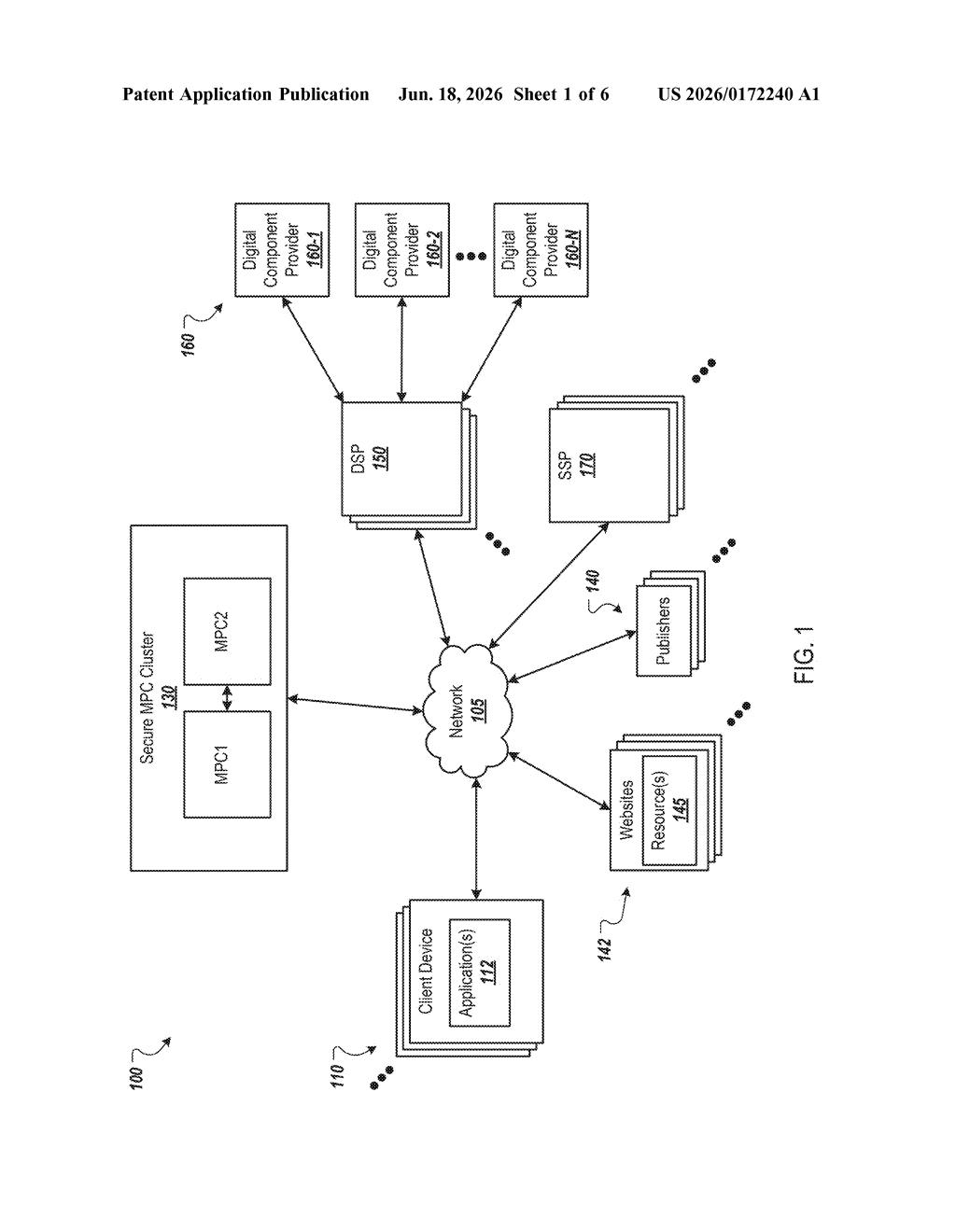
How Google wants to pick ads without seeing your data
Imagine a webpage with five ad spaces to fill. Today, each slot often triggers its own behind-the-scenes request that can quietly build a profile of you. Google's new patent tries to change that by bundling all five requests into one — and running the whole selection process through a system where no single computer ever sees your complete personal data.
The trick is something called multi-party computation: your data gets split into encrypted fragments, and multiple separate servers each work on a piece of the puzzle. They collaborate to pick the right ad for each slot without any one of them ever holding enough information to identify you directly.
For you, the experience looks the same — ads appear on the page. But underneath, Google is arguing this approach is both faster (one round-trip instead of many) and more private (your data stays scrambled throughout).
How the MPC computers split, score, and select ads secretly
The patent describes a system built around multi-party computation (MPC) — a cryptographic technique where multiple independent computers jointly compute a result without any single participant learning the underlying private inputs. Think of it like splitting a safe's combination across three people: all three have to cooperate to open it, but none of them alone knows the full code.
Here's the flow the patent lays out:
- A user's browser sends one composite request — a single bundled message — to a lead MPC server. Embedded in that request are secret shares of data identifying which audience groups the user belongs to (e.g., "sports fan," "in-market for laptops"). These shares are encrypted fragments; alone, they reveal nothing.
- The lead server works with one or more partner MPC servers to evaluate candidate expressions — essentially scoring formulas — for every ad competing for every slot on the page, all at once, using the encrypted fragments.
- As each slot gets filled, the system updates the remaining scoring formulas so the same ad can't win two slots, and the process repeats until all slots are assigned.
- The client receives a single composite result containing one winning ad per slot.
The key technical claim is doing all of this in a single request-response cycle rather than separate per-slot auctions, which the patent says cuts down on both latency and the number of times user data has to be transmitted.
What this means for ad privacy after third-party cookies
The ad industry has been scrambling since browsers started blocking third-party cookies, which were the traditional way of targeting users across sites. Google has been building a suite of privacy-preserving alternatives — and this patent fits squarely into that effort. By keeping user data encrypted throughout the ad selection process, Google can argue it's delivering targeted ads without exposing raw user profiles to the ad-selection infrastructure.
For you as a user, this would theoretically reduce the number of data-touching round-trips your browser makes every time a page loads. For advertisers and publishers, it matters because it suggests Google is trying to make its privacy-safe ad stack faster and more practical — not just more private on paper. Whether regulators and privacy advocates will view MPC-based systems as genuinely safe is a separate and ongoing debate.
This is unglamorous but genuinely important infrastructure work. The single-request architecture is a real engineering improvement over per-slot ad auctions, and bolting MPC onto it is a credible privacy claim — not just a PR move. Whether Google can make this fast enough to replace today's real-time bidding at scale is the real question, and this patent doesn't answer it.
There are more where this came from
We read every patent application Big Tech publishes and send you the ones worth knowing. Plain English, free, every week.
Want this weekly breakdown for a company we don't cover? Patentlyze Pro →