
Google Patents a Fingerprint-Tap Method for Adding Trusted Users to Devices
What if you could add your partner to your phone's fingerprint unlock just by both touching the sensor at the same time? That's essentially what Google is patenting.
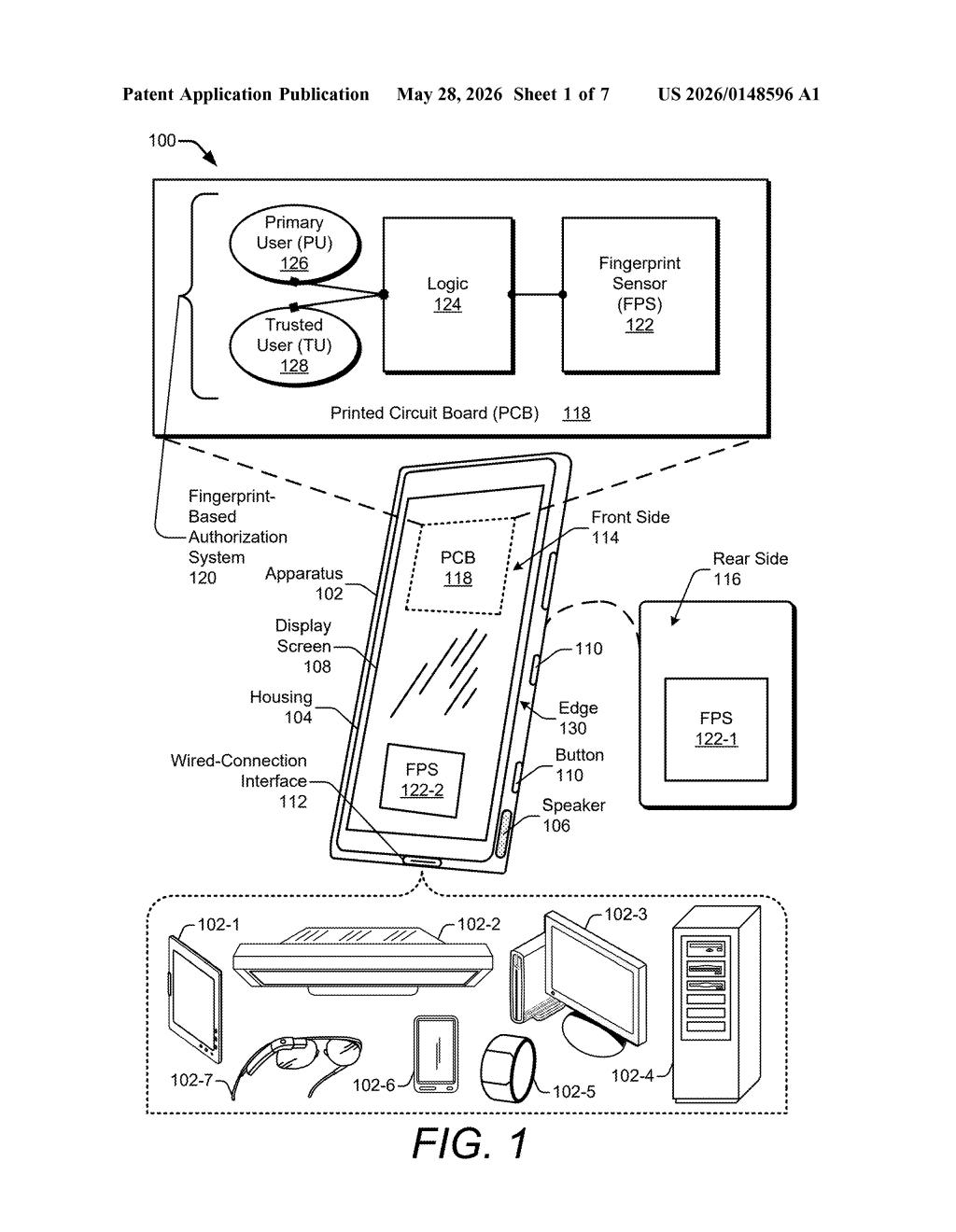
What Google's joint-fingerprint enrollment actually does
Imagine handing your phone to your spouse and wanting them to be able to unlock it — but dreading the usual setup: dig through Settings, find Biometrics, hand over the phone, have them scan their fingerprint repeatedly. It's clunky.
Google's patent describes a much more intuitive shortcut. The primary user (that's you, already authenticated) places their finger on the sensor, and the person you're trusting places their finger there too — either at the same time or right after you. The device reads both fingerprints together and interprets that joint presence as a deliberate act of trust. The second person's fingerprint gets enrolled automatically.
The patent also lets you put guardrails on that trust. The trusted user's access can be limited to certain hours of the day or specific locations — so you could let a family member unlock the phone at home, but not while you're at work. The system can also refine its fingerprint template over time as the trusted user authenticates more.
How the joint-exposure detection triggers enrollment
The core invention is what the patent calls joint exposure: the device's logic watches for a moment when two different fingerprints are both present on the sensor at or near the same time.
There are two ways this joint exposure can happen:
- Simultaneous contact — both fingers on a large-area sensor at once (think an under-display fingerprint sensor with enough real estate for two fingertips).
- Temporal proximity — the trusted user's fingerprint is scanned within a short, predetermined window after the primary user authenticates.
The enrollment itself is lighter-weight than a standard biometric setup. Standard fingerprint enrollment typically asks you to lift and re-press your finger many times to build a robust template. Here, the patent says fewer scans are needed upfront, and the template gets iteratively improved each time the trusted user authenticates successfully afterward.
Finally, the system supports bounded access: the trusted user's enrollment can be paired with temporal constraints (only valid between 8am–10pm, for example) or geospatial constraints (only valid within a defined location). This is handled at the logic layer, not just through a separate app-level permission.
What this means for shared Android devices
For anyone who shares an Android device — partners, parents, caregivers — this is a genuine quality-of-life improvement. The current flow for adding a trusted fingerprint on Android is buried and multi-step. A gesture as natural as both people touching the phone together is far lower friction, and the bounded-access feature is genuinely useful for household or workplace sharing scenarios.
From Google's perspective, this also has implications for Pixel hardware design. A patent that specifically contemplates large-area simultaneous sensing suggests Google is at least exploring sensors with more surface area than a typical power-button reader — possibly under-display sensors on future Pixel phones. The geospatial and time-based access controls also align with Google's existing Android identity and family-safety feature investments.
This is a small but thoughtful UX patent that solves a real, everyday annoyance. The 'joint touch as a trust signal' idea is intuitive enough that it's surprising nobody has shipped it yet. The bounded-access layer — time and location limits on a trusted fingerprint — is the more interesting technical piece and could make this genuinely useful in enterprise or family contexts, not just as a convenience feature.
There are more where this came from
We read every patent application Big Tech publishes and send you the ones worth knowing. Plain English, free, every week.
Want this weekly breakdown for a company we don't cover? Patentlyze Pro →