
Google Patents a Flux-Based Readout System for Superconducting Qubits
Reading out a qubit's state without wrecking it is one of quantum computing's hardest plumbing problems. Google's new patent proposes using a secondary 'flux qubit' as a go-between — potentially cutting the complexity of the signal chain significantly.
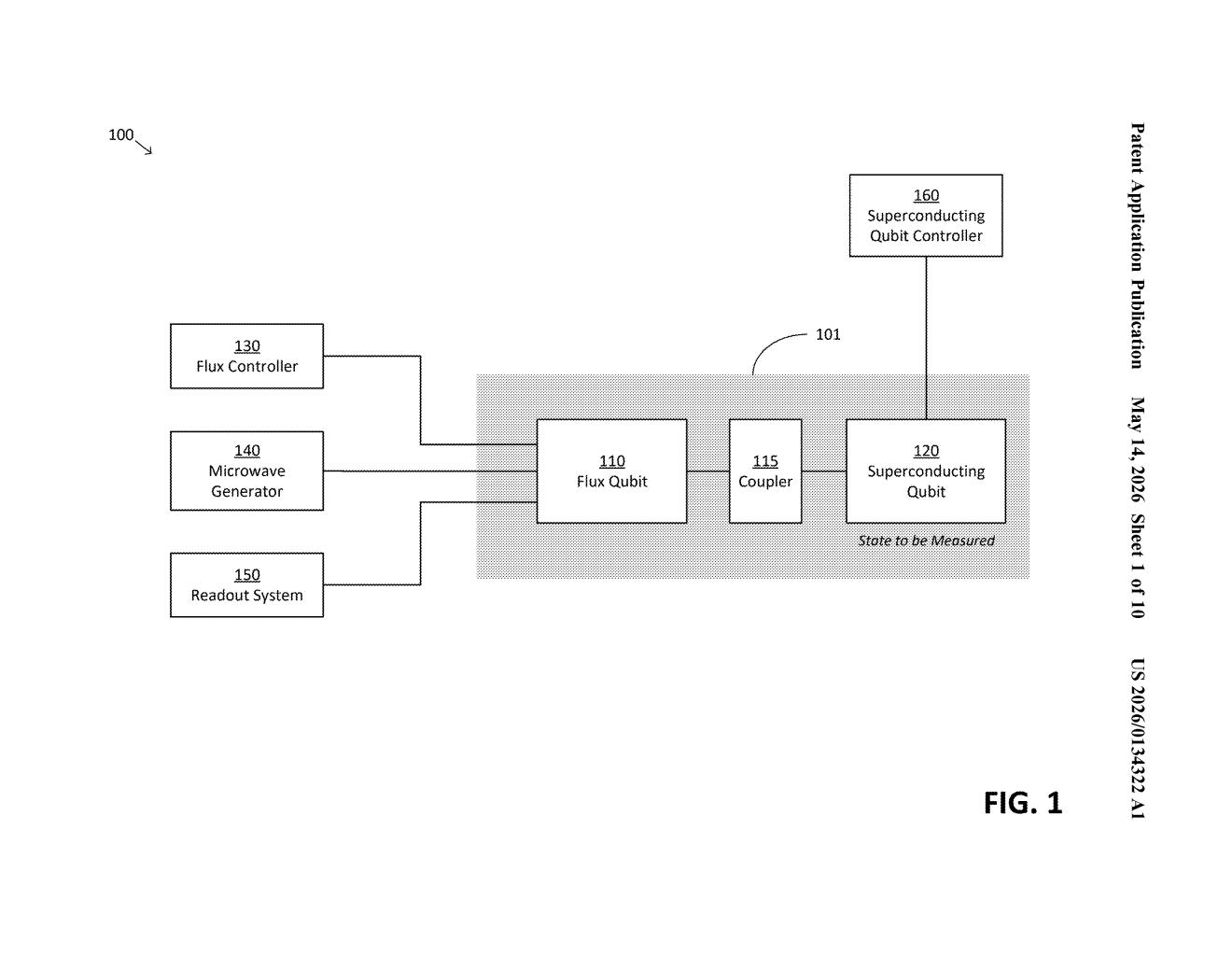
What Google's flux qubit readout actually does
Imagine you want to check the answer a quantum computer just calculated, but the very act of looking tends to disturb the fragile quantum state you're trying to read. Today's superconducting quantum computers usually handle this by bouncing a carefully tuned microwave signal off a resonator — essentially a tiny antenna — and interpreting what comes back. It works, but it requires a lot of delicate hardware and signal processing.
Google's patent describes a different approach: instead of a microwave probe, a small secondary circuit called a flux qubit sits right next to the main qubit and acts like a translator. The main qubit's quantum state nudges the flux qubit into one of two distinguishable electrical states, and you can then read that out by simply measuring the current flowing in the flux qubit loop — a much more straightforward measurement.
The upshot is a potentially lighter, simpler readout chain. Less hardware per qubit could matter a lot when you're trying to scale up to thousands or millions of qubits on a single chip.
How the flux transducer maps and measures qubit state
The patent describes a three-part hardware stack:
- Superconducting qubit — the main computational element whose quantum state (0, 1, or a superposition of both) needs to be measured.
- Flux qubit — a small superconducting loop interrupted by Josephson junctions (tiny quantum tunneling devices) that can exist in two persistent-current states. It acts as a transducer, converting the computational qubit's state into a measurable classical signal.
- Readout system — circuitry that measures the current in the flux qubit loop to determine which state the main qubit was in.
The coupling element between the two qubits ensures that the flux qubit's energy landscape — and therefore its current — is sensitive to the state of the computational qubit. Once that mapping is established, reading out the flux qubit's current tells you what you want to know about the main qubit.
Conventional dispersive readout (the standard approach) fires a microwave probe tone at a resonator and looks at how the resonator's frequency shifts depending on the qubit state. That requires a microwave generator, careful frequency tuning, amplifiers, and analog signal processing. The flux-based method sidesteps much of that by turning the problem into a DC or low-frequency current measurement — a simpler analog task.
The patent also references a flux controller for biasing the system, suggesting the coupling strength or readout sensitivity can be tuned in situ.
What this means for simpler quantum hardware
The readout chain is one of the biggest bottlenecks in scaling superconducting quantum processors. Every qubit today typically needs its own microwave line, its own resonator, and its own amplifier chain running down from room temperature into the millikelvin refrigerator. That's expensive, space-hungry, and thermally constrained. A flux-based readout that reduces or simplifies this chain could help squeeze more qubits into the same fridge.
It's worth noting this patent is assigned to Atlantic Quantum Corp. — a quantum hardware startup spun out of MIT — not directly to Google, even though Google is listed as applicant. That's an unusual filing arrangement worth watching, and it suggests this work may be part of a collaborative or acquisition-related context rather than purely internal Google quantum research.
This is genuinely interesting low-level quantum hardware work, not marketing fluff. Flux-based readout isn't brand new as a concept in academic literature, but seeing it patented in a system-level claim by a well-resourced group signals real engineering investment. The Atlantic Quantum assignee wrinkle makes it more intriguing — whoever ends up owning this IP, the underlying idea addresses a real scaling pain point.
There are more where this came from
We read every patent application Big Tech publishes and send you the ones worth knowing. Plain English, free, every week.
Want this weekly breakdown for a company we don't cover? Patentlyze Pro →