
Google Files Patent for a Health Chatbot That Reads Your Lab Results and Lung Tests
Ask a general-purpose chatbot whether you have asthma and it knows nothing about your lungs. Google's filing describes a way to feed it your lab results, breathing test and body stats first, so the answer is about you.
What Google's personalized health chatbot does
Imagine asking a health chatbot, "Do I have asthma?" A general-purpose chatbot has no idea about your age, your cholesterol, or how well your lungs actually work, so all it can offer is generic advice.
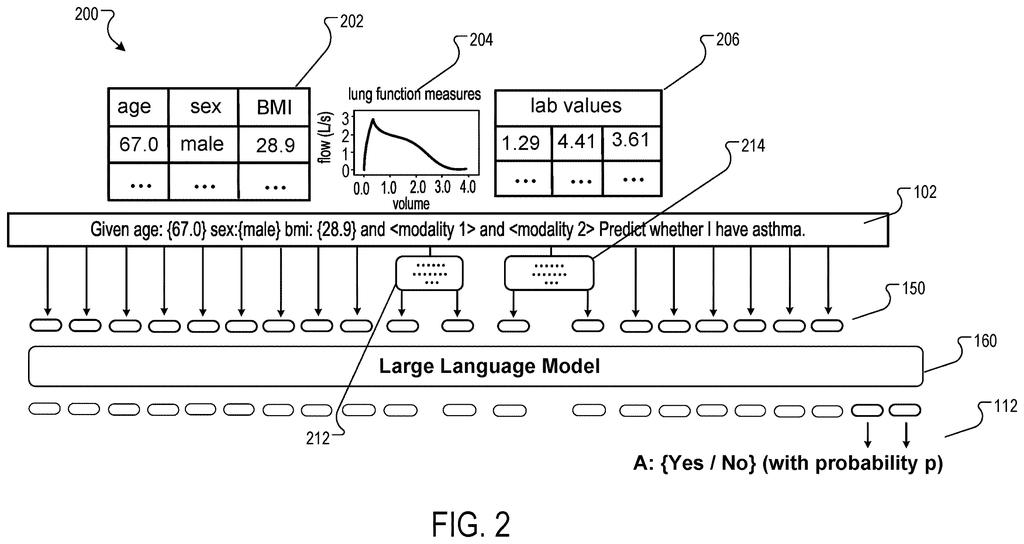
Google's filing describes a way to hand the chatbot your own records first. Details like your age, sex and body mass index get written out as plain text. Harder-to-read data, like a breathing test curve or a table of lab results, goes through small translator programs that convert it into the same kind of building blocks the chatbot already uses for words.
Then the chatbot reads your question and your data together and answers about you. It can reply with a yes or no plus a probability, or with a written explanation. According to the filing, the chatbot itself doesn't need retraining. Only the translators do.
… obtaining multi-modal health features associated with the particular patent, the multi-modal health features comprising one or more features from each of a plurality of modalities …
Translation: Gathering different types of medical data like lab tests and scans for the patient.
How lung curves and lab tables become word-like data
The filing covers a method for answering a question about one specific patient. The system takes the question plus multi-modal health features (data in several different forms, such as text, images, tables and time-series curves) and converts every piece into tokens in the same embedding space the language model uses for words. An embedding is just a fixed-length list of numbers that stands for a word or a piece of data.
Each form of data is handled differently:
- Text and personal details: feature names and values (like age or body mass index) are written out as a sentence, split into word pieces, and mapped to tokens.
- Lab tables, images and time series: each gets its own encoder neural network (a small trained translator program). Examples include an image network, a multi-layer perceptron for tables, and a 1-D convolutional, recurrent or Transformer network for curves like a spirogram, a graph of how much air your lungs move.
The language model is pre-trained and then held frozen. Only the encoders are trained, using examples that pair a question, patient data and a known answer. For a likelihood, the system reads the probability the model gives to words like "yes" or "no" and turns it into a score. It can also write a plain-language reply, or pass the score to a second language model for follow-up advice, such as exercise tips for asthma.
In the filing's own comparison, the single model matched or beat separate per-condition models built with logistic regression and XGBoost, two standard prediction tools.
Why Google's one-model health approach matters
For you, the payoff would be health answers that reflect your own numbers. The filing sketches three settings: a wellness chatbot you talk to, an assistant that helps a clinician, and a hospital early warning system that flags patients likely to get worse, for example when a new lab result arrives.
For Google, the appeal is economy. One model can handle many conditions instead of one custom model per illness, and the filing says it can even handle conditions that were missing from the encoders' training data. It also reuses an existing language model rather than retraining it. Of course, a system like this only works if people are willing to share their medical records with it.
This is the 81st Google filing we've tracked in AI assistant and agent work since May, a topic that also covers one on robot self-checks and a chatbot history screen.
The big trade here is control for convenience. By keeping the main language model frozen, Google skips the expense of retraining it, and a single model can answer questions about many conditions. The price is that the model's medical knowledge stays whatever it picked up before, and only the small translator programs learn anything about your data.
That creates a weak spot. If a translator mangles a lung test or a lab table on the way in, the chatbot has no obvious way to catch it, and the answer could still come out as a confident percentage. A yes or no with a probability looks precise, and readers may trust it more than a wellness app deserves.
On balance the trade reads as worth it for a research prototype, since the filing's own comparison shows the single model matching or beating separate per-condition models. Whether that holds up on messy real-world records is something a patent filing cannot tell you.
Get our take in your Top Stories
Liked this breakdown? Add Patentlyze as a preferred source on Google, and our plain-English take shows up more often in your Top Stories the next time Google patent news breaks.
There are more where this came from
We read every patent application Big Tech publishes and send you the ones worth knowing. Plain English, free, every week.
The drawings
5 drawing sheets from US 2026/0339995 A1 · click any drawing to enlarge


Want this weekly breakdown for a company we don't cover? Patentlyze Pro →
Be the first to weigh in