
Google
Google · Cell phone · Filed May 21, 2025 · USPTO published Jul 2, 2026 · Jul 2 release
Google Patents a Multi-Antenna Method for Precise Device Distance Measurement
Your phone already knows roughly where it is, but knowing exactly how far it is from another device, down to centimeters, is a much harder problem. Google is patenting a way to solve it by listening with multiple antennas at the same time.
- Publication number
- US 2026/0186119 A1(US20260186119A1)
- Applicant
- Google LLC
- Filed · Published
- May 21, 2025 · Jul 2, 2026
- Inventors
- Chin-Wei Hsu, Li-Xuan Chuo, Qi Jiang, Daniel Jose Fernandes Barros
- Status when we published
- Waiting for an examiner
- Document
- 19 claims
- US classification
- 340/5.61
- Examiner
- SYED, NABIL H (Art Unit 2689)
- Parent application
- National Stage Entry of PCT/US2022/081742 (filed Dec 16, 2022)(PCTUS2022081742)
What Google's multi-antenna distance trick actually does
Imagine you're trying to figure out how far your front door is from your phone, not in a "one room away" sense, but precise enough to unlock automatically only when you're standing right in front of it, not when you're still in the hallway. That kind of precision is surprisingly hard to pull off with a single wireless antenna.
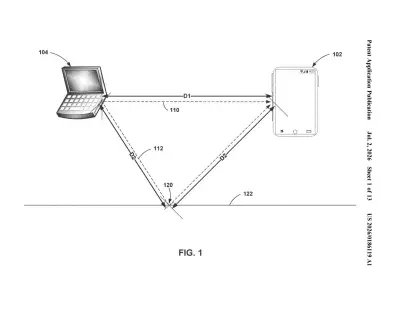
Google's patent describes a system where a device uses multiple antennas to receive the same wireless signal simultaneously. Instead of relying on one antenna's reading, it blends all those readings together into a single, cleaner picture of how far away the other device is.
The result is a much more accurate distance estimate, which the device then uses to take an action, like unlocking a door, waking a screen, or adjusting what content appears. Think of it like triangulating a location using several listeners instead of one.
How the signals get combined into one distance estimate
The patent describes a method where a receiving device (say, a smart speaker, phone, or door lock) picks up a wireless signal from a nearby transmitting device using multiple antennas at once.
Each antenna captures its own version of the incoming signal. The device then converts each of those versions into the frequency domain (a mathematical representation that breaks a signal into its component frequencies, similar to how a music equalizer displays individual notes). These multiple frequency-domain snapshots are then combined into a single unified signal.
From that combined signal, the device calculates an estimated distance between itself and the transmitter. Using more antennas improves the resolution of this estimate because each antenna sits at a slightly different physical position, capturing the signal from a slightly different angle. Blending those perspectives filters out noise and ambiguity that would plague a single-antenna reading.
Once the distance is known, the device performs an action based on it. The patent doesn't lock this down to one use case, covering any action triggered by a proximity threshold.
What this means for smart home and location tech
Precise short-range distance measurement is the backbone of features like hands-free unlock, automatic device pairing, spatial audio positioning, and proximity-triggered smart home routines. Most current systems use signal strength as a rough proxy for distance, which is notoriously unreliable because walls, furniture, and even your body absorb and reflect signals unpredictably.
Google's approach, combining spatially diverse antenna readings into a single frequency-domain estimate, could make those features far more reliable without requiring new hardware standards. If this ends up in Pixel phones or Nest devices, you could see more consistent "walk up and it just works" behavior, the kind that currently misfires often enough that most people turn it off.
Source: US 2026/0186119 A1 at the USPTO (PDF). Full patent text and figures are in the official publication.
Get our take in your Top Stories
Liked this breakdown? Add Patentlyze as a preferred source on Google, and our plain-English take shows up more often in your Top Stories the next time Google patent news breaks.
Add Patentlyze on Google
One click.
There are more where this came from
We read the new patents from Big Tech, carmakers and more and send you the ones worth knowing. Plain English, free, every week.
More from Google
All 1,127 Google patents →
More in Antenna & radio
All 32 Antenna & radio patents →
Qualcomm
Qualcomm Patents a GPS System That Filters Out Satellites With Blocked Signals
Qualcomm
Qualcomm Patents a GPS System That Cross-Checks Satellites to Fix Its Own Errors
Samsung
Samsung Patents a Way to Stop Phone Calls From Howling When Two Devices Get Too Close
Qualcomm