
Google Patent Shows Two Protected Systems Sharing Ad Tasks Without Exposing User Data
Google wants to serve you targeted ads without any single server ever knowing who you are and what ad you saw at the same time. The trick is splitting the job between two isolated computing environments that can't leak data to each other.
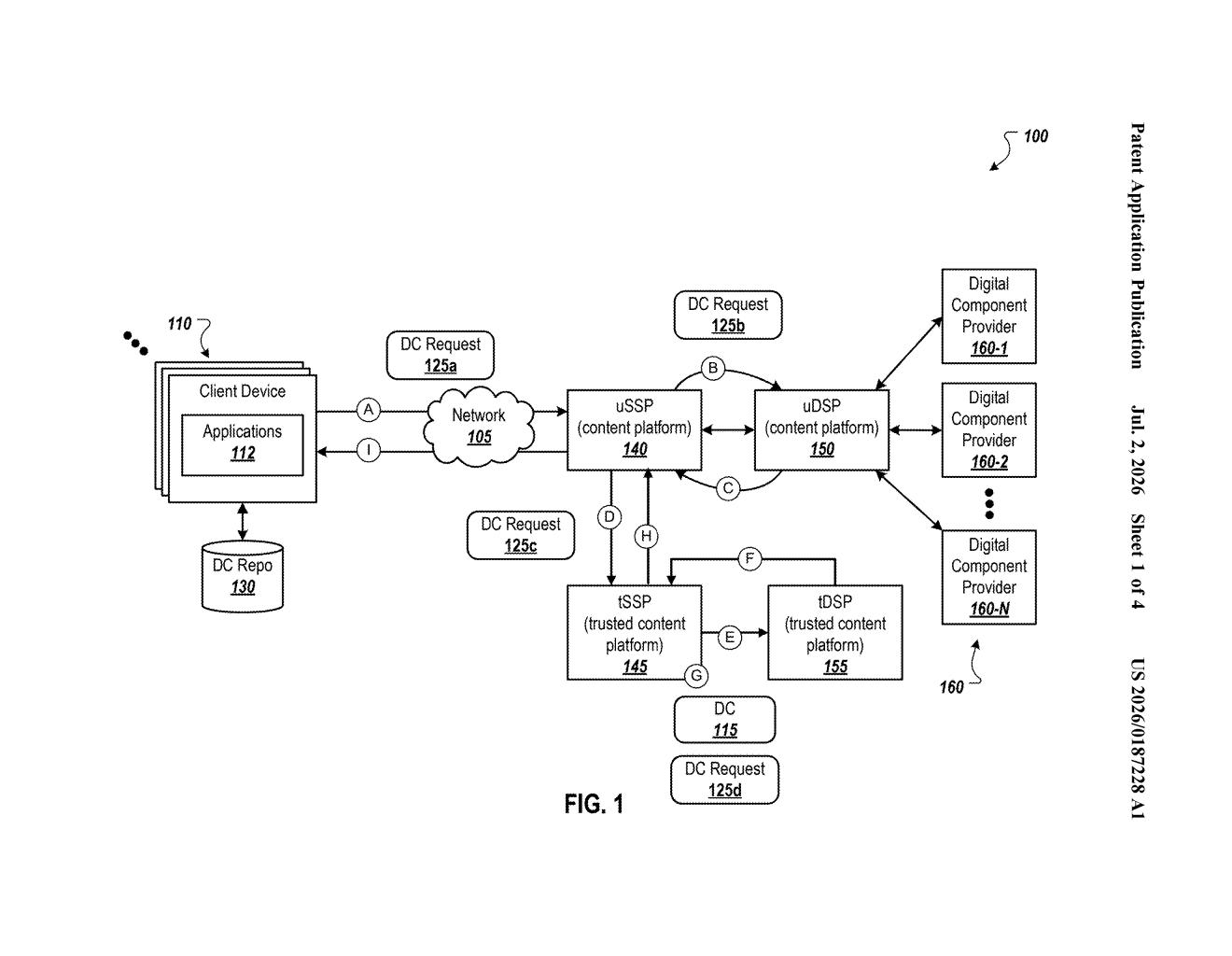
How Google picks ads without handing over your personal data
Imagine a bank that processes your payment without the teller ever seeing your account number. Google is trying to do something similar with online ads.
Right now, when a website decides which ad to show you, that decision-making system can see your browsing history, your device, and which ad won the auction all at once. That's a privacy problem. Google's patent describes a system where the job is split between two separate, locked-down servers, called trusted execution environments, that are designed so that no one, not even Google's own engineers, can peek at what's happening inside.
One server handles context about the page you're visiting. The other handles the advertiser's targeting rules. They exchange only the minimum information needed to pick a winner, and the final ad goes to your browser without either server ever building a complete picture of you. It's a more private assembly line for the ads that pay for the internet.
How the two trusted environments divide the selection work
The patent describes a two-stage pipeline built on trusted execution environments (TEEs), which are isolated hardware-level vaults inside a server where code runs in a way that can be verified and can't be tampered with, not even by the machine's owner.
- A first trusted content platform receives two types of ad candidates: contextual ads (chosen based on what the page is about, not who you are) and constrained ads (chosen based on advertiser targeting rules tied to user data).
- It sends only the targeting parameters and a set of constraining values (numerical limits that encode what the user is eligible to see without revealing identity) to a second trusted content platform in a separate TEE.
- The second TEE picks the best constrained ad and sends back a selection value (a score) rather than raw user data.
- The first TEE combines that score with scores for the contextual ads and picks the overall winner, which then goes to an untrusted delivery layer for display.
By separating contextual signals from user-targeting signals across two isolated environments, the system prevents any one party from combining them into a surveillance-ready profile. The patent also emphasizes reducing latency: the two TEEs work in a coordinated handoff rather than a slow sequential chain.
What this means for privacy-safe advertising after cookies
The ad industry is under pressure to move away from third-party cookies, which currently let advertisers track you across websites. Google's Privacy Sandbox initiative has been trying to build replacement systems for years, and this patent looks like infrastructure for exactly that. A two-TEE architecture could let advertisers still bid on relevant audiences while satisfying regulators who want proof that personal data stays locked up.
For you as a user, the practical bet here is that ads keep working (funding free content) while the data exhaust trail behind you shrinks. Whether that promise holds depends on how these TEEs are audited and who controls them, questions the patent doesn't answer, but the architecture is a meaningful step beyond what today's ad auctions do.
This is genuinely interesting infrastructure work, not a flashy consumer feature. Google has real regulatory and competitive reasons to build privacy-preserving ad systems, and a two-TEE split is a concrete architectural answer to a hard problem. The cynical read is that Google is designing a system where it remains the trusted party inside both vaults, but the technical approach is more substantive than most ad-privacy patents.
Get our take in your Top Stories
Liked this breakdown? Add Patentlyze as a preferred source on Google, and our plain-English take shows up more often in your Top Stories the next time Google patent news breaks.
There are more where this came from
We read every patent application Big Tech publishes and send you the ones worth knowing. Plain English, free, every week.
Want this weekly breakdown for a company we don't cover? Patentlyze Pro →