
Google Patent Automatically Generates Ad Copy From Website Content
Google has patented a system that automatically reads a website, summarizes it, and uses that summary as a guardrail for writing ad copy with an AI language model. In plain terms: give Google a URL, and its AI writes ads that stay faithful to that page.
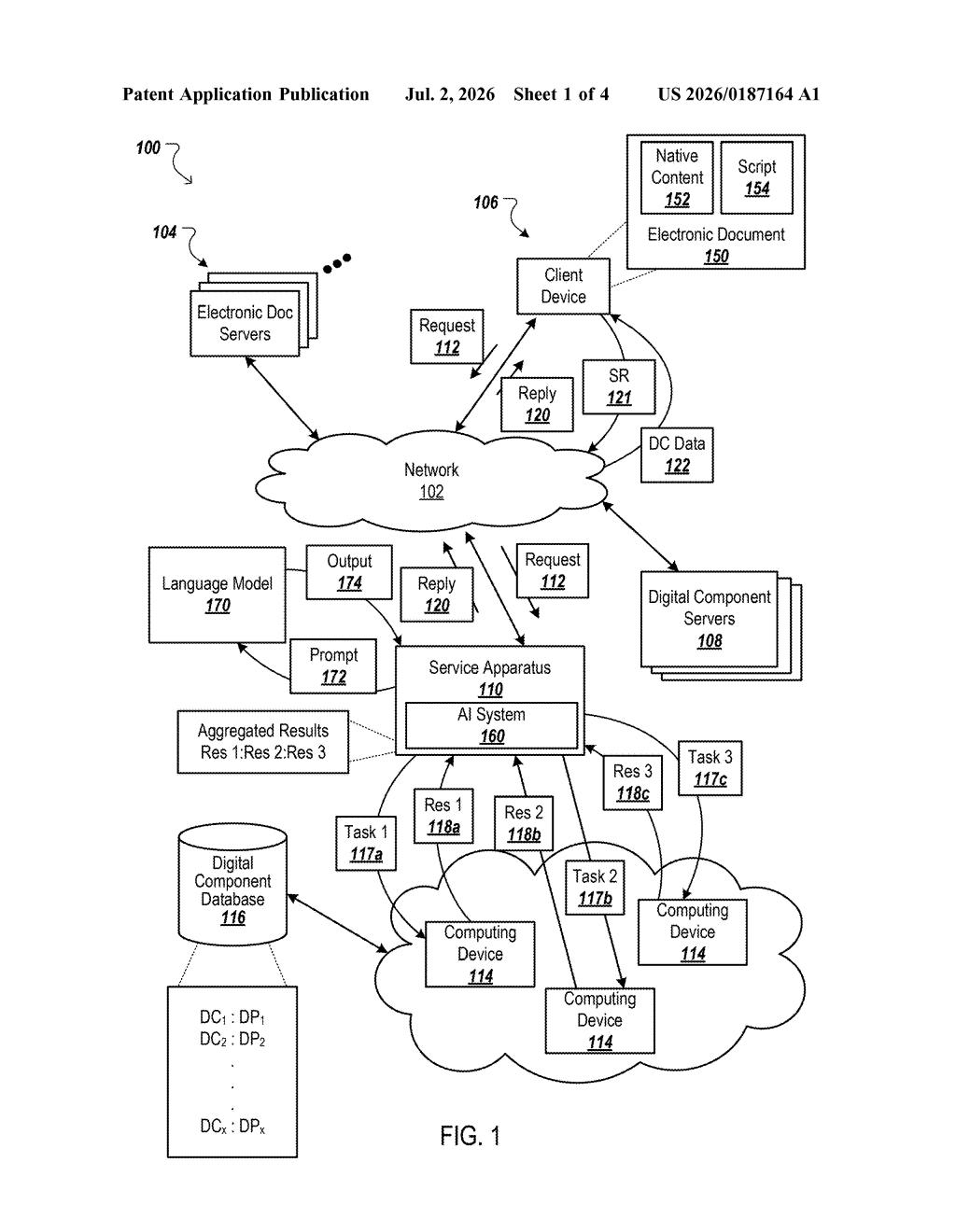
How Google's AI turns your website into ad copy
Imagine you run a small online store selling handmade leather bags. Instead of hiring a copywriter or typing out ad descriptions yourself, you just point Google's system at your product page, and it reads the page, summarizes it, and tells an AI writer "only produce ads that reflect what's actually on this site."
That's the core idea here. The patent describes an AI system that generates many possible ad versions all anchored to the content of a specific webpage, then scores and ranks them before picking the best one to show.
The key difference from a generic AI ad writer is the constraint layer. The AI isn't just brainstorming freely; it's fenced in by a summary of your content, which is meant to keep the ads accurate and relevant to what you're actually offering.
How the ranking and constraint system filters ad candidates
The system works in a pipeline of four main steps.
- Prompt construction: The AI builds a prompt that combines an advertiser's query (essentially a brief or campaign goal) with a set of constraints derived from a summary of a specified webpage. The summary acts as a fact-check layer, preventing the language model from generating claims not supported by the source.
- Candidate generation: The language model produces multiple candidate ad units (called "digital components" in the patent), each constructed using "clauses" that were shaped by the source-content summary. Generating several candidates at once is standard practice for AI systems that need to pick the best output rather than accept the first one.
- Post-processing evaluation: Each candidate is scored against one or more quality characteristics. The patent doesn't fully enumerate these, but typical ad-quality checks include relevance, grammar, policy compliance, and click-quality signals.
- Ranking and serving: Candidates are ranked by their scores, and only the top-ranked output is delivered as the final ad.
The patent frames the "specified source of online content" as a grounding anchor, a technique in AI systems known as retrieval-augmented generation (RAG), where external reference material is injected into the prompt to keep outputs accurate and on-topic.
What this means for advertisers and ad transparency
For advertisers, especially smaller ones without dedicated marketing teams, this describes a path where ad creation becomes nearly automatic. You provide a landing page; Google's system does the rest, in theory producing copy that won't contradict or misrepresent what's on your site. That grounding constraint is the interesting part, since AI ad writers without such a guardrail can hallucinate claims that get advertisers into trouble.
For the broader ad industry, this is Google codifying an AI pipeline that keeps its AI tightly coupled to advertiser-supplied content rather than running loose. Whether that translates into better or worse ad quality for users is a separate question, but it does suggest Google is building legal and factual accountability into its automated ad generation from the ground up.
This is a sensible, if unglamorous, engineering patent. Google is not doing anything exotic here; it's applying retrieval-augmented generation to ad copy, which is an obvious move for the world's largest digital advertising company. The interesting signal is the explicit ranking and post-processing layer, which suggests Google wants quality controls baked in before an AI-written ad ever reaches a user. Worth tracking, but not a surprise.
Get our take in your Top Stories
Liked this breakdown? Add Patentlyze as a preferred source on Google, and our plain-English take shows up more often in your Top Stories the next time Google patent news breaks.
There are more where this came from
We read every patent application Big Tech publishes and send you the ones worth knowing. Plain English, free, every week.
Want this weekly breakdown for a company we don't cover? Patentlyze Pro →